





 Portuguese
  English
  Spanish
  2 min of reading
  0 comments


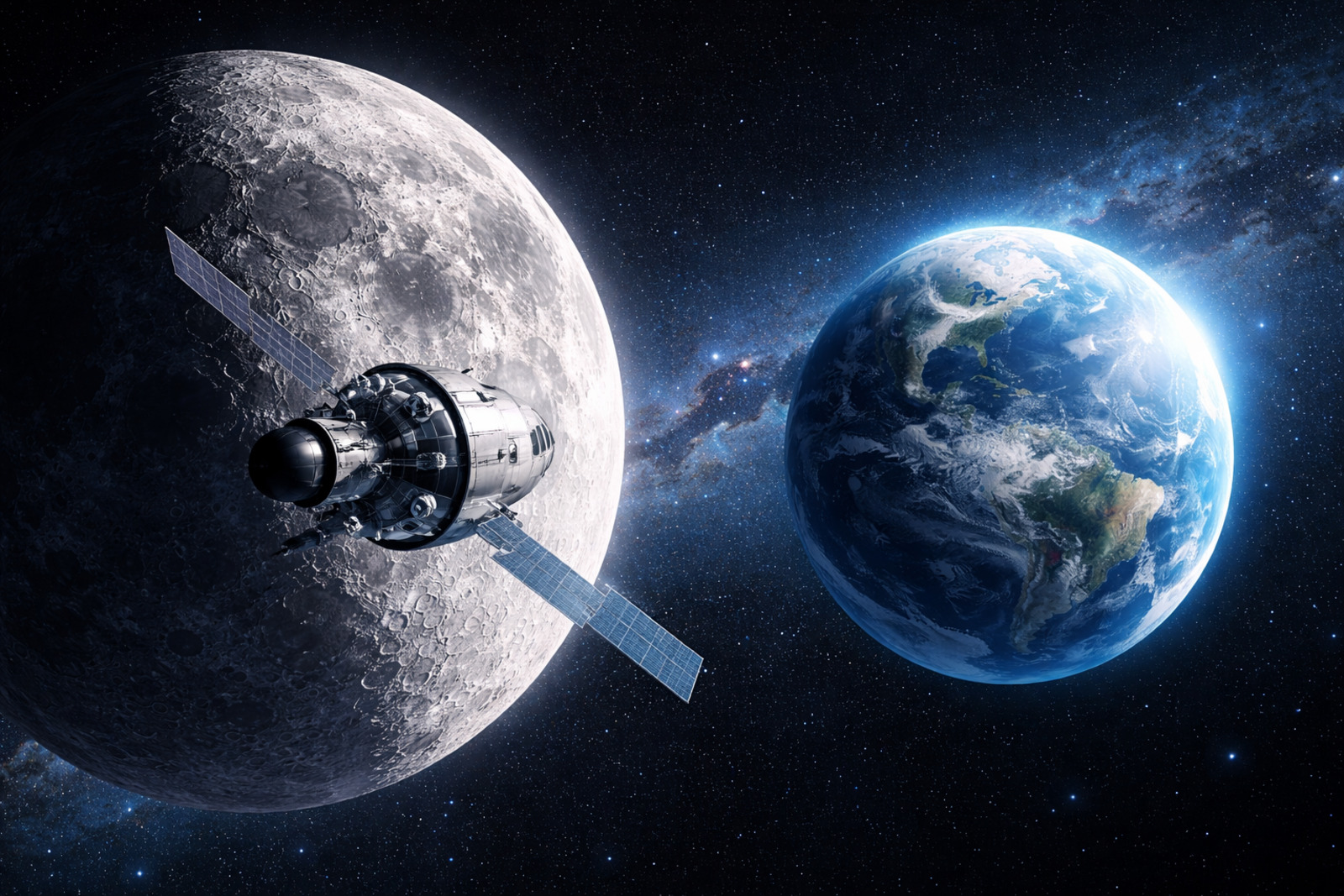
During maneuver around the Moon, the Artemis II mission took Orion to 406,771 kilometers from Earth and surpassed the Apollo 13 record by 6,600 kilometers
The Artemis II mission reached on April 6, 2026, the farthest point ever occupied by living humans in space. The Orion spacecraft reached 406,771 kilometers from Earth during a maneuver around the Moon, extending the reach of space exploration.
Historical record
With the mark of 406,771 kilometers from the Earth’s surface, Orion surpassed the record set by Apollo 13 in 1970 by 6,600 kilometers.
This result placed Artemis II at a new level for crewed missions and solidified the greatest advancement ever achieved by humanity in space.
-
Wax notebook falls into latrine 800 years ago, survives intact in Germany and reveals Latin notes that may expose the routine of a high-status medieval merchant.

-
After more than 11 years orbiting Mars, NASA declared the MAVEN probe lost, which disappeared after passing behind the Red Planet in December, began to spin abnormally, depleted its batteries, and never responded to controllers on Earth again.

-
China creates a capsule with artificial intelligence that scans the stomach in just 8 minutes and can reduce costs by up to R$ 1,400, paving the way for a new era of gastrointestinal diagnostics without tubes, sedation, and discomfort for patients.

-
Scientists simulate nuclear fireball in the laboratory and discover a surprise in the radioactive fallout by observing how cesium, uranium, and cerium change when they remain at high temperatures for a longer time.



Operation around the Moon
The record was achieved during an orbital maneuver conducted near the Moon. The operation was a central part of the Artemis II mission.
The activity was conducted from the Kennedy Space Center in Florida, as part of NASA’s plan to validate technical resources in more complex operations beyond low Earth orbit.
Mission objectives
In addition to the record, Artemis II focuses on testing innovative technologies and advanced safety systems designed to ensure the success of the journey.
The objectives include protecting the crew and the spacecraft during delicate stages of the mission, generating essential learnings for crewed flights beyond Earth’s orbit.
Experts believe that the results of Artemis II may help answer central questions about the challenges of long missions in deep space.
Next steps of Artemis II exploration
The data gathered by Artemis II is considered crucial for future expeditions. NASA intends to use these experiences in the development of new lunar missions.
These advancements are also expected to support the design of a sustainable lunar base, enhancing preparation for scientific and logistical operations on the Moon.
The insights gained from the mission may also be applied to optimize future shipments and potential crewed missions to Mars.
With this milestone, Artemis II reinforces NASA’s commitment to lunar exploration and expands the boundaries of human presence in space.
With information from TNH1.





Be the first to react!