





 Portuguese
  English
  Spanish
  4 min of reading
  32 comments


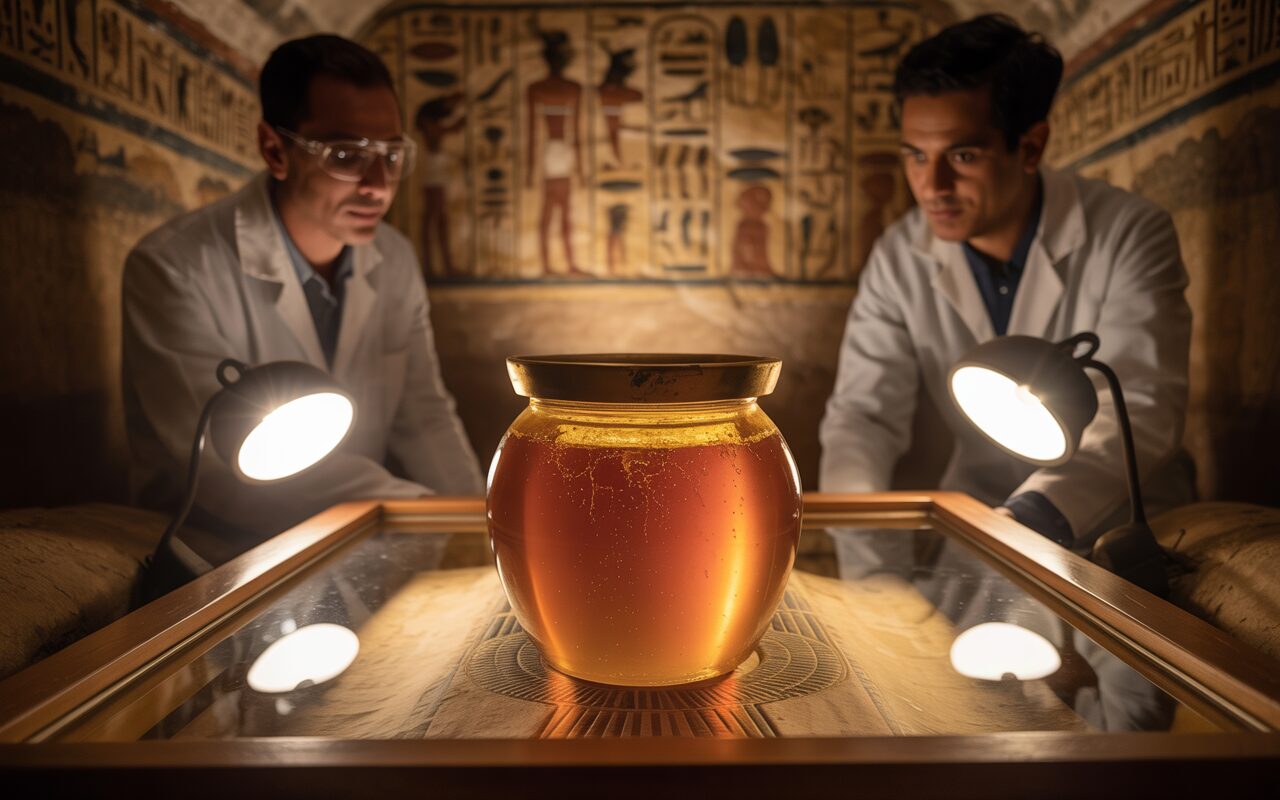


Archaeological Discovery Amazes Experts by Revealing the Durability of Honey and Its Importance for Ancient Civilizations Such as Egypt, Mesopotamia, and Sumer. The Natural Product Has Been Used for Over 8,000 Years.
An impressive discovery in Egypt is capturing the attention of the scientific community and the general public: archaeologists found honey over 3,000 years old in perfect condition inside an Egyptian tomb. The food was identified in sealed pottery jars, and, to the researchers’ surprise, it was still fit for consumption. This finding not only highlights the remarkable durability of honey over the centuries but also reignites interest in how ancient peoples used this substance in their diet, medicine, and even religious rituals.
Furthermore, there are records indicating that honey collection dates back over 8,000 years, making this delicacy a direct link between the present and past civilizations.
Why Was Honey with 3,000 Years Still Preserved?
According to experts, the preservation of honey for such a long time is possible due to its chemical composition. Despite its sweet taste, honey has low moisture content and a naturally acidic pH (between 3.0 and 4.5), which makes it difficult for fungi and bacteria to proliferate. Additionally, during production, bees add an enzyme called glucose oxidase to the nectar of flowers. This enzyme transforms the nectar into gluconic acid and hydrogen peroxide — commonly known as hydrogen peroxide — which has antiseptic properties.
-
The oceans are darkening all over the planet – what is happening?

-
An engineer designs a solar plane to fly on Mars at an altitude of 1,000 meters and a speed of 300 km/h, covering 16,000 kilometers in a Martian year, 900 times the distance traveled by the Ingenuity helicopter in three years on the planet before experiencing a rotor failure, and NASA is already funding the feasibility study.

-
A new phenomenon of contactless magnetic friction intrigues scientists and questions a theory that has been valid since the 17th century.

-
An impressive phenomenon in Northern Brazil causes rivers of different colors to flow side by side, revealing secrets about sediments, currents, and biodiversity.


These properties make honey one of the few foods with an almost indefinite shelf life, as long as it is kept in ideal conditions. This is what happened with the sealed jars discovered in the Egyptian tombs, which remained intact for millennia.
The Importance of 3,000-Year-Old Honey in Ancient Egypt
Honey was not just a food in Ancient Egypt — it also had medicinal and religious functions. Relief paintings dating back to the 3rd century BC show Egyptian workers collecting honey from hives. Historical records indicate that Ramses III offered 21,000 jars of honey to the god Hapi, a deity linked to the Nile River.
The presence of honey in royal tombs indicates that it was also considered a valuable asset for the afterlife, often included in burials as a source of food in the beyond.
Oldest Honey in the World
The use of honey dates back over 8,000 years. The oldest evidence is found in the cave paintings of La Araña in Valencia, Spain. The rock art depicts a human figure hanging from vines attempting to reach a hive to collect wild honey, illustrating the practice of primitive beekeeping.
In Mesopotamia, a 4,000-year-old clay tablet found in the ancient Sumerian city of Nippur contains a medicinal recipe with honey, olive oil, water, and cedar oil, used to treat wounds.
In Christian tradition, honey also appears as part of the diet of John the Baptist, mentioned in the New Testament. Even in military campaigns, like that of the Carthaginian general Hannibal, honey was used to feed troops during the crossing of the Alps toward the Roman Empire.
Honey in Chinese Medicine and Eastern Traditions
In traditional Chinese medicine, honey is classified as a neutral substance that affects the lungs, spleen, and intestines. During the Eastern Zhou Dynasty (770 to 256 BC), honey was reserved for royalty and used in sophisticated dishes, including recipes with bee larvae.
Its versatility and nutritional value have always been recognized by Eastern cultures, reinforcing its universal importance throughout history.
World’s Oldest Honey Is 5,500 Years Old
Although the honey found in an Egyptian tomb is 3,000 years old, the oldest honey in the world has been identified in Georgia, in a grave near the village of Sakire, dated to approximately 5,500 years ago. Archaeologists found pottery jars containing remnants of honey and flowers at the site, suggesting that the food was offered as provision for the afterlife.
This discovery is 2,500 years older than the honey found in the famous tomb of the Pharaoh Tutankhamun, excavated in 1922.
A Millenary Food That Crosses Civilizations
These discoveries demonstrate that honey is more than just a simple food — it is a testament to the intelligence and knowledge of ancient peoples. Its presence in different civilizations, from Europe to Asia, through North Africa and the Middle East, reveals a millennial legacy of medicinal, ritualistic, and nutritional use.
In addition to being a natural source of energy and antioxidants, honey is a symbol of purity, preservation, and connection to nature. Its durability over time is impressive and reinforces its value as one of humanity’s most complete and durable foods.
The discovery of honey that is 3,000 years old in Egypt proves that some human traditions are older — and better preserved — than previously thought. Honey has crossed eras, reigns, and continents, remaining relevant to this day.
Among its multiple uses, it stands out not only as food but also as a healing agent, spiritual offering, and luxury ingredient. Whether in Egyptian rituals, Sumerian recipes, or Chinese medicine, honey solidifies its role as a natural link between the past and present, keeping alive the memory of our ancestors.








3 year old honey
I have 3 year old honey in my cupboard. Was this written by AI lol?
3 Year old honey.? Confused article. Needs rewriting for clarity