





 Portuguese
  English
  Spanish
  10 min of reading
  73 comments


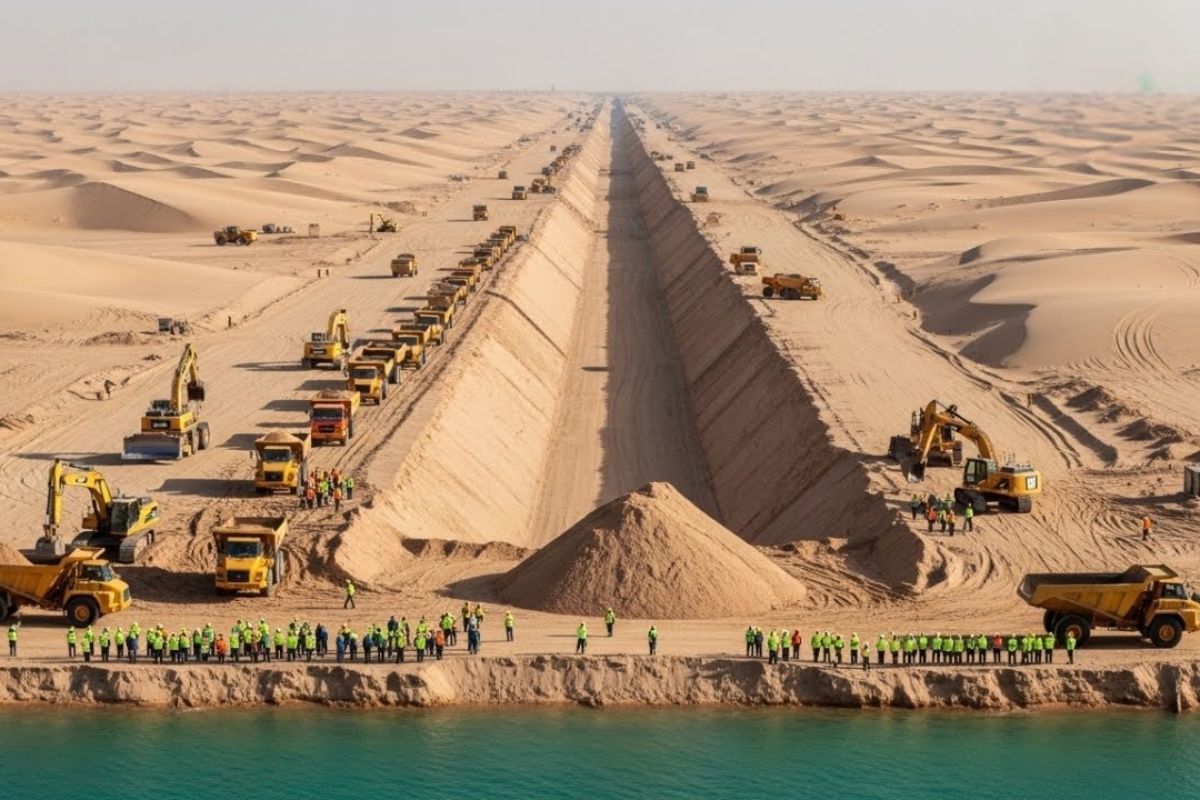


The Mexican Interoceanic Corridor Promises To Cut The Path Between Atlantic And Pacific To 20 Hours, Move 200 Million Tons Per Year, Attract Industries In Nearshoring And Test Limits Between Development, Local Communities And Nature Sensitive Along The Isthmus Of Tehuantepec Under Global Environmental And Geopolitical Scrutiny
In 2023, while Gatun Lake forced the Panama Canal to reduce the number of daily crossings and form queues of more than 200 ships, Mexico accelerated an old plan to create a new path between Atlantic and Pacific without locks, without dependence on freshwater reservoirs and with direct support from the great powers interested in faster and more predictable routes.
Since 2020, with the advancement of nearshoring, the country has seen foreign direct investment grow by more than 40 percent between 2020 and 2024, and only in 2023 more than 400 companies from the United States and Europe announced that they would leave China to settle in Mexican territory, reinforcing the bet that an interoceanic railway could redesign the logistics map of the Americas.
Crisis In The Panama Canal Opens Dispute For A New Path Between Atlantic And Pacific

For more than a century, since 1914, the Panama Canal has concentrated almost 6 percent of global trade, something close to 270 billion dollars in goods per year, in a waterway just over 100 meters wide and about 14 thousand ships crossing the isthmus annually.
-
Congonhas receives the monorail promised for the 2014 World Cup after more than a decade of delays and becomes the first airport in Brazil with integrated subway.
-
Goodbye, concrete: a new trend in civil construction reduces the weight of the structure by up to 30%, accelerates projects by up to 40%, cuts costs on steel and labor, and improves thermal insulation with EPS.
-
Russian engineers create an innovative propeller blade for aircraft that could completely change the way airplanes and helicopters operate.

-
Couple finishes building PVC chalet on the beach on the last day, with air conditioning and curtains, but discovers the bathroom drain is inverted: water escapes from the drain, risking breaking the floor, and the rush continues before the trip.


When Gatun Lake reached its lowest level in 60 years, the logic of this system was exposed.
The drought associated with El Niño forced the canal to reduce the number of crossings from 36 to only 20 per day, forcing container ships to navigate with half loads to avoid grounding.
In 2023, more than 200 ships were stuck in aquatic traffic jams, while companies calculated the cost of diverting routes to go around South America, adding about 13,000 kilometers and weeks of travel to each crossing.
In this void, the Mexican idea of a competitive land axis gained political and economic traction.
How The Mexican Interoceanic Corridor Shortens The Path Between Atlantic And Pacific

The so-called Interoceanic Corridor of the Isthmus of Tehuantepec was designed to function as a rail canal, in the words of former president Andrés Manuel López Obrador, replacing locks with rails and modernized ports.
The goal is to coordinate containers that represent about 5 percent of global trade, equivalent to 200 million tons of cargo per year, with the promise of reducing the crossing to approximately 20 hours.
Instead of a ship spending days waiting for space in Panama, the cargo disembarks at a Mexican port on the Pacific, crosses the isthmus by train, and boards again on the Atlantic, or vice versa.
Each train carries more than 120 containers, equivalent to a medium-sized ship, crossing jungles and plains at about 70 kilometers per hour.
When the entire railway is fully operational, the internal transport time between the two oceans is expected to drop by more than 80 percent compared to the original model and queues in maritime shipping.
Ports Of Salina Cruz And Coatzacoalcos Redesign The Ocean-Rail Link


To enable the new path between Atlantic and Pacific, Mexico started by the sea.
On the Pacific, the port of Salina Cruz, an old oil terminal with a depth of between 10 and 14 meters, underwent massive dredging that removed tens of millions of cubic meters of sediment, deepening the channel to about 23 to 24 meters, a level comparable to the largest container terminals in the world.
In addition, a breakwater of approximately 6 kilometers was built, wider and taller, designed to withstand hurricane-category winds and waves of up to 10 meters in a bay known for severe storms.
Hundreds of sensors monitor wind, current, and wave patterns in real time, while more than two thousand concrete piles reinforce piers prepared to receive automated cranes and post-Panamax ships with up to 24 thousand TEUs.
On the Atlantic side, Coatzacoalcos faced intense silting, deteriorated piers, and draft restrictions.
The dredging raised the depth of the access channel to about 12 meters, allowing regular entry of medium and large ships without depending on the tide.
A protective wall of approximately 700 meters reduces the impact of waves, and the railway now goes directly to the dock, transferring cargo from the train to the ship without the need for intermediate trucks.
The release time for goods, which took days, has dropped to around two to three hours, according to the project presented.
Renovated Railway, Nearshoring And Industrial Poles In The Isthmus Of Tehuantepec
In the interior of the isthmus, almost the entire historical railway network had to be rebuilt.
About 90 percent of the tracks were replaced, with reinforced concrete sleepers, a new layer of basalt gravel, and viaducts in flooded areas or unstable soil.
In critical stretches, engineers elevated the bed of the track with metal piles and controlled embankments to ensure the stability of heavy freight trains.
Alongside the railway, the government structured ten development poles for well-being, industrial parks with specific vocations in petrochemicals, electronics, logistics, high-tech agriculture, and clean energy.
The state provides electricity, water, fiber optics, and digital infrastructure, while companies receive incentive packages with exemptions or deep tax reductions for 10 to 15 years.
Official estimates speak of more than 250 thousand direct jobs and over half a million considering the production chain, concentrated in regions where about half the population lives today below the poverty line.
This combination of renovated railway, industrial poles, and reconfigured ports tries to transform the corridor into a central piece of nearshoring.
Industries migrating from Asia gain access to a shorter and less vulnerable path between Atlantic and Pacific, while positioning themselves just hours away by truck from the border with the United States, the main target market for this production.
Line K, The New Axis Of The Mexican Interoceanic Corridor

Behind the discourse about a new path between Atlantic and Pacific, the numbers show that the Mexican interoceanic corridor is still under construction.
The K Line of the interoceanic train, an axis that extends the corridor southward, is currently about 87.7 percent physically advanced with an official completion forecast in June 2026, according to the Secretary of the Navy.
The K Line is divided into three main stretches in the Isthmus of Tehuantepec.
The section between Ciudad Ixtepec and Tonalá is practically ready, with about 99.4 percent completed and in load tests since August, adjusting tracks and structure to support heavy compositions.
The Tonalá–Huixtla stretch is progressing at about 79.3 percent and is expected to be finalized in July next year, while the Huixtla–Ciudad Hidalgo segment and the KA Line to Puerto Chiapas exceed 84 percent completion, with delivery expected in February.
In total, 447 kilometers of tracks will be rehabilitated, with 14 stations, 439 bridges, 14 sidings, 626 drainage works, and three transfer yards redistributing cargo between railway and highways.
President Claudia Sheinbaum announced the inauguration of the first stretch of the K Line in November and revealed that negotiations are already underway with the Guatemalan government to extend the network into the neighboring country.
The idea is to transform the Mexican interoceanic corridor into the backbone of a regional route, connecting the path between Atlantic and Pacific to the production chains of Central America and expanding the reach of nearshoring beyond the Mexican border.
Suburban Train, Giant Viaducts And Impact On Cities Of The Isthmus
While freight trains are still awaiting the full completion of the K Line, the government is preparing to launch a low-cost suburban service called El Tehuanito.
The forecast is for the train to begin operations in December of this year, with two reduced-fare routes aimed at low-income residents of the Isthmus of Tehuantepec.
One line will connect Ubero to Ixtepec and the other Unión Hidalgo to Salina Cruz, covering about 189 kilometers on weekdays and using stations that are already over 80 percent complete.
In heavy engineering, the highlight is the Huixtla viaduct, approximately four kilometers and three hundred meters long and nearly 99 percent complete, a structure that alone generated about one thousand and five hundred direct jobs.
Around it, linear parks in cities like Arriaga and Huixtla have surpassed half of the works completed, signaling that the Mexican interoceanic corridor is not limited to the cargo axis, but redesigns local urbanization, with leisure areas, bike paths, and new accesses connected to the railway.
Billion-Dollar Budget And Political Priority For The Mexican Interoceanic Corridor
The Mexican federal budget for 2026 allocates about one hundred and five billion pesos for new trains and twenty-five billion pesos specifically for the Isthmus of Tehuantepec, consolidating the Mexican interoceanic corridor as a priority project of the government.
In practice, this means more resources to purchase rolling stock, conclude the K Line, reinforce the path between Atlantic and Pacific, and equip the industrial poles that anchor the nearshoring strategy.
In addition to long-distance cargo, already rehabilitated lines, such as Lines Z and FA, currently offer mixed passenger and cargo services.
Since the end of 2023 and mid-2024, they have transported more than one hundred and thirty thousand passengers and nearly nine hundred thousand tons of various products, a trial run of the potential for integration between regional transport and the new land corridor that competes for logistical space with the Panama Canal.
Ports Of Coatzacoalcos, Salina Cruz, Dos Bocas And Puerto Chiapas On The Interoceanic Route
On the Atlantic side, Coatzacoalcos is advancing in consolidating as the entry point for the path between Atlantic and Pacific.
The multipurpose terminal of the port is nearing completion, with works more than 97 percent finished, while the Maritime and Port Protection Unit building is expected to be ready by mid-2026.
The idea is to integrate security control, inspection, and logistics into a single complex, reducing the time ships spend at the dock.
On the Pacific, Salina Cruz has practically completed the dredging phase to deepen the channel, with more than 87 percent of the work finished and delivery expected this month, consolidating the port as a key point in the Mexican interoceanic corridor.
At Dos Bocas, the dock of the Bulk Mineral Terminal has already been delivered, but the east and west breakwaters, designed to protect the bay from waves and storms, are not expected to be completed until 2029.
In Puerto Chiapas, port infrastructure is also nearing the finish line, with almost all of the maritime protection unit, administrative buildings, and railway yards completed, preparing the southern tip to receive part of the flows associated with the K Line.
Development Hubs, Housing And Land Disputes Along The Corridor
Along the path between Atlantic and Pacific, the Mexican government has structured fourteen Well-Being Development Hubs, industrial zones known as Podebis, benefited by federal and state tax incentives.
Nine have already been granted to the private sector, three are in international bidding, and two are awaiting formal declaration. The promise is that these hubs will receive factories, logistics centers, and services associated with nearshoring, radiating jobs and income in historically neglected municipalities.
In social terms, official data records the delivery of more than four thousand housing units and nearly five thousand subsidies for housing improvements in communities of the Isthmus of Tehuantepec since 2023, as well as the financing and execution of about one hundred and fifty community projects.
The official discourse insists that the Mexican interoceanic corridor should be a vector of social and economic development as much as of logistical competitiveness, and not just a fast route for containers.
In parallel, the expansion of the access road Roberto Ayala-Dos Bocas, which crosses the municipalities of Huimanguillo, Cárdenas, Comalcalco, and Paraíso in Tabasco, requires the acquisition of one thousand seven hundred and sixty-six properties by 2027.
The section is just above 40 percent completion and reveals the other side of this new path between Atlantic and Pacific, where land negotiations, family displacement, and local disputes for compensation become as sensitive as any work of bridge, tunnel, or railway yard.
Nature Pressured, Lessons From The Nicaragua Canal And The Arctic Route
The advancement of the interoceanic project does not come without environmental costs.
The recent experience of the Dos Bocas refining complex in the Bay of Paradise illustrates the tension: to erect tanks and pipelines, extensive areas of mangroves were removed, undermining the natural protection of the coast and opening space for accelerated erosion, while flooding linked to the Grijalva River began to hit the region with greater intensity.
Environmental reports cited by local organizations mention thousands of individuals from more than a hundred species affected, including dozens of endangered species.
In the isthmus itself, wind farms erected in areas of extreme wind are multiplying like forests of steel.
Although they generate renewable energy, the blades of dozens of meters turning at high speeds have transformed part of the sky into a lethal barrier for raptors and migratory bats, with records of carcasses around the wind turbines and alerts about changes in migratory routes.
The challenge declared by those responsible for the corridor is to implement nature-based solutions and ecosystem restoration programs capable of offsetting the impacts on fauna and vegetation.
Outside Mexico, the history of megaprojects competing with Panama leaves additional lessons.
In 2013, Nicaragua launched a 276-kilometer canal financed by a Chinese group, with an estimated cost of 50 billion dollars and a promise to surpass the Panama Canal, but the layout would cross Lake Nicaragua, the main source of drinking water in the country, and affect dozens of indigenous communities.
The combination of protests and financial collapse of the investor caused the initiative to sink a few years later, leaving behind only rusty landmarks and abandoned construction sites.
In the extreme north, the accelerated melting of the Arctic opens the possibility of the Northwest Passage linking Atlantic and Pacific without fees, without locks, and without queues, shortening routes between Europe and Asia by more than 7,000 kilometers.
Some optimistic projections point to a first summer of complete ice-free conditions around 2035, which would create a third competitor for interoceanic trade on top of an even more severe climate crisis.
On this board, the Mexican land corridor tries to establish itself as a stable alternative in a world of increasingly more vulnerable routes to climate.
In the face of a Mexico that is heavily investing to create a new path between Atlantic and Pacific, challenging the Panama Canal and balancing jobs, industry, and environmental pressure in the Isthmus of Tehuantepec, do you think this interoceanic railway corridor really has the strength to change the map of global trade or is it likely to be just another megaproject that falls short of expectations?








Felicitaciones México con gobiernos progresistas, siempre se observa obras para el bien común
ES UN PROUECTO MUY AMBICIOSO, SOLO EN MANOS DE HENTE QUE PIENSE CON SANIDURIA Y HONRADEZ SE PODRÀ LOGRAR.
Deve melhorar os preços dos produtos e alavancar mais o comércio de vários países latinos Americanos . Arriba Brasil!♥️✌️😎