





 Portuguese
  English
  Spanish
  5 min of reading
  0 comments


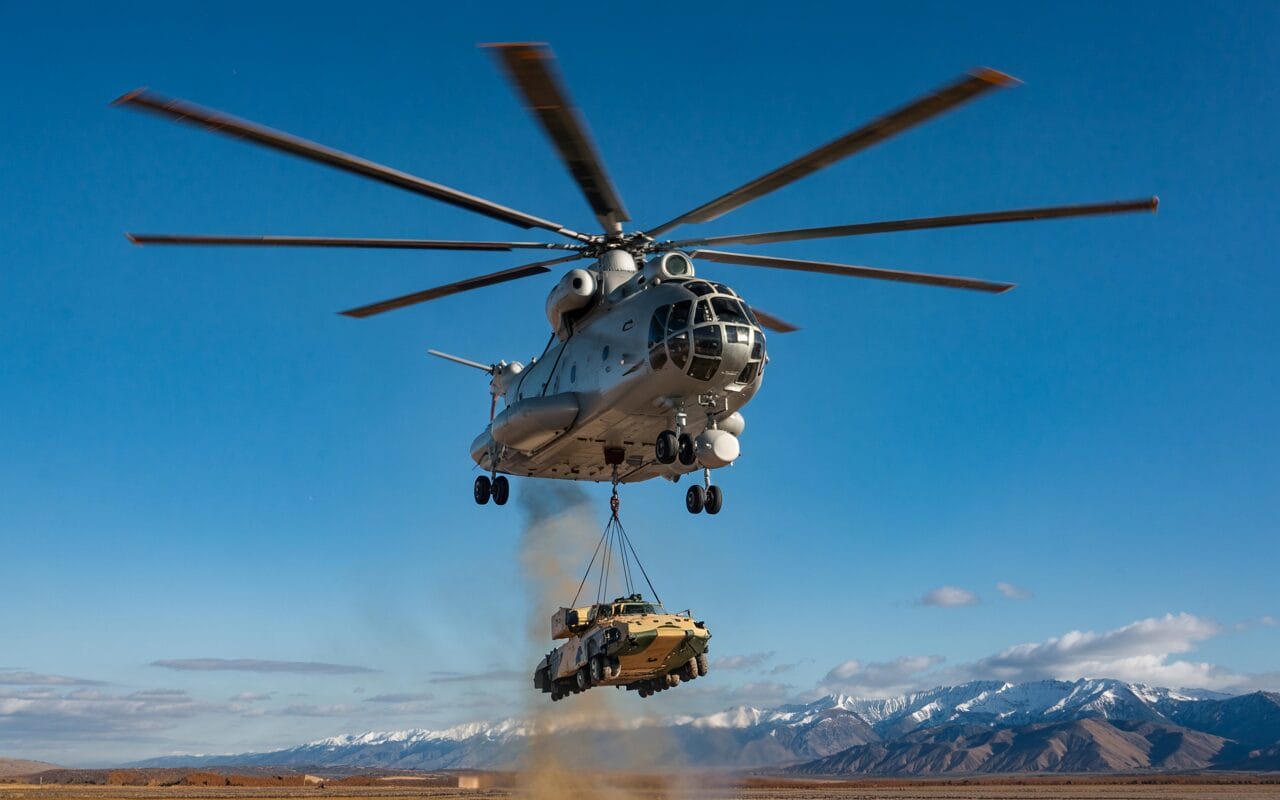
With 56 Meters in Length, a Capacity to Lift 20 Tons, and an Impressive Fuel Consumption of 9 Liters per Second, the Mil Mi-26 Helicopter is Considered the Largest Helicopter in the World and One of the Greatest Marvels of Military Aviation Engineering.
Designed to operate in extreme conditions and transport heavy loads, the Mil Mi-26, also known by its NATO codename “Halo,” is the largest helicopter in the world manufactured in Russia, impressing both with its size and performance. With a total length of 56 meters, a main rotor diameter of 32 meters, and a height equivalent to a three-story building, the Mi-26 is a true titan of the skies. Developed by the Mil Moscow Helicopter Plant, it officially entered service in 1983 but continues to be a benchmark in the heavy air cargo transport and large military helicopter segments. There is also The “Monster” of 3,000 Tons That Consumes 625 Liters of Diesel to Travel Just 1 km: NASA’s Crawler Transporter, the Truck That Moves Rockets at 5 km/h with Millimeter Precision
Unmatched Cargo Capacity: The Largest Helicopter in the World Lifts War Tanks
The Mil Mi-26 was designed for logistical missions in battlefields, especially over the vast distances of Siberia, Afghanistan, and more recently, in humanitarian aid operations and emergencies around the world.
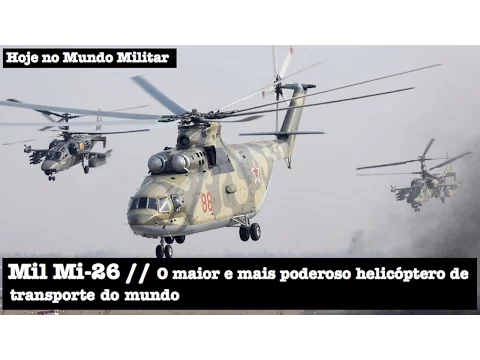

Its main feature is its cargo capacity. The helicopter can transport:
-
Attracting around 250,000 people a year, a lighthouse 200 meters from the sea, on a 60-meter high cliff, on the North Sea coast in Denmark, becomes one of the most impressive examples of how nature can threaten historical buildings.

-
The narrowest house in the world is only 63 centimeters wide, but inside it can accommodate a bathroom, kitchen, bedroom, office, and even two staircases.

-
In the middle of the sea, these enormous concrete and steel structures, built by the British Navy to protect strategic maritime routes, look like they came straight out of a Star Wars movie.
-
For years, no one could cross a neighborhood in Tokyo because of the tracks, but an impressive solution changed mobility and completely transformed the local routine.


- Up to 20 tons of internal or external cargo, including light war tanks like the T-80U (weighing about 42 tons split into two flights);
- Military trucks, cranes, power generators, tractors, and armored vehicles;
- Entire disassembled planes, like the Sukhoi Su-25;
- Damaged helicopters, like other Mi-17 and Mi-24;
- Containers, telecom towers, and even wind towers.
Besides vehicles, the helicopter can also carry up to 90 armed soldiers, or operate as an air ambulance with 60 stretchers and 3 medical attendants.
A Helicopter That Consumes 9 Liters per Second
All this power comes at a cost: the Mil Mi-26 consumes about 9 liters of fuel per second when on a full-load flight. For a one-hour flight, approximately 5,400 liters of aviation kerosene are needed.

The helicopter has two Lotarev D-136 engines, each with 11,400 hp. Together, these engines power the eight-blade main rotor, providing lift for stable flights even under maximum load.
This consumption makes it one of the most expensive helicopters to operate in the world, which limits its use to situations where other aircraft simply wouldn’t be able to do the job.
Technical Specifications of the Mil Mi-26
| Feature | Technical Data |
|---|---|
| Manufacturer | Mil Moscow Helicopter Plant (Russia) |
| First Flight | 1977 |
| Entered Service | 1983 |
| Total Length | 40 Meters (Fuselage) / 56 Meters (Total) |
| Main Rotor | 32 Meters in Diameter, 8 Blades |
| Height | 8.1 Meters |
| Maximum Takeoff Weight | 56,000 kg (56 tons) |
| Cargo Capacity | 20,000 kg |
| Maximum Speed | 295 km/h |
| Range | 800 km with Maximum Load |
| Engines | 2 × Lotarev D-136 (11,400 hp each) |
| Consumption | Approximately 9 Liters per Second |
Military and Civil Use of the Largest Helicopter in the World
Although designed for military use, the Mil Mi-26 is also widely used in civil and humanitarian operations. Its versatility allows it to operate in:
- Rescues in remote areas and natural disasters, such as earthquakes and floods;
- Fighting forest fires, with a capability to carry up to 15,000 liters of water in a single drop;
- Installation of equipment in hard-to-reach areas, such as antennas, towers, and structures on mountains;
- Support for the oil and mining industries in Siberia and Arctic regions.
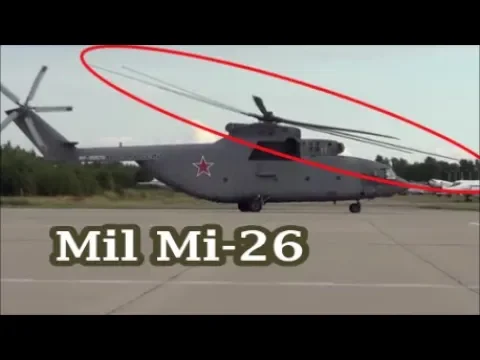
During the catastrophe at Chernobyl in 1986, the Mi-26 was used to drop tons of concrete and lead over the destroyed reactor, helping to contain the radiation. It was also used to remove damaged aircraft from the battlefield during the Afghanistan War and, more recently, in the Syrian War and evacuation operations in Ukraine.
Comparison with Other Giant Helicopters
To grasp the magnitude of the Mil Mi-26, it’s worth comparing it with other famous helicopters:
| Model | Cargo Capacity | Maximum Takeoff Weight | Main Rotor |
|---|---|---|---|
| Mil Mi-26 | 20 Tons | 56 Tons | 32 m |
| CH-53K King Stallion (USA) | 16 Tons | 39.9 Tons | 24 m |
| CH-47 Chinook (USA) | 10 Tons | 22 Tons | 18.3 m (dual) |
| Mi-6 (USSR) | 12 Tons | 42 Tons | 35 m |
Even the most modern Western helicopters cannot compare to the Russian military helicopter, which remains the largest helicopter in the world in regular operation.
Evolution and Variants of the Mi-26
With over 300 units produced since 1983, the Mi-26 has undergone various updates. The most recent is the Mi-26T2V, a modernized version with:
- Digital cockpit with multifunction displays;
- Next-generation autopilot;
- GLONASS and GPS satellite navigation system;
- Reinforced armor;
- Ability to operate at night and in any weather conditions.
The Mi-26T2V is in use by the Russian Army and is expected to continue in operation until at least 2040.
Curiosities About the Mil Mi-26 Helicopter
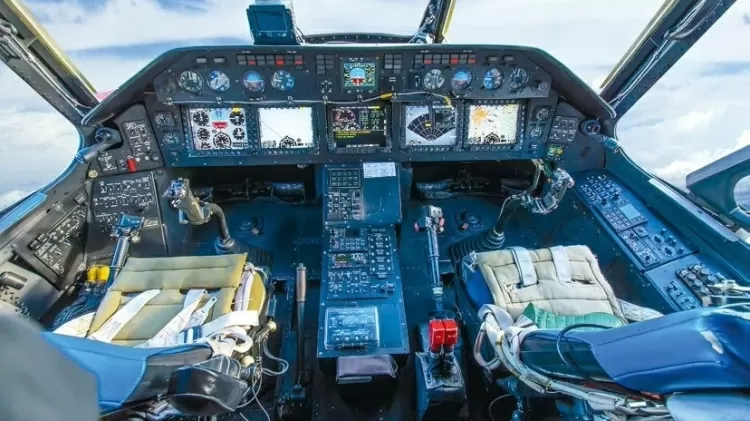
Image: Rostvertol
- The helicopter is so large that it can carry a smaller helicopter inside it, like the Mi-8.
- It has already transported an entire locomotive to remote regions of Siberia.
- It features a blade de-icing system to fly in environments below -30 °C.
- It was used in the extraction of a passenger plane that had made an emergency landing in a flooded area.
- The cost per flight hour is estimated at over US$ 30,000, depending on the load and altitude.
The Future of Heavy Air Cargo Transport
Despite advances in drones and unmanned aircraft, air cargo transport by heavy helicopters is still essential in hard-to-reach areas. No aircraft has completely replaced the role of the Mi-26, particularly in war missions, rescues, and remote construction.
Russia continues to invest in improvements to the Mil Mi-26 military helicopter, and other countries such as China and India have already shown interest in developing projects inspired by it. Even after 40 years since its first flight, it still reigns supreme in the skies.
Mil Mi-26 is a Flying Monument of Engineering
The Mil Mi-26, with its 56 meters and capacity to lift entire tanks, is not only the largest helicopter in the world — it is also an icon of military engineering and a symbol of Russia’s air power.
Capable of consuming 9 liters of fuel per second and undertaking missions that challenge physics, the helicopter that consumes 9 liters per second has become one of the most respected vehicles in global aviation. In a constantly changing world, the Mi-26 remains irreplaceable — a flying fortress that redefines what is possible to transport through the skies.







-

-

-

4 pessoas reagiram a isso.