





 Portuguese
  English
  Spanish
  4 min of reading
  0 comments


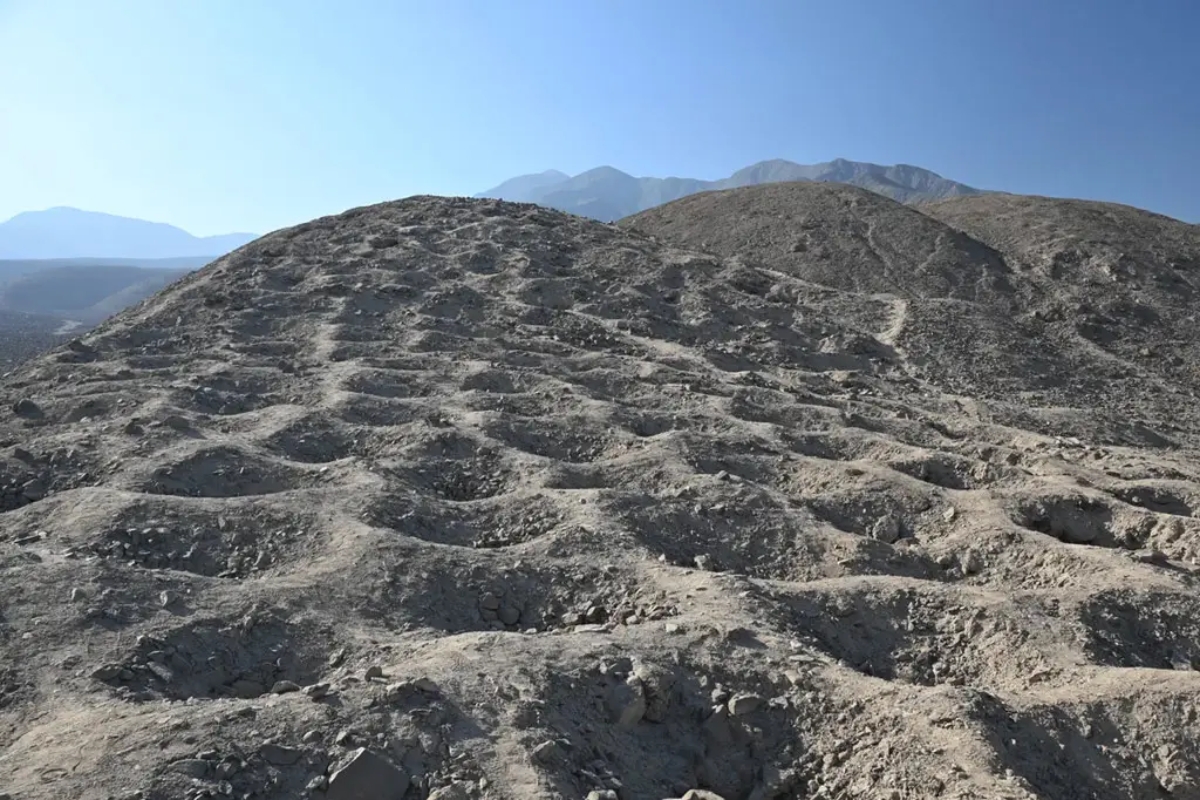
Scientists Decipher Mystery of Mount Sierpe in Peru: Over 5,000 Aligned Holes Formed a Pre-Inca Accounting and Market System, Revealing the Economic Sophistication of Ancient Andes.
For almost a century, Mount Sierpe, also known as the “Serpent Mountain,” in southern Peru, has intrigued archaeologists and travelers. The rocky slope, filled with over 5,000 precisely aligned holes, seemed to defy any human logic.
Now, new research published in the scientific journal Antiquity brings an explanation that may change the understanding of one of the most enigmatic sites in the Andes: the holes may have served as a commercial exchange center and accounting system for ancient Andean civilizations, long before the arrival of the Spanish.
A Millennial Enigma in the Pisco Valley
Using drones and high-precision microscopy, researchers led by archaeologist Jacob Bongers from the University of California analyzed the so-called Hole Strip — a series of cavities extending about 1.5 km in the Pisco Valley, just 35 km from the Peruvian coast. Each cavity is between one and two meters wide and about half a meter deep, arranged in blocks separated by strips of land, as if they were sectors of a large storage site.
-
Sleeping at different times each day can be a bomb for your heart and even double your risk of having a heart attack.

-
Without help and without heavy machinery, a woman builds a house from scratch with stone, wood, and cement, erects a chimney, creates a complete leisure area, and transforms an empty lot into her dream home.
-
Couple transforms abandoned house after years of being closed; residence was overgrown with weeds, had a green pool, and a deteriorated structure in the interior of Rio de Janeiro.
-
Hidden marks on the walls of the site associated with the Last Supper of Jesus for centuries have been deciphered in Jerusalem, revealing medieval inscriptions left by pilgrims, European nobles, and travelers from the Middle East.


Aerial images revealed mathematical patterns and specific repetitions: series of seven or eight holes form symmetrical rows, suggesting organized logic. The shape resembles the quipu, the ancient cord-and-knot system used by the Incas to record tributes, stocks, and productive activities. This similarity led scientists to propose that Mount Sierpe functioned as a “landscape quipu,” a physical form of accounting that transformed the terrain into a tool for economic control.
Evidence of an Ancient Market
Microscopic analyses of the soil showed traces of maize and reeds, plants traditionally used for weaving baskets. This discovery indicates that the site was used to store plant products that likely arrived in bundles or baskets transported by llama caravans.
Mount Sierpe is situated in a strategic region known as chaupiyunga, a transition zone between the Andes and the coast, where groups of farmers, fishermen, and traders used to gather to exchange goods. This location, combined with its proximity to ancient trade routes and Inca administrative centers, reinforces the hypothesis that the site functioned as a pre-Inca market — perhaps the oldest in the Andes.
In an interview with Antiquity, Bongers explained:
“We know that the pre-Hispanic population of this region was around 100,000 people. It is possible that llama caravans gathered here to trade maize, cotton, and products from the mountains and the coast. I see these holes as a form of social technology that connected people and later evolved into a large-scale accounting system under Inca rule.”
A Legacy of the Kingdom of Chincha
According to the study, Mount Sierpe was constructed around the year 1000 AD, when the Pisco Valley was part of the Kingdom of Chincha, a powerful agricultural and maritime society that predated the Inca Empire. With the Inca expansion in the 15th century, the site would have been adapted to the imperial tax system, where entire communities were required to contribute goods and labor. Each group of holes, according to the authors, could represent a quota of products intended for state collection.
The geometric structure of the site also resembles a royal quipu found nearby, currently preserved in the Ethnological Museum in Berlin. This similarity reinforces the idea that the Incas used Mount Sierpe as a physical tool for recording tributes and commercial exchanges.
End of Extraterrestrial Theories
For decades, the mystery of the holes attracted extravagant speculations — from hypotheses about lost civilizations to theories of extraterrestrial origin. However, researchers have completely dismissed these versions. No traces of fortifications, tombs, or mining have been identified, and the agricultural hypothesis is considered unlikely, as the arid soil and scarcity of water make cultivation impossible.
For Bongers, the value of Mount Sierpe lies precisely in how ancient communities shaped the landscape to promote exchanges and social interaction.
“Mount Sierpe is a fundamental case study for understanding how pre-Hispanic societies modified the environment to bring people together, negotiate, and create systems of collective organization,” the archaeologist stated.
Researchers plan to conduct new excavations and radiocarbon analyses to determine more precisely when and how the site was excavated. The goal is to better understand the accounting and economic methods used by these civilizations before Spanish colonization.
“There are still many questions, but we are getting closer to understanding this mysterious monument. It is fascinating to see how such complex ideas were materialized in something as simple as holes in the rock,” Bongers concluded.








-

-

2 pessoas reagiram a isso.