





 Portuguese
  English
  Spanish
  7 min of reading
  6 comments


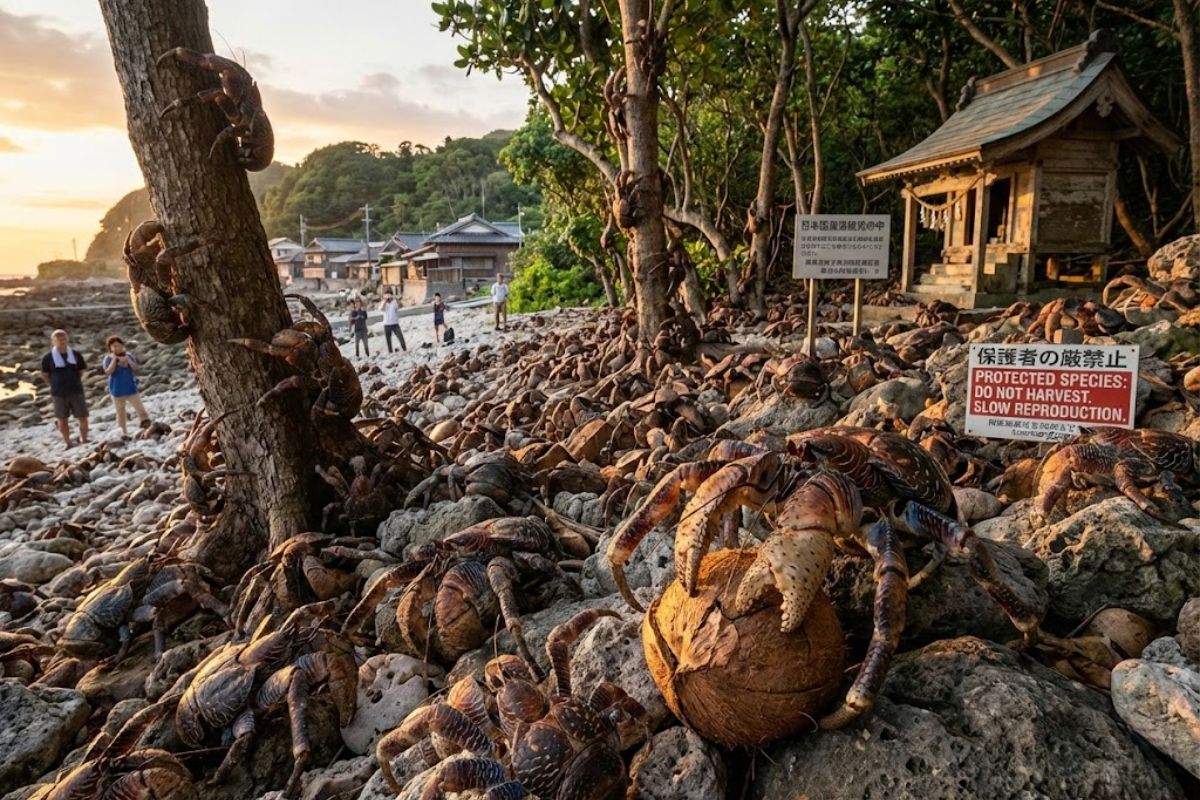


Even though they are enormous and seen as abundant by those who find them, coconut crabs in Japan are protected. The strength of their claw is impressive, but slow reproduction increases the risk of extinction. Thus, environmental laws create sanctuaries, restrict capture, and alter the routine of those who traffic and live on the islands without becoming food.
Coconut crabs are huge, seem indestructible, and, in theory, would be an obvious dish on any coast. In Japan, however, they have become something else: a modern symbol of conservation. Amid reports of extraordinary strength and a lifespan that can extend for decades, this species has come to be treated as a living treasure.
The reason is practical and harsh at the same time. The strength of the claw is impressive, but slow reproduction makes recovery difficult when there is human pressure. With the risk of extinction associated with capture and environmental changes, environmental laws and local regulations have created sanctuaries and protective measures that keep the crustacean off the plate.
The Terrestrial Crab That Seems to Have Come Out of a Movie

Coconut crabs are relatives of hermit crabs, but they follow an unusual path. As adults, they live on land and discard shells, which places them as the largest crustacean that spends its adult life out of water. Their bodies have turned into sufficient armor, and this changes how they feed and defend themselves.
-
Expedition 501: Scientists drill into the ocean floor and discover a giant reserve of fresh water hidden beneath the sea, extracting nearly 50,000 liters and revealing an invisible system that could reshape the map of water scarcity.
-
Archaeologists find an intact tomb over 2,500 years old, with more than 100 preserved objects, weapons, jewelry, and human remains never touched.
-
Volcanic lava transforms into threads as fine as human hair that travel over 30 kilometers by wind and fall like cutting rain on roofs and backyards in Hawaii and Iceland.
-
NASA issues a warning for the feared Godzilla El Niño that could change the planet’s climate in 2026 with extreme warming of the Pacific capable of causing devastating droughts in some regions and historic floods in others simultaneously.


The scale is impressive. Their leg span can reach around 90 cm and their weight can be around 4 kg.
The name coconut crab comes from their ability to open green coconuts to reach the white, soft part, but the coconut is not the limit; it’s just the most famous symbol.
There is also a physical limit that defines the animal’s map. Coconut crabs do not swim. They even enter the water, but can drown quickly, which confines them to the solid ground of the islands and makes the population more sensitive to local losses.
Strength of the Claw: Why This Pinch Has Become Data
The strength of the claw is the most striking point. It is used to open food, hold objects, and fend off threats, and it helps explain why coconut crabs do not rely on shells in adulthood.
A simple example translates the exaggeration that seems real: coconut crabs can lift objects weighing close to 66 pounds, something challenging even for a human.
The strength of the claw also appears in field stories, such as the case of a huge coconut crab that broke a golf club in half in a documented incident in Australia.
In Japan, the most direct data cited about this power came from Okinawa. In 2016, scientists captured 29 coconut crabs and used steel force sensors to measure claw strength. The results ranged from 29 to 1765 newtons.
For comparison, a human bites with something around 340 newtons. The same analysis related strength and size and projected that a 9-pound coconut crab can exert about 3,300 newtons with its claw.
With this tool, the animal gains access to food and defense, but that does not make it “infinite” against human pressure. Individual strength does not guarantee population security.
Opportunistic Diet and a Sense of Smell That Finds Food in the Dark
The coconut is the mark, but the diet is opportunistic. Coconut crabs eat leaves and fruits and also hard materials, such as the exoskeletons of other crustaceans, which provide calcium for their own growth. In extreme cases, they consume rats, migratory seabirds, and even other coconut crabs.
Hunting often favors darkness. Attacking at night reduces exposure and increases the chance of capturing unsuspecting prey on islands where supply may be limited.
Survival on land requires improvisation, and this explains the predatory behavior.
To locate food, coconut crabs depend on smell and their antennae. The search can be slow and persistent, as if it were a deliberate effort.
This sense of smell also explains curious episodes, like reports of coconut crabs taking camp knives, attracted by food residues stuck on the blade.
Why Coconut Crabs Don’t Become Food in Japan
The question always comes back: if they are edible, why not eat them? In Japan, the answer stands on three measures that reinforce each other continuously: slow reproduction, extinction risk, and environmental laws.
The first point is the uncertainty about the total size of populations in all locations. There is not always comprehensive research, and the exact number may be unknown, which makes management more cautious. The second point is biological.
There are reports that coconut crabs can live up to 60 years. When a species is long-lived, rapid losses leave scars for decades, especially if slow reproduction does not replenish what has been removed.
The result is a simple calculation. If capture increases, the risk of extinction rises. If the risk of extinction rises, environmental laws tighten. And when environmental laws tighten, the plate ceases to be an option.
Slow Reproduction and Extinction Risk: How Vulnerability Forms
Coconut crabs are classified as vulnerable, and this alone alters the logic of consumption.
The risk of extinction appears associated with capture and environmental changes, particularly overfishing and climate, factors that compress the safe habitat of a species that already lives in a limited area.
There is a clear human incentive. Coconut crabs have flesh, making capture attractive where there is permission or little oversight.
However, with slow reproduction, the replenishment cycle does not keep up with the removal. It is the mismatch that pushes the animal toward conservation, and not to the market.
Even when someone says, “it seems that there are thousands,” vulnerability does not disappear. If slow reproduction does not sustain replenishment and capture is constant, the risk of extinction can materialize quickly on specific islands.
Environmental Laws, Sanctuaries, and Local Regulations That Changed the Game
The central axis of protection in Japan revolves around environmental laws and local decisions. There are references that more than a third of the Okinawa archipelago has become protected to save species, including coconut crabs.
On another front, a sanctuary was announced in Makako Gima, on Makako Island. The protected area was created in four districts and covers about 17 million square feet.
The local regulation prohibited the capture of coconut crabs for 20 years, starting in April 2014.
The weight of the measure appears when looking at the history. There was a moment when local populations seemed reduced to around 100 individuals.
Given this scenario, environmental laws cease to be theory and become a concrete barrier to prevent disappearance.
The idea of controlled breeding of coconut crabs also appears for two purposes: conservation and human use. Even so, the logic remains the same: protect first, think of consumption later, and only if the risk of extinction is controlled.
The Contrast Alert: When Eating Is Strategy and When It Is a Mistake
Comparison helps understand Japan’s choice. In other places, the relationship with crabs changes depending on species, risk, and context.
On Christmas Island, Australia, millions of red crabs migrate and can block roads and cover beaches.
There are estimates that the island once had about 43.7 million adult crabs and has lost between 10 and 15 million. To reduce damage, barriers, a crab bridge, and 31 underpasses were used.
This same island shows how unexpected threats can diminish giant numbers. Invasive yellow ants formed supercolonies with millions of workers and thousands of queens, killing crabs with formic acid, blinding and immobilizing the animals.
In Cuba, another type of restriction appears. Red crabs can carry toxins and heavy metals, posing risks of nausea, pain, vomiting, dizziness, and even seizures.
In California, protection laws prevent capture in specific areas. In Italy, an invasive crab has become an economic headache, and part of the debate now involves combating the invasion through consumption, with resources dedicated to facing the problem.
The point is that consumption is not a universal rule. For coconut crabs in Japan, slow reproduction, extinction risks, and environmental laws make the plate a bad decision.
A Modern Symbol of Conservation and Ecological Warning
With coconut crabs, Japan treats food as a last resort. The strength of the claw becomes a scientific curiosity and a warning. Slow reproduction becomes a management argument.
The risk of extinction becomes a dividing line. And environmental laws become the shield that prevents irreversible losses.
In the end, the message is simple: not everything that can be eaten should be eaten, especially when the ecological cost is greater than the immediate benefit.
Should coconut crabs remain untouched in Japan, or would controlled human use make sense in recovery areas?






I understood that in Japan like China ,everything is eaten,no **** is safe!
Eating animals whilst still alive also is unremarkable within their cultures.
Interesting topic to read😊
Essa pesquisa não cita o perfil reprodutivo. Quantos indivíduos são gerados por cada **** no ciclo de vida?