





 Portuguese
  English
  Spanish
  6 min of reading
  1 comment


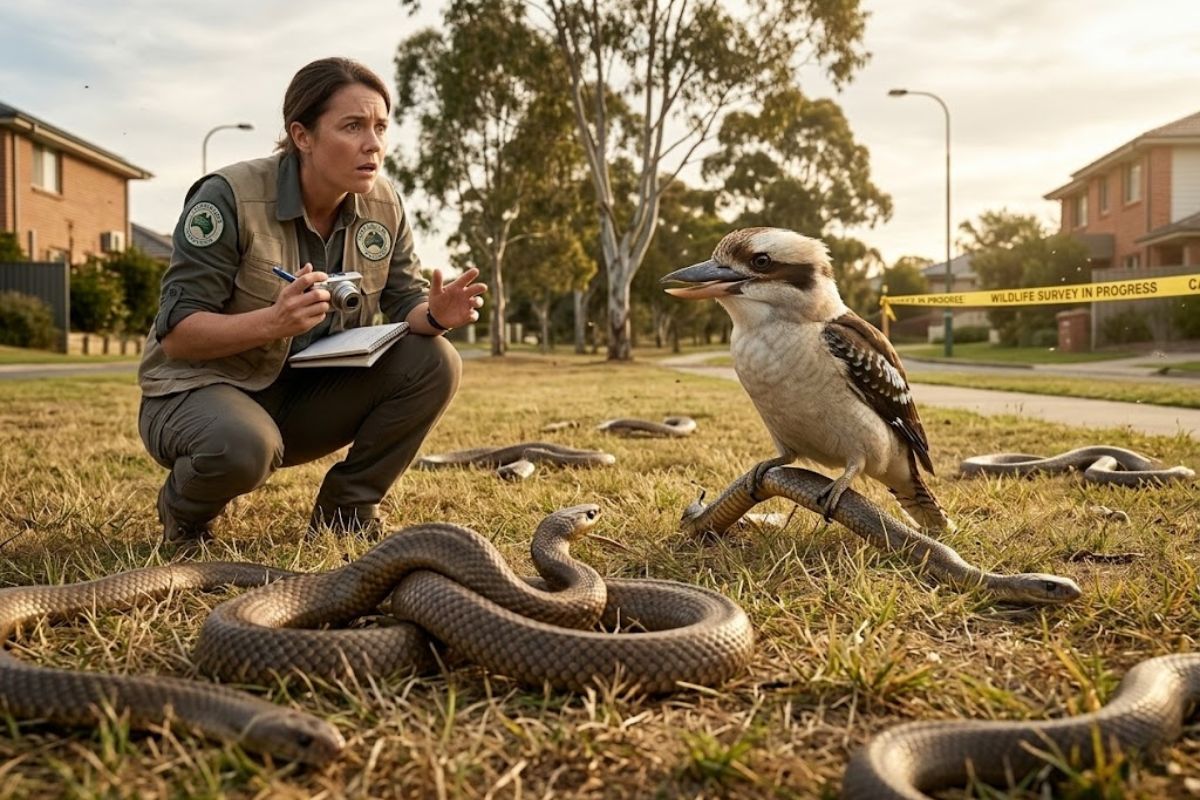


Eastern Brown Snakes Began To Appear Dead In Suburban Neighborhoods In Australia With Fractures To The Head And Spine, And The Surprise Of Scientists Was To Identify The Kookaburra As A Decisive Predator Against Young Venomous Reptiles, Reducing Domestic Risks In Yards, Streets And Urban Residential Areas Of The Region.
The most dangerous snakes in Australia began to appear dead on lawns and suburban neighborhoods, many with serious injuries to the head and spine. What seemed at first glance to be yet another strange episode of local wildlife ended up revealing a natural control mechanism over the Eastern Brown Snake, a species responsible for 60% of emergency medical services related to reptile bites on the continent.
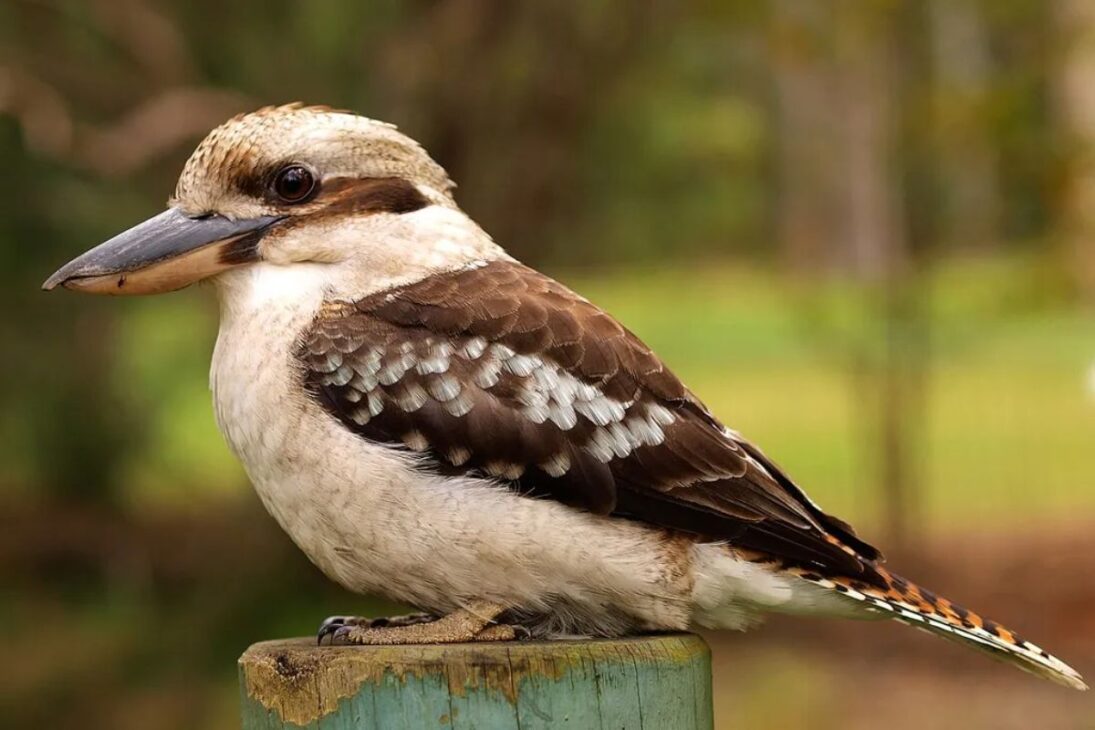
What caught the attention of the scientists at the Australia Reptile Park the most was the agent of this neutralization. Instead of fences, sensors, or expensive technology, it was the kookaburra, an apparently common bird, that started interrupting the advance of the snakes, capable of attacking young specimens before they occupied yards, pipelines, lawns, and residential areas. The discovery is surprising because it reveals a biological solution where human control had been almost completely failing.
How Urbanization Transformed Suburbs Of Australia Into Ideal Ground For Snakes
The urban growth changed the ecological rules of Australia and opened space for the expansion of snakes in residential areas.
-
In Mexico, a 3,000-year-old Maya site with the dimensions of an entire city may have been built as a colossal map of the cosmos, created to represent the order of the universe and reveal how this people organized space, time, and rituals.

-
Japan wants to build a solar ring of 10,900 kilometers on the Moon to continuously send energy to Earth.

-
Weighing almost 1 ton, with temperatures of up to 3,000°C, the ability to launch 10,000 fragments within a radius of 1 km, capable of penetrating concrete and melting steel, Turkey’s terrifying bomb emerges as one of the most destructive non-nuclear weapons ever presented.

-
After a submarine disappeared beneath the “Doomsday Glacier,” scientists announce a new monstrous machine capable of operating at 3,000 meters depth to return to the heart of the ice and investigate a threat that could raise sea levels worldwide.

Cities began to offer easy food, accumulated heat, and artificial shelters. Exotic rats and mice exploded in numbers around human settlements, turning entire neighborhoods into a permanent market for the Eastern Brown Snake.
Humans, unwittingly, helped create a perfect environment for the continent’s most dangerous predator.
Furthermore, data mentioned for the period from 2020 to 2025 indicate that urban centers are 2 to 4 degrees Celsius warmer than wilderness areas.
This extra heat, retained by concrete and urban surfaces, prolongs the reproductive cycle of the species by an additional three to four weeks. A female snake can lay from 15 to 35 eggs per clutch, and the hatchlings disperse through pipelines, emerging even from household drains.
This is not just about more snakes in the landscape, but about snakes physically entering people’s daily spaces.
Why The Venom Of The Brown Snake Has Made The Problem Even More Serious
The venom of the Eastern Brown Snake is a combination of procoagulants and neurotoxins. When this toxin enters the body, the blood can coagulate uncontrollably while the heart, lungs, and nervous system collapse.
Without antivenom within the first 45 minutes, the consequences can become extremely severe.
This helps to understand why the presence of these snakes in suburban neighborhoods has ceased to be an environmental nuisance and become a direct public health issue.
The most troubling detail is that the young snakes, which are precisely those that the kookaburra tends to attack, are also the hardest to detect in the grass, near gardens and around houses.
They circulate more freely, seek territory, and pose a high risk in places where children, pets, and residents move without perceiving the danger.
In other words, the threat was not just in the distant bush, but in the home yard.
How The Kookaburra Managed To Neutralize Such A Dangerous Predator

The kookaburra does not win by brute force but by a combination of visual processing, vigilance, and biomechanical precision.
While the human eye perceives movement at about 60 frames per second, the bird processes light and movement at over 100 frames per second.
This allows the snake’s lightning-fast strike, almost invisible to humans, to be read by the bird with much more clarity. For the kookaburra, the snake’s attack practically slows down.
The strategy is also specific. The kookaburra remains motionless on low branches about 3 meters high, picking up signals of the snakes moving on the ground.
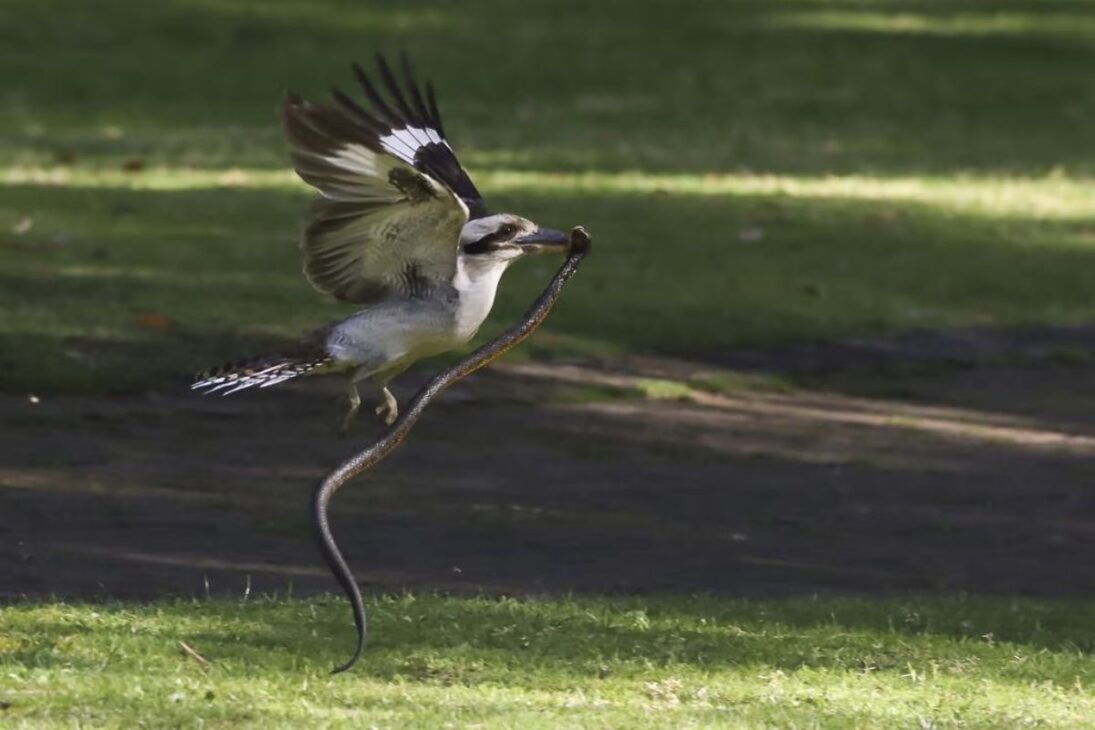
When it identifies the target, it dives at an angle outside the prey’s field of vision at about 9 meters per second and grips the beak just behind the skull, at the cervical region.
From there, it lifts the snake’s body and repeatedly throws it against logs, stones, or concrete, in sequences of 10 to 20 impacts.
It’s a brutal, precise technique designed to block the snake’s ability to react and inject venom.
The Predator Does Not Hunt Any Snake And This Explains Its Efficiency
The success rate attributed to the kookaburra reaches 98%, but this does not mean that it faces any reptile. The bird almost always selects young snakes under 50 centimeters long. This cut makes all the difference.
These are the individuals that circulate the most, enter residential lawns more, and become the hardest to detect. At the same time, they are targets where the risk to the bird remains manageable.
Efficiency arises less from courage and more from careful target selection.
When the adult brown snake exceeds 1.5 meters and carries enough venom to take down even a bull, the kookaburra avoids confrontation.
This dismantles the notion that the bird is “solving” the entire problem of venomous snakes in Australia.
What it does is something else: it acts at the most dangerous stage for urban coexistence, cutting off part of the flow of young snakes invading residential areas.
It’s a selective brake, not a total elimination of the species.
The Ecological Paradox That Left Scientists In Shock
The irony of the case is that the kookaburra is not originally native to all areas where it now plays this role.
The bird did not exist naturally in Western Australia or Tasmania. It was brought to new territories in the late 19th and early 20th centuries by European settlers who wanted to replicate sounds of nature in other regions.
Later, it began to be regarded as an invasive exotic predator for attacking nests, lizards, and aggressively competing for food. In other words, the same animal that was once seen as an ecological mistake ended up filling a void that urbanization opened.
This does not mean that transporting species is a good idea. The very material recalls classic cases of ecological disaster, such as European rabbits in Australia, Asian carp in the Mississippi system, cane toads in agricultural areas, and starlings out of control in America.
What happened with the kookaburra appears as a rare exception, not as a replicable recipe.
Scientists were shocked precisely because nature delivered a functional result through a pathway that, in almost all other cases, usually ends poorly.
Where The Presence Of The Kookaburra Has Already Changed The Urban Landscape
In areas with an abundance of kookaburra, sound monitoring systems with artificial intelligence installed since 2024 have recorded a decrease of up to 30% in emergency calls for snake capture.
There was also a reduction of 5% to 7% in medical treatments related to bites from young brown snakes. For a problem that has challenged traps, sensors, and sound waves for years, these numbers help to measure the weight of the bird’s natural intervention.
The effect is not absolute, but it is already evident where people live.
This result matters because it returns part of the discussion to the central point: the cities of Australia created an ecological trap favorable to snakes, and the most effective response so far did not come from a laboratory or million-dollar equipment.
It came from a predator that occupied a niche left vacant by large raptors and other natural controllers pushed away by urbanization.
Nature did not act out of benevolence but out of selective efficiency.
The case of the snakes found dead in neighborhoods of Australia shows an uncomfortable inversion for human logic of environmental control.
While fences, devices, and artificial solutions failed in the field, the kookaburra emerged as a partial regulator of a problem created by urbanization itself.
What surprised the scientists was not just the violence of the method, but the precision with which the bird targets precisely the most risky stage of urban infestation.
Still, this episode does not authorize romanticization. The kookaburra does not eliminate all snakes, does not make venom less dangerous, and does not transform a past ecological intervention into a model safe to repeat in other countries.
What it reveals is something else: when human action disorganizes the ecosystem, correction can emerge in an unexpected, harsh, and profoundly selective manner.
In your view, does this case show more about the strength of nature’s adaptation or the scale of human failure in controlling the very environment it created?








Achei ótima esta reportagem.Odeio cobras.Por mim eu defenderia o cucaburra e teria o prazer de cuidar da reprodução deles.👍