





 Portuguese
  English
  Spanish
  5 min of reading
  2 comments


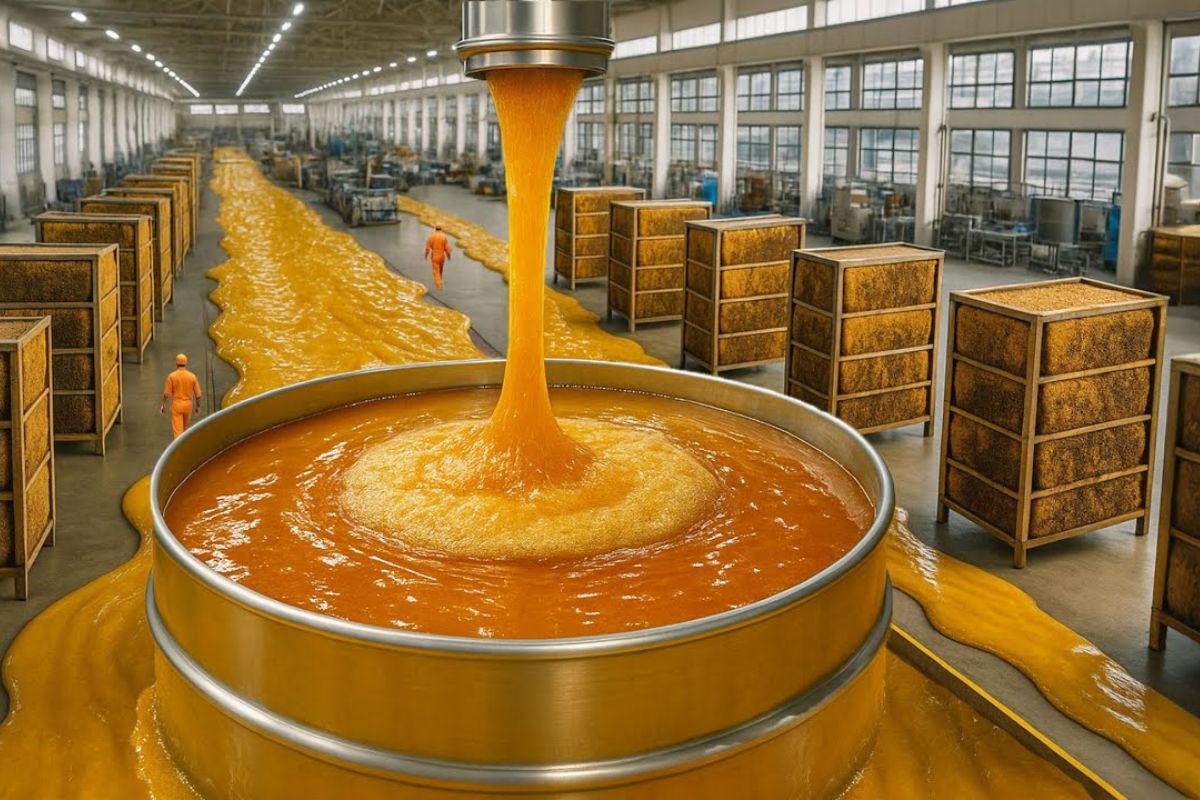


Honey Goes Through a Chain That Starts in Hives, Passes Through Spring Inspections in South Dakota, and Ends in a Factory with a Heating Room at 98 to 104 Fahrenheit, Uncapping, Centrifugal Extraction, Filtration, Tanks, and Filling of Nearly 6,000 Bottles per Hour Without Losing Enzymes, Aroma, and Natural Moisture.
Honey is called the liquid of nature and, in the United States, beekeepers harvested nearly 139 million pounds in a year, a volume associated with a golden layer capable of covering billions of pancakes. Behind this number is a system that starts with millions of bees and ends in an industrial line calibrated by time and temperature.
Honey production on a large scale depends on routine and maintenance. Before harvesting, beekeepers inspect each colony, assess the overall health of the bees, the strength of the worker population, and the condition of the queen, ensuring that nectar storage evolves to the point where honey can proceed to processing without the risk of fermentation.
Bees, Speed, and the Honey Economy

Bees are described as little warriors and operate at a high pace: wings flapping hundreds of times per second, flying over 15 miles per hour, and visiting up to 2,000 flowers per day to build honey drop by drop.
-
From space, Buenos Aires appears as a colossal spot of light surrounded by kilometers of darkness, revealing at a single glance the exact boundary between the metropolis and the countryside, seen from 400 km altitude.

-
NASA spent over 118 million reais to build a single bathroom that works in zero gravity, and it has just gone to space on the first crewed mission to the Moon in more than 50 years.

-
Man never set foot on the Moon? 5 scientific proofs confirm that humanity has been there and definitively dismantle conspiracy theories.

-
The Brazilian Army will adopt humanoid robots to test the concept of future combat, says a website, surprising everyone, but later revealing that it was all just an allusion to April Fool’s Day.


The United States ranks among the top producers, and the honey industry is associated with nearly US$ 175 million in annual revenue.
The value does not lie only in honey.
Bees are cited as essential to American agriculture, adding about US$ 15 billion per year through pollination, a link that sustains the nation’s food system.
Spring Inspections and Hive Preparation

With the gentle breezes of spring in South Dakota, beekeepers start meticulous preparations for the honey season.
Old frames are repaired or replaced, new frames are added, and the internal space of the hive is adjusted to receive the growing supply of nectar, in a balance of care, time, and observation.
This work cycle lasts six to eight weeks.
At the end of this period, the honeycombs display a thin layer of white wax, indicating that the honey has matured and that the moisture level has dropped to a point allowing for long-term storage without fermenting.
Harvest: Smoke, Frames, and Honey Preservation

When the cells are fully capped with wax and filled with mature honey, beekeepers begin the harvest with a classic technique: thin streams of smoke produced from dry wood, tree bark, or sawdust.
The smoke is spread around the hive to calm the colony and mask alarm pheromones, allowing for the removal of frames with less disturbance.
The frames filled with honey are taken out one by one, handled carefully to avoid cracks in the wax and damage to the comb, which will be reused by the colony in the next season.
Bees are brushed away with soft bristles or specialized tools, and a sufficient amount of honey is left to sustain the colony through winter.
Air Logistics and Arrival at the Industrial Line
After leaving the farm, the honey goes through a modern logistics network that includes specialized aircraft, aimed at reducing exposure to climate variations.
The study describes tons of honey crossing mountains, plains, and rivers to the Manuka factory, where time and temperature are treated as critical to preserving purity, aroma, and enzyme-rich quality.
It is at this point that the industrial line takes center stage.
The honey arrives sealed, packaged, and ready for a series of controlled steps that combine automation and respect for the biological material.
Heating Room and Uncapping with Precision
The first phase occurs in a heating room, with temperature kept constant between 98 and 104 degrees Fahrenheit, gently warming the honey to reduce viscosity and facilitate flow in the subsequent steps.
An automated monitoring system tracks variations in time and temperature, with the stated goal of preserving natural enzymes, vitamins, and the aroma of raw honey, without exposure to excessive heat.
Next, the frames go through an uncapping machine that removes the layer of wax sealing the honey.
High-speed rotating blades or heated knives slide with precision, cutting the wax without destroying the hexagonal structure of the comb, which remains reusable.
The removed wax is melted, filtered, and recycled into candles, natural balms, cosmetics, or base sheets for hives.
Centrifugal Extraction and Filtration Without Chemicals
With the wax cap removed, the honey enters the centrifugal extractor.
The stainless steel drum spins, and the centrifugal force separates the honey from the cells, launching the golden liquid against the walls of the drum, while the comb remains intact for return to the hive.
The description emphasizes a mechanical operation, without the use of chemicals and without relying on heat to perform the extraction.
After extraction, the honey still carries traces of wax and dust.
It is sent for coarse filtration, passing through macro layers of stainless steel or ultra-fine mesh filters, until it comes out clean and translucent, ready for further refinement.
Tanks, Temperature, and Stability
After filtration, the honey goes to large stainless steel tanks, where it is gently stirred to unify flavor and color.
The temperature is maintained between 95 and 104 degrees Fahrenheit to prevent crystallization and ensure a smooth texture, as well as to remove small air bubbles and deliver a clear and shiny appearance.
Here, the industrial line once again relies on fine control: each adjustment aims to keep the honey with a consistent appearance without disrupting what has been preserved since the hive.
Quality Control: Moisture, pH, and Sensory Profile
Before filling, each batch of honey undergoes a quality inspection.
Technicians evaluate clarity, viscosity, color, aroma, and purity under precise lighting, while viscometers measure flow as an indicator of freshness and moisture balance.
Samples are sent to the laboratory, where sugar composition, moisture content, pH levels, and residual impurities are analyzed.
The moisture content is described as typically between 15 and 18%, a range linked to the long-term stability of honey, preventing crystallization or fermentation.
In addition to chemical analysis, sensory specialists check aroma and taste to confirm floral notes and natural sweetness.
Filling: 6,000 Bottles per Hour on the Industrial Line
In the final step, honey flows through stainless steel tubes to automatic filling machines.
Sensors measure each portion, and the system is described as capable of filling nearly 6,000 bottles in just one hour, maintaining uniformity.
After that, the bottles proceed to automatic capping, high-speed labeling, and final inspection of weight and visual standard before being packed and prepared for distribution.
The industrial line transforms a biological raw material into a stable product, but the starting point remains the same: bees, flowers, hive, and the constant work of beekeepers.
If you consume honey frequently, it’s worth noting how temperature, humidity, and handling become decisive variables between the hive and the shelf. Which step of this honey chain surprises you the most: harvesting in the hive or filling on the industrial line?









Perfeito, vale saber qual a floradaque mantém essa produção intensa de néctar!
Nessa escala industrial a apicultura e a variabilidade da qualidade das floradas dos méis tropicais se perdem, não tem muita graça um mel “industrial” desse.