





 Português
  Inglês
  Espanhol
  3 min de leitura
  0 comentários


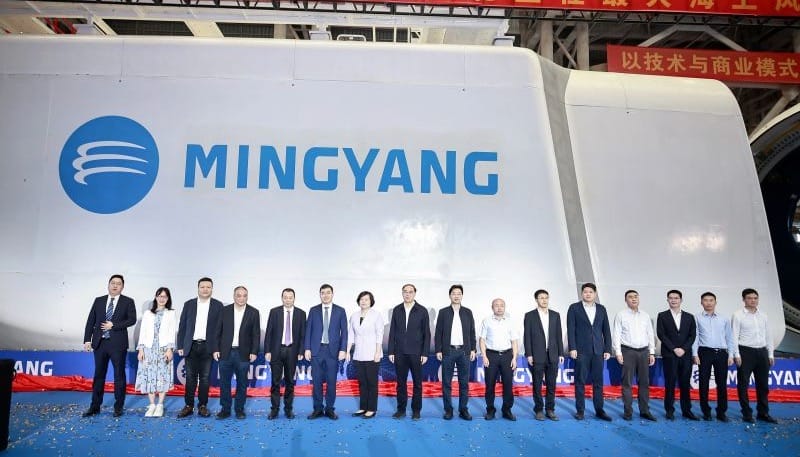
MySE 18.X-20MW Offshore Wind Turbine with Technology for Deeper Waters and Innovative Solutions, Manufactured in Shanwei, Flexible Generation Capacity, and Anti-Typhoon Technology.
Mingyang Smart Energy has launched its new 18 MW offshore wind turbine at its manufacturing base in Shanwei. This wind turbine is considered the largest in the world in terms of capacity and rotor diameter, demonstrating the company’s commitment to advancing technology for deeper waters and providing innovative and more powerful solutions. Furthermore, the turbine features flexible capacities ranging from 18.X to 20 MW, along with rotor diameters from 260 to 292 m, covering a maximum swept area equivalent to 9 football fields.
With an annual generation capacity of 80 million kWh in eastern Guangdong, this wind turbine can supply 96 thousand households and reduce CO2 emissions by 66 thousand tons, contributing to the promotion of sustainable energy. Additionally, this technology is designed for global deployment in regions with medium to high wind speeds, with specific suitability for typhoon-prone locations, being equipped with active anti-typhoon technology capable of withstanding category 17 typhoons (56.1-61.2 m/s), the manufacturer stated.
The Importance of Wind Turbines in Renewable Energy Generation
Wind turbines, also known as wind generators or aerogenerators, play a fundamental role in producing clean and sustainable energy. The technology for deeper waters has driven innovative solutions for wind turbines, providing flexible outputs and increasing the generation capacity.
-
Renewable energy advances over protected areas in Brazil, and a survey by the Energy Transition Observatory reveals silent impacts that challenge environmental conservation and pressure sensitive traditional territories.

-
Rio Grande do Sul accelerates energy transition: State invests in renewable technologies and consolidates decarbonization strategies and pathways to attract billions in new industrial investments.

-
With 160,000 m² of collectors, an area larger than 20 football fields, Silkeborg, in Denmark, hosts a solar thermal plant that heats 19,500 homes and could become the largest solar heating plant in the world.

-
A study reveals the expansion of renewable energy procurement in Brazil and shows how companies are taking advantage of opportunities to reduce expenses, ensure energy efficiency, and strengthen strategic environmental commitments.

The wind turbine consists of a rotor, which is responsible for capturing wind energy and converting it into electrical energy. The rotor diameter and maximum swept area are essential characteristics to ensure the efficiency of the wind turbine. Additionally, the generation capacity and CO2 emissions are determining factors in the global choice and deployment of wind turbines.
Anti-typhoon technology has been developed to protect wind turbines in typhoon-prone regions, ensuring safety and efficiency in energy generation. Additionally, domestic manufacturing of wind turbines contributes to strengthening the supply chain and reducing transportation and import costs.
In Brazil, wind turbines have gained prominence, boosting renewable energy production and contributing to the diversification of the energy matrix. With investments in new projects and technologies, the country has the potential to become a powerhouse in wind energy generation, harnessing favorable winds in various regions.
The Technology Behind the Wind Turbine
The wind turbine is one of the primary means of renewable energy generation worldwide. With advanced design and cutting-edge technology, wind turbines have stood out as a sustainable alternative to traditional energy sources.
The rotor diameter and maximum swept area are crucial aspects in the operation of the wind turbine, ensuring maximum energy capture from the winds. Additionally, generation capacity and CO2 emissions are determining factors in the global choice and deployment of wind turbines.
Anti-typhoon technology has been developed to protect wind turbines in typhoon-prone regions, ensuring safety and efficiency in energy generation. Furthermore, domestic manufacturing of wind turbines contributes to strengthening the supply chain and reducing transportation and import costs.
With advances in technology, wind turbines are becoming increasingly efficient, allowing energy generation in areas with weaker winds. This expands the opportunities for deploying wind turbines, making wind energy an important part of the transition to a more sustainable future.
Source: © Re News.Biz










Seja o primeiro a reagir!