





 Portuguese
  English
  Spanish
  4 min of reading
  0 comments


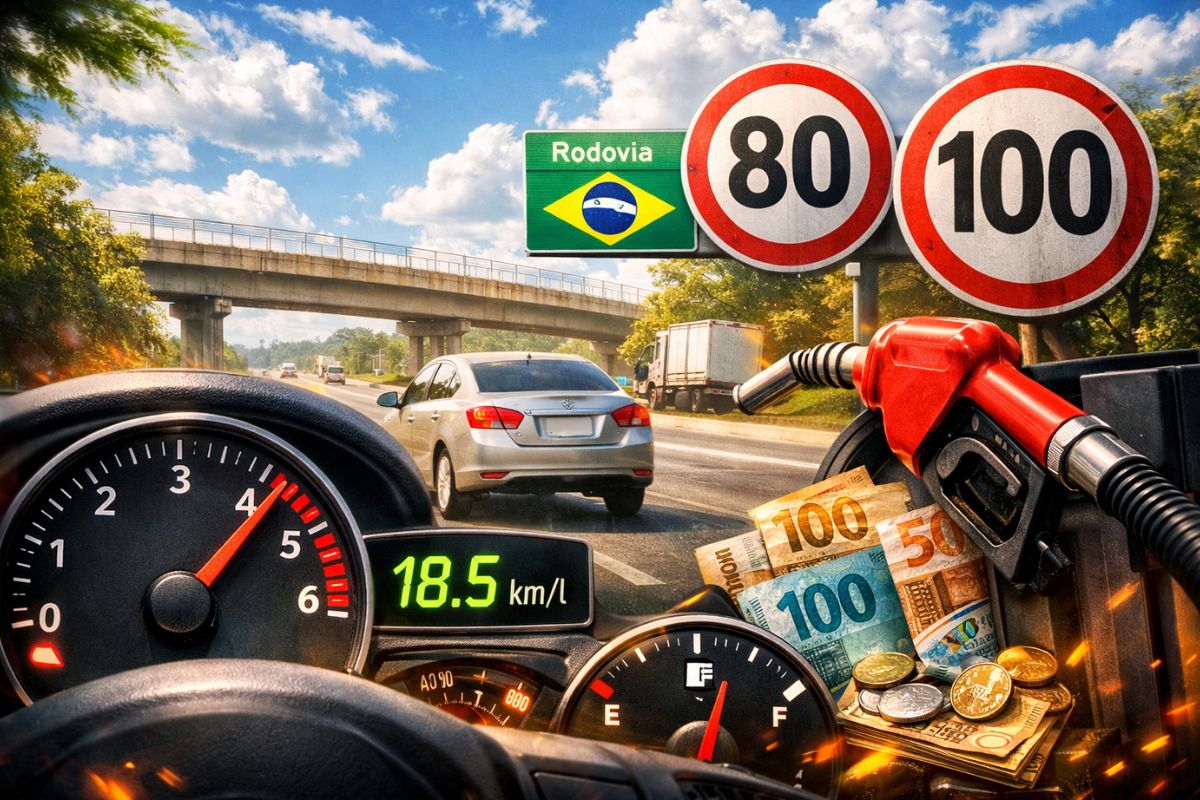
The speed that uses less fuel on the road is between 80 and 90 km/h according to automotive engineering and European traffic agencies because in this range the engine operates at low revolutions in the highest gear while aerodynamic drag has not yet dominated consumption and each km/h above that is expensive.
Anyone driving on the road has heard that the slower you go, the more economical it is. But the reality of fuel consumption is more precise than that and surprising. According to information from the portal Revista Oeste, there is an exact point where the engine works with maximum efficiency and fuel consumption reaches the minimum possible, and it is at 90 km/h for most passenger cars. Below this point, the engine works harder than it needs to. Above it, air resistance begins to dominate and consumption rises disproportionately.
This data does not come from guesswork. The DGT, the General Directorate of Traffic in Spain, confirms in official educational material that 90 km/h is the point of highest fuel efficiency for passenger vehicles on highways. The European Environment Agency estimates that reducing speed from 120 to 110 km/h already saves between 12% and 18% of fuel and going from 90 to 110 km/h represents an increase of 15% to 20% in consumption. The difference is real, measurable, and shows up directly at the pump.
The physics that explains why 90 km/h uses less fuel
Two phenomena compete throughout any trip. The first is rolling resistance the friction between tires and asphalt, which dominates at low speeds and grows linearly. The second is aerodynamic drag the resistance of air, which increases with the square of speed.
-
Mechanic explains: Ferrari 296 has a hybrid system management failure that can drain the high-voltage battery to an “irrecoverable” point in the car; recovery requires charging cell by cell on a bench, is risky, and the battery can cost R$ 250,000 imported.

-
It surpassed the T-Cross, Creta, and Tracker: with nearly 8,000 units sold, the Volkswagen Tera was the best-selling SUV in March 2026.
-
Honda performs miracles in fuel consumption with a hatch that marks 13.2 km/l in the city and 15 km/l on the highway, leaving Polo, HB20, 208, and Onix behind and becoming a reference among compact cars without resorting to turbo or hybrid systems.

-
Six diseases that seem common but can prevent the renewal of the driver’s license for the elderly throughout Brazil and surprise experienced drivers — could any of them affect you without showing clear signs?

If the speed doubles, the drag quadruples. That’s why fuel consumption skyrockets above 90 km/h: the force that the engine needs to overcome to push the car against the air becomes the dominant factor.
The relationship between speed and fuel consumption follows a U-shaped curve. At one extreme, driving too slowly forces the engine to work in low gear at high revolutions. At the other, driving too fast forces the engine to overcome brutal aerodynamic drag.
The bottom of the U the point of lowest fuel consumption is precisely between 80 and 90 km/h, where the engine operates in the highest gear, at low revolutions (usually between 2,000 and 2,500 RPM), with minimal work from the combustion system.
Why 80 km/h is not the ideal fuel consumption point
The speed of 80 km/h is close to the optimal point, but in most modern vehicles with five gears or automatic transmission, 90 km/h keeps the engine in better conditions.
In automatic transmissions, the gearbox often does not engage overdrive below 85 to 90 km/h which means that at 80 km/h the engine may be revving more than necessary, consuming more fuel than it would at 90.
A master’s thesis from the Federal University of Ceará, from 2024, tested models such as the Hyundai ix35 and the HB20 and identified that 80 km/h was the speed with the best correlation between vertical acceleration and consumption for these specific cars.
The study confirms that the optimal fuel point varies by model, but always falls within the range of 80 to 90 km/h. No tested passenger vehicle had its maximum efficiency point above 90 km/h.
What changes the ideal fuel speed from one car to another
The range of 80 to 90 km/h is a reference for passenger vehicles under normal conditions, but several factors can shift this point depending on the car and the situation. SUVs and pickups have higher aerodynamic drag due to their taller profile, and the optimal fuel point tends to be slightly lower around 80 km/h.
Automatic transmissions with more gears (6, 7, or 8 speeds) or CVT allow the engine to operate efficiently at slightly higher speeds.
External factors also weigh in. Tires below the recommended pressure increase rolling resistance and raise fuel consumption at all speeds. Uphills shift the optimal point down; downhills allow for higher speeds with reduced consumption.
Headwinds at 20 km/h combined with the vehicle’s speed aerodynamically equate to driving 20 km/h faster that is, a car at 90 km/h against a headwind consumes fuel as if it were at 110 km/h. This is a factor that most drivers completely ignore.
The mistake that uses more fuel than any wrong speed
Regardless of the speed chosen, there is one habit that consumes much more fuel than driving at 100 or 110 km/h: accelerating and braking abruptly.
The engine injects the maximum amount of fuel during intense accelerations, and all the accumulated work is dissipated as heat during braking. Those who alternate between 80 and 110 km/h along the same route consume significantly more than those who maintain a constant 90 km/h even if the final average speed is similar.
The combination that automotive engineering points to as ideal is straightforward: 90 km/h at a constant speed, in the highest gear possible, with properly inflated tires and a warmed-up engine.
Maintaining a constant speed with anticipation of traffic slowing down smoothly upon seeing a slower vehicle ahead instead of braking suddenly is just as important for saving fuel as hitting the ideal cruising speed. The difference shows up directly in your wallet at every stop at the pump.
What speed do you usually maintain on the road? Have you noticed a difference in consumption when driving at 90 km/h? Share in the comments.








Seja o primeiro a reagir!