





 Portuguese
  English
  Spanish
  5 min of reading
  0 comments


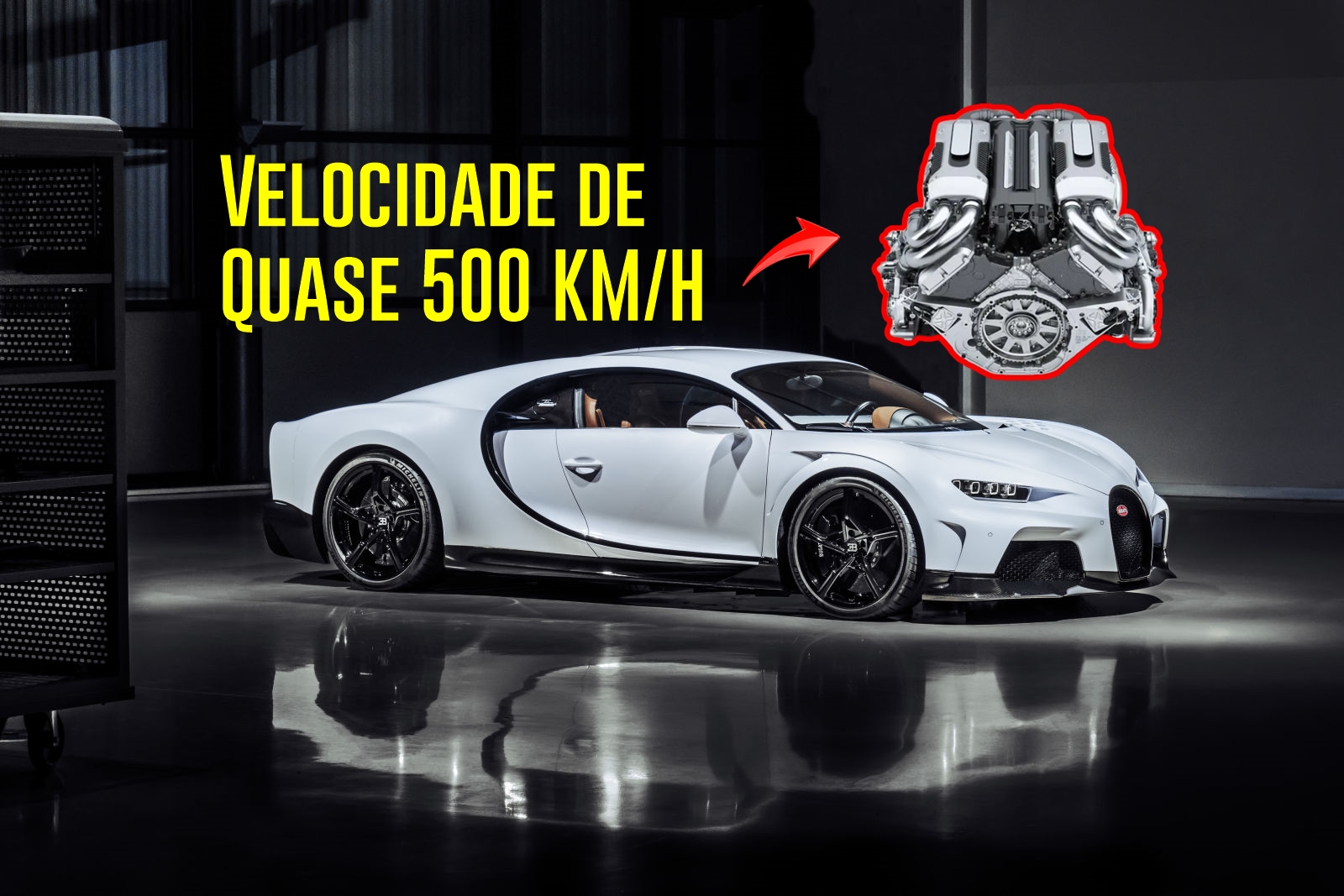
A Revolutionary Engine With 1,578 Horsepower Broke Records And Can Reach Speeds Of Nearly 500 Km; It Is The Most Powerful Car Engine In The World
For decades, the automotive world has tirelessly sought to break barriers of power, speed, and engineering. At the center of this movement, Bugatti solidified its legacy by introducing the most powerful car engine in the world, the W16, a masterpiece of engineering that not only challenged conventions but also became a symbol of innovation and exclusivity.
With 16 cylinders arranged in a unique format and four turbochargers, the most powerful car engine in the world W16 has left an indelible mark on the industry and in the hearts of speed enthusiasts.
The Impressive Aspect Of The World’s Most Powerful Car Engine
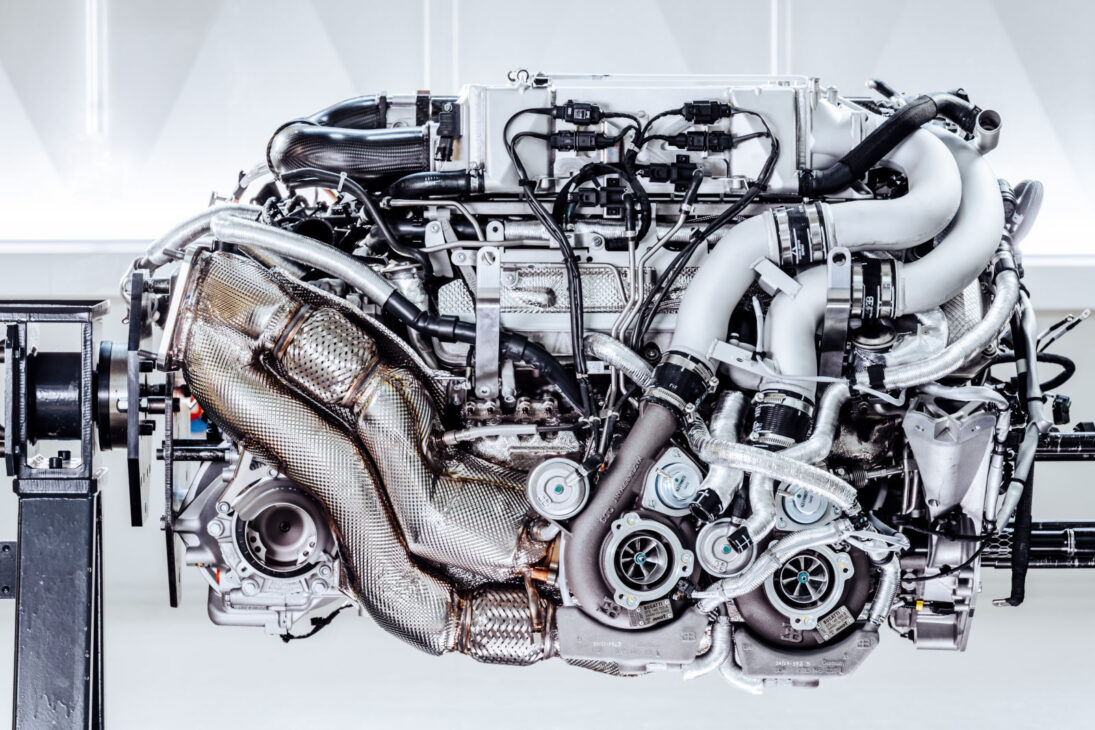
The W16 engine, as the name suggests, features 16 cylinders arranged in a “W” shape, something rarely seen in automotive history.
-
The Toyota Hilux is R$ 75.5 thousand cheaper and bets on the 2.8 turbodiesel engine with up to 204 hp and 50.9 kgfm to catch up with the VW Saveiro, which leads with 4,472 sales.
-
The new Renault Koleos has a screen exclusively for the passenger that is invisible to the driver, heated rear seats, and 29 assistance systems, but its Chinese competitors cost R$ 40,000 less and deliver more power.
-
The car stored for 38 years: when opening the barn door, what appears is breathtaking and looks like a scene from a movie!

-
Fiat works miracles in the Brazilian market, lowers the price of its 0 km hatch to R$ 69,990, reestablishes the model as the cheapest car in the country, and reignites the battle against Kwid and C3.

This configuration consists of four banks of four cylinders, creating a 90-degree angle between them. This unique layout was designed to deliver maximum power without sacrificing compactness, which is crucial for a supercar like the Bugatti Veyron, the first model to house this piece of engineering in 2005.
With a displacement of 8.0 liters, the W16 utilizes a stroke and bore of 86 mm. This precision in details is merely a reflection of the meticulous work involved in its design, developed in collaboration with Volkswagen, which owns Bugatti.
Massive Power
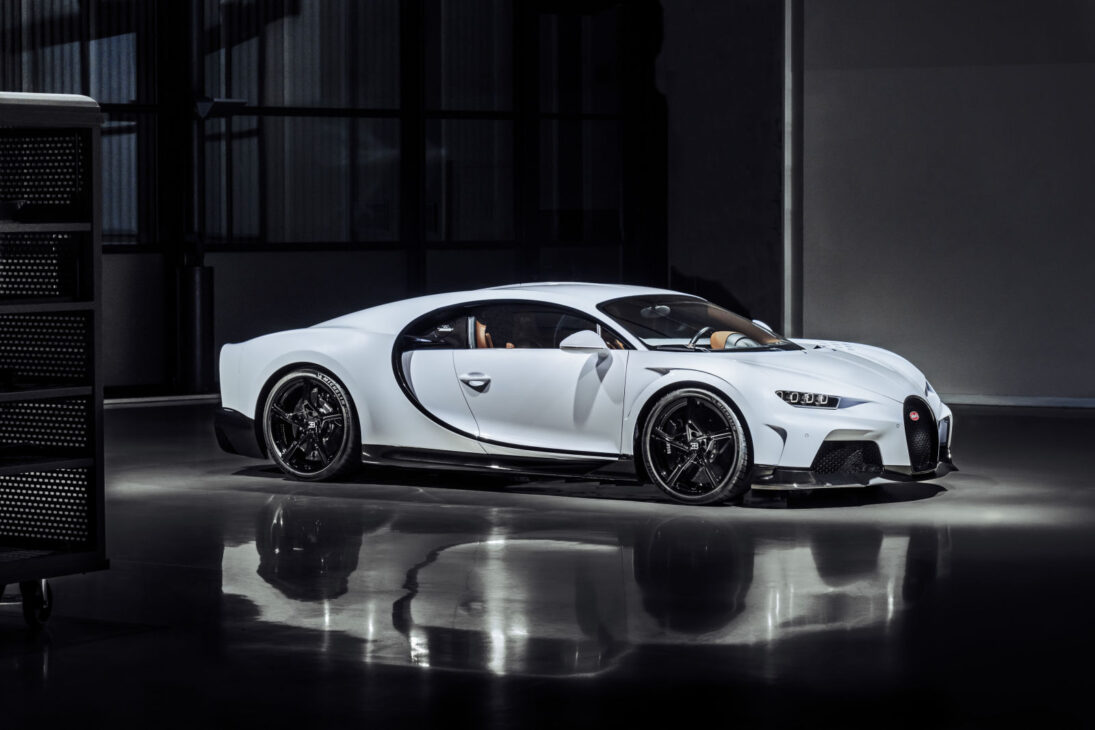
The numbers associated with the W16 are nothing short of impressive. In the Veyron model, the engine generated 987 horsepower, enough to propel the car to an impressive speed of 407 km/h, a record for production vehicles at the time.
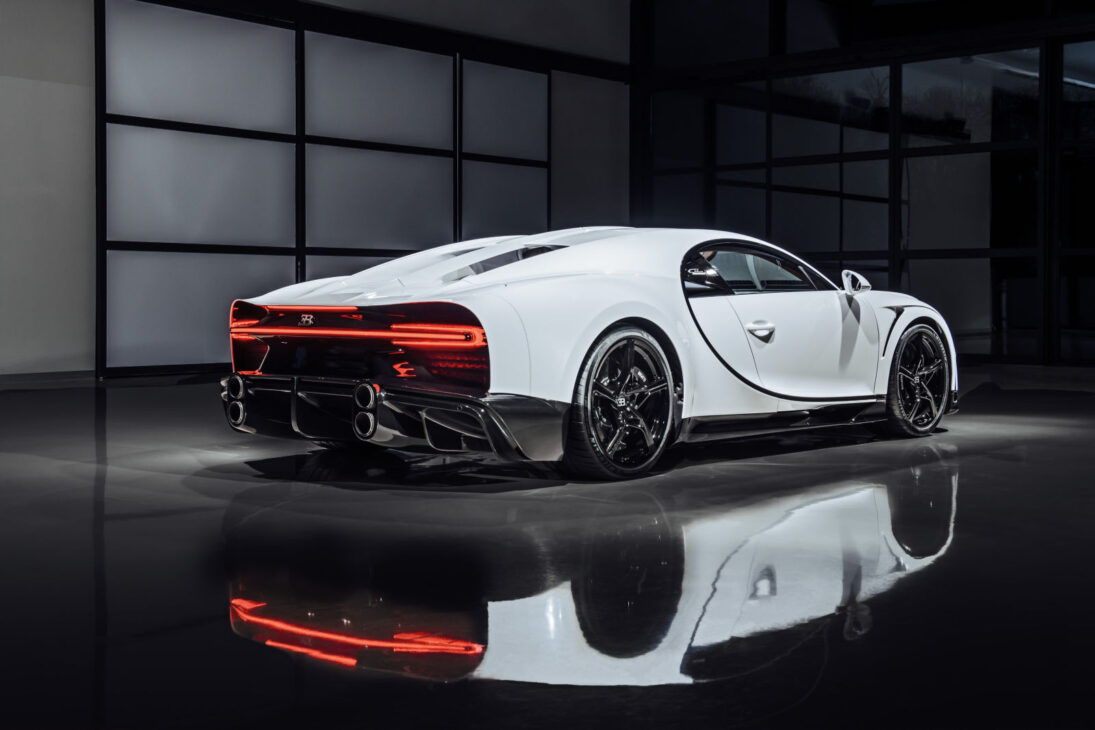
However, Bugatti did not stop there. In the following years, enhanced versions of the engine managed to produce up to 1,825 horsepower, as in the Bugatti Bolide, designed to deliver extreme performance on the track.
Beyond power, the W16 also stands out for its exceptional torque. With peaks ranging from 1,250 Nm to 1,850 Nm, the delivery of force is instantaneous and overwhelming, allowing accelerations from 0 to 100 km/h in less than 2.5 seconds in several models equipped with this engine.
Quad-Turbo Of The Most Powerful Engine In The World
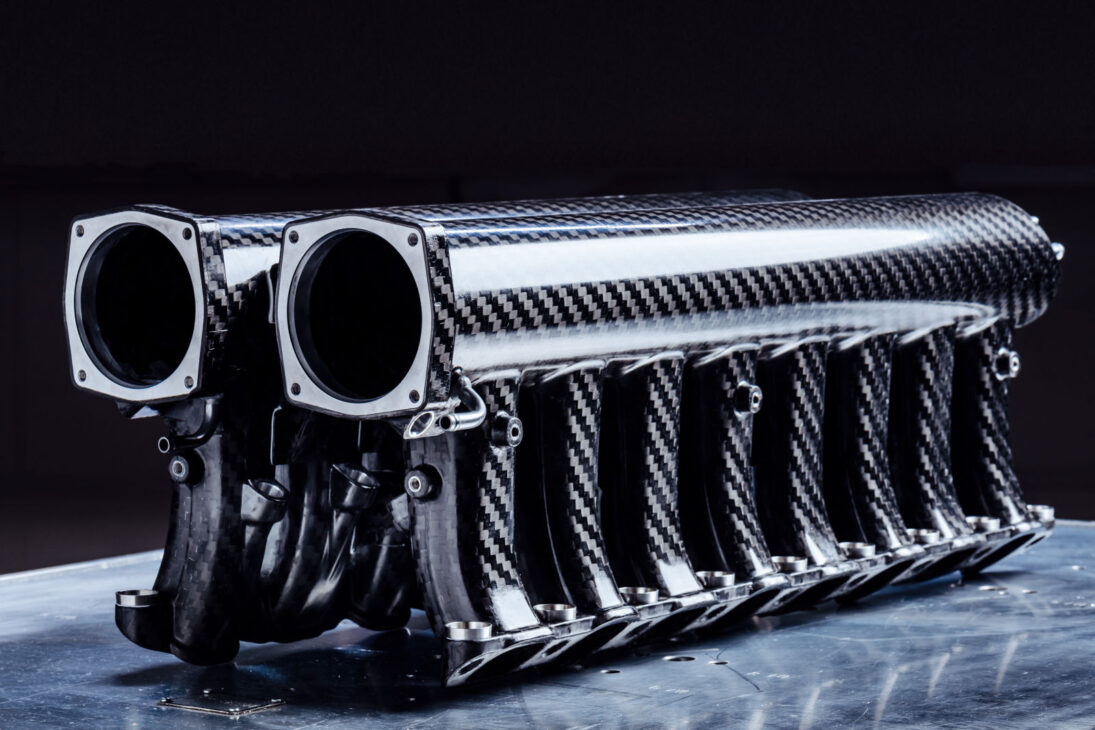
One of the secrets behind the phenomenal performance of the W16 is the quad-turbo system, which employs four turbochargers to maximize air intake into the cylinders. This not only boosts power but also ensures that the engine operates efficiently across a wide range of RPMs.
This system has been refined over the years to reduce “turbo lag” and provide a more linear response, something crucial for the drivability of a luxury high-performance car.
<strong Cutting-Edge Technology
Innovation is not limited to the configuration or power. The W16 employs a dry sump lubrication system, common in race cars, to ensure that oil is distributed evenly, even under extreme G-forces. Additionally, the electronic fuel injection and dual overhead camshaft (DOHC) ensure precision and efficiency in all engine cycles.
Despite weighing approximately 400 kg, the engine has been meticulously designed to balance weight and power, a challenge for any manufacturer aiming to combine performance with luxury and comfort.
The End Of An Era
The W16 engine was produced between 2005 and 2024, equipping legendary models such as the Bugatti Veyron, Chiron, Divo, Centodieci, Bolide, and Mistral. Each car not only carried the promise of speed but also featured a design that complemented the engine’s technical excellence.
The decision to end W16 production was motivated by the industry’s shift towards more sustainable technologies, such as electrification. Still, the legacy of the W16 remains intact, representing the pinnacle of combustion engineering in an increasingly electric motor-dominated world.
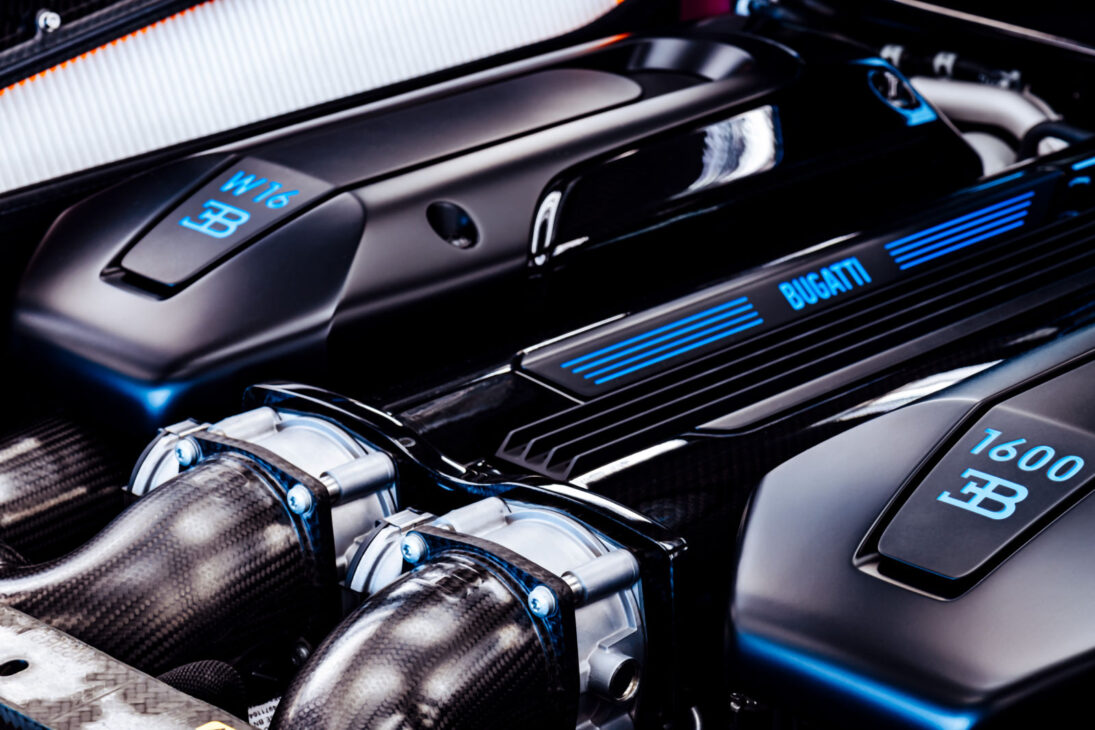
The Bugatti W16 engine is a masterpiece of automotive engineering, distinguished by its unique configuration and exceptional performance. The following table presents the detailed technical specifications of this engine:
| Specification | Details |
|---|---|
| Configuration | W16 at 90°, with four banks of four cylinders each |
| Displacement | 7,993 cm³ (8.0 liters) |
| Bore x Stroke | 86 mm x 86 mm |
| Valves per Cylinder | 4, totaling 64 valves |
| Valve Timing | DOHC (Dual Overhead Camshaft) |
| Fuel System | Electronic fuel injection |
| Induction | Quad-turbo (four turbochargers) |
| Power | Variable between 987 hp and 1,825 hp, depending on the version |
| Torque | Between 922 lb·ft (1,250 Nm) and 1,364.5 lb·ft (1,850 Nm) |
| Lubrication System | Dry sump |
| Engine Weight | Approximately 400 kg |
Other Powerful Engines
If the Bugatti W16 is the pinnacle of sophistication, the engines of Top Fuel Dragsters represent pure brute force. These cars, used in drag racing, are equipped with engines that generate an impressive 11,000 horsepower. It’s hard to imagine what that means in practice, but suffice it to say that a Top Fuel accelerates from 0 to 100 km/h in less than a second.
The secret to this power lies in the use of a mixture of nitromethane and methanol as fuel. This highly explosive combination, coupled with extremely reinforced components, allows the engine to withstand unimaginable temperatures and pressures. However, energy efficiency is not a priority: a Top Fuel engine consumes about 38 liters of fuel in less than 4 seconds.
These engines are designed to last only a few races, given the workload they endure. They represent an extreme of automotive engineering, where durability is sacrificed in the name of absolute speed.
Adapted Engines
While sports and drag racing engines have specific purposes, there is a category of adapted engines that challenges conventional limits. A notable example is the use of tank engines, such as the V12 Meteor, originally developed for the British Cromwell tank during World War II. This engine, with a 27-liter capacity, has been adapted by enthusiasts to create unique vehicles with thousands of horsepower.
One of the most famous projects is the “Brutus”, an experimental car equipped with a 46-liter BMW V12 aircraft engine. While not practical or safe for everyday use, the Brutus is a testament to how a passion for engineering can yield extraordinary results. These adapted engines do not enter competitions, but are historical landmarks that demonstrate how far creativity can take us.
What Defines Power?
Power is not the only parameter for measuring engine performance, but it is certainly the most fascinating. It is measured in horsepower (hp) and represents the engine’s capability to do work over a specific period. However, the practical application of this power depends on factors such as torque, efficiency, and vehicle weight.
The mentioned engines exemplify different approaches to achieving maximum power. While the Bugatti W16 is a commercial engine capable of providing luxury and speed, the Top Fuel and adapted engines are geared towards extreme applications, often at the cost of usability.
The Future Of Automotive Power
With the transition to electric vehicles, the definition of automotive power is changing. Electric motors like the Rimac Nevera, which produces 1,914 hp, are redefining what is possible in terms of acceleration and performance. Furthermore, these motors have the advantage of being more efficient and sustainable, a growing priority in the automotive industry.
However, for many enthusiasts, internal combustion engines still have an unmatched appeal. They represent not only technology but also passion, history, and the visceral connection between man and machine.








-

-

-

6 pessoas reagiram a isso.