





 English
  Francês
  Alemão
  Italiano
  Japonês
  Norueguês
  Portuguese
  Spanish
  8 min of reading
  7 comments


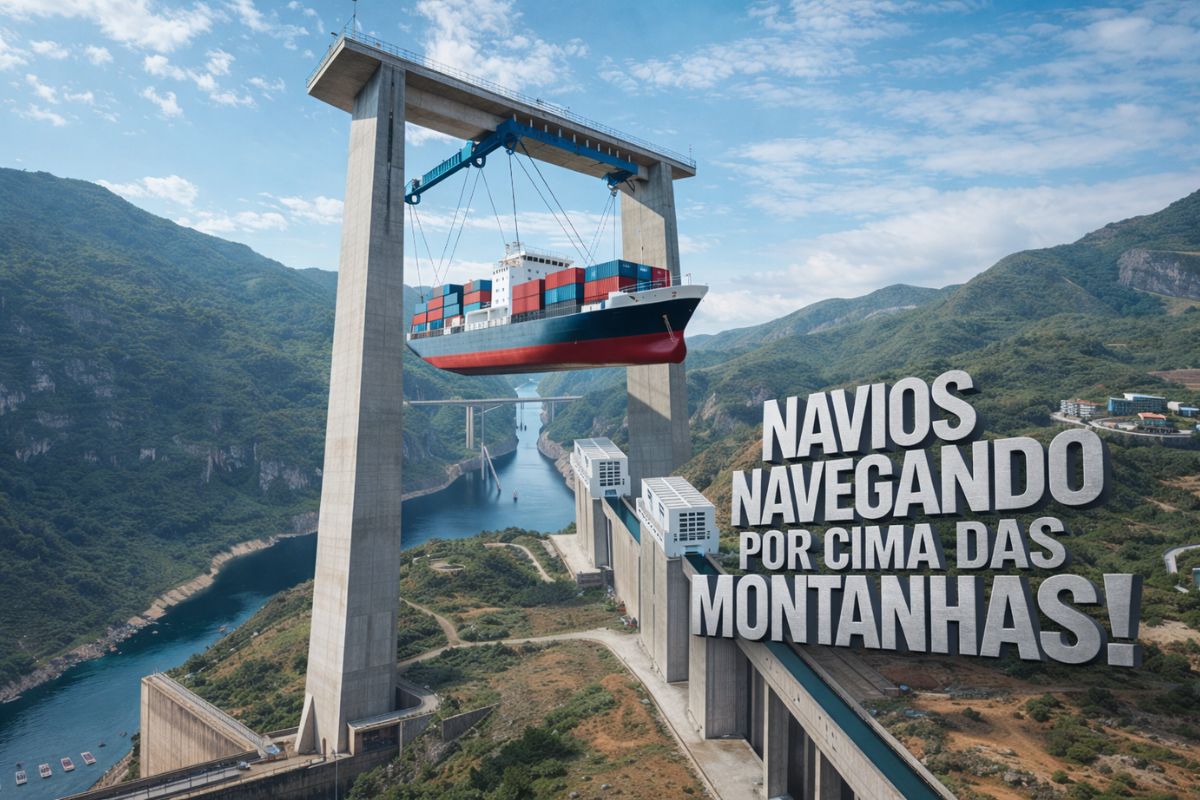


In The Mountainous Province of Guizhou, China, Giant Ship Lifts Overcome Elevation Changes of More Than 250 Meters, Crossing Suspended Aqueducts and Tunnels Dug into the Rock to Keep Waterways Connected to The Yangtze River and the Economic Heart of The Country.
Crossing mountains by boating may seem like a movie scene, but today it is routine in one of the most rugged regions of China. Combining dams, hydropower plants, canals, elevated aqueducts, and giant lifts capable of lifting entire vessels, the country has transformed a hostile terrain into an essential logistical corridor, through which heavy cargo passes to the Yangtze River.
All of this is possible thanks to an engineering project that integrates hydropower generation, river transport, and mountain infrastructure into a single system. At the core of this solution are the giant lifts of Gaotan, which allow ships to ascend and descend hundreds of meters in stages, cross an elevated aqueduct, go through tunnels in the rock, and, finally, continue their journey along a waterway that connects directly to one of the most important rivers on the planet.
China That Navigates Above The Mountains

China is responsible for about one third of all hydropower in the world, with approximately 391 gigawatts of a total close to 1360 gigawatts of global capacity. This is possible because the country has spread dozens of large power plants across its territory, many of which are installed in mountainous regions, deep valleys, and fast-flowing rivers.
-
Abandoned house for 15 years disappears in the woods, shocks owner with unrecognizable scenery and is reborn in an intense transformation after almost 90 hours of work in just 10 days.

-
In just three hours, a natural stone floor transforms the entrance of the house with an organic effect, immediate drainage, and a sophisticated non-slip finish that doesn’t puddle water, dries quickly, and impresses with the final result.
-
‘Interlocking brick’ made of earth arrives in the construction industry with cost reductions of up to 40% on the project.

-
Espírito Santo will receive the largest engineering project in its history with the duplication of BR 262, which will have 50 viaducts, 28 bridges, and 2-kilometer tunnels cutting through the most challenging mountainous region of the entire state.

Among these structures are some of the largest hydroelectric complexes on the planet, such as the Three Gorges Dam, considered the largest hydropower plant in operation, and others like Bairretan, which also rank among the global giants. At several of these dams, the rugged geography has demanded extreme solutions to reconcile two seemingly contradictory objectives: impound water to generate energy while also maintaining river navigation.
It was in this context that the systems of giant lifts for ships emerged. Rather than trying to open roads and railways in terrain where 90 percent or more of the area is made up of mountains, dissected plateaus, and narrow valleys, Chinese engineers opted to harness the potential of rivers and create vertical waterways, where vessels ascend and descend enormous elevation changes within minutes.
Inside The Giant Lifts Of Gaotan
The Gaotan system in Guizhou looks like a science fiction laboratory applied to navigation. From afar, what you see is a large concrete building on the edge of a canal. Up close, this building hides the heart of the solution: giant lifts specifically designed to transport ships carrying hundreds of tons of cargo and water.
On the outside, these lifts resemble a tall industrial building. On the inside, they consist of chambers filled with water, robust steel cables, drums, and gears that operate similarly to a building elevator, but on a colossal scale. Instead of people, entire vessels enter.
Each trip can elevate a ship weighing up to about 500 tons in about 10 minutes, keeping the boat stable within a sort of metallic “bathtub.” The system is designed to support even larger loads—on the order of thousands of tons—depending on the operational configuration. Visually, it’s like watching a building lift a section of river along with the vessel.
The first of the giant lifts at Gaotan is capable of raising the vessel to about 78 meters in height, equivalent to a building of more than 20 floors. But this is just the first stage of the climb.
Three Lifts, 252 Meters of Elevation Change, and A Vertical Waterway
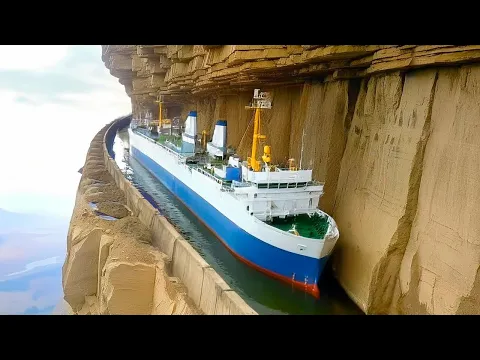

The system consists of not just one, but three interconnected giant lifts, forming a true hydraulic ladder. After overcoming the first elevation change, the ship continues along a canal to the second lift, which adds another 127 meters of ascent. Then, there is a third lift responsible for performing the final descent of up to 47 meters, depending on the water level on the other side of the dam.
Adding up all the stages, the vessels overcome a total elevation change of approximately 252 meters. In comparison, this is taller than the Statue of Liberty and far exceeds the height of the Great Pyramid of Giza. At certain points, the ship is floating at heights equivalent to 60-story buildings, with water all around and mountains nearby.
At first glance, it may seem like a slow system, as each giant lift moves only one vessel at a time. But the secret lies in the sequential organization: while one ship ascends, another is already positioning itself at the next lift or entering the next route. Thus, a constant flow is formed, almost like a vertical convoy, maximizing the use of the available infrastructure.
The Suspended Aqueduct That Connects The Lifts

Among the giant lifts, there is another discreet and essential protagonist: a suspended aqueduct, which functions as a bridge of water in the heights. Instead of simple pipes, we are talking about an elevated navigable canal, through which ships travel as if they were on a river, just several meters above the ground.
Aqueducts have been known since ancient times, especially by the Romans, but here they serve a completely different role. It is not just about conducting water but about supporting an entire channel with heavy vessels in motion, in an environment subject to geological instabilities, strong winds, and fluctuations in water levels.
The layout of the aqueduct was carefully adapted to the terrain, fitted into the mountainous topography of Guizhou. The structure must be robust enough to withstand the weight of the water and the ships, but also flexible and safe to accommodate a setting of steep slopes, deep valleys, and difficult-to-stabilize soil. The result is a kind of water viaduct, completing the connection between the giant lifts and transforming the whole into a continuous waterway.
The Navigable Tunnel That Passes Through The Mountain
In another section of the route, the challenge shifted from height to the massive rock obstacle. There was no way to go around the mountain from above or outside with a viable path for boats. The solution found was radical: to open a tunnel in the mountain exclusively for the continuity of the waterway.
This tunnel, excavated with giant tunneling machines, extends approximately 2.2 kilometers. Inside, the environment is dark and closed, but the channel is fully navigable. The ships enter, travel through the mountain’s interior, and emerge on the other side ready to continue the sequence of lifts and channels.
The combination of giant lifts, suspended aqueduct, and navigable tunnel transforms an extremely rugged stretch of Guizhou into an integrated aquatic transport solution, where each geographical element, instead of hindering, was incorporated into the project.
Hydropower and Strategy on The Wu River and Yangtze
None of this would have been built without a consistent strategic motive. The province of Guizhou is in one of the most mountainous regions of China and has an estimated hydropower potential of tens of millions of kilowatts, which places it among the richest areas in hydro energy in the country.
Along the Wu River, one of the direct tributaries of the Yangtze River, there are now several hydropower plants in operation, totaling thousands of megawatts of installed capacity. The Gaotan Dam is one piece of this puzzle, integrating energy generation and navigation into the same corridor.
The key point is that the Wu River connects to the Yangtze, and the Yangtze is China’s main river artery, cutting through the country from west to east, passing through highly industrial areas and one of the largest economic hubs on the planet, the river delta. Abandoning navigation along this axis would mean removing Guizhou from the main logistical routes of the country.
Therefore, instead of choosing between energy and transport, China decided to invest in both at the same time, creating large-scale hydropower plants and, alongside them, systems of giant lifts, aqueducts, and tunnels that maintain the connection of waterways with the Yangtze.
Gaotan vs. Three Gorges – Comparison Between Giants
The Gaotan system impresses with the height achieved and the combination of structures. But when it comes to weight, another giant comes into play: the ship lift of the Three Gorges Dam.
In the case of Three Gorges, the lift can raise vessels weighing up to about 3,000 tons, in a water chamber approximately 122 meters long and 18 meters wide, equivalent to the volume of several Olympic-sized swimming pools. It rises about 113 meters high in a single cycle, drastically reducing crossing time compared to the traditional lock system, which can take hours.
Before this lift, ships would cross the dam through locks in five stages, arranged in two parallel rows. Even with this system, the total crossing time was lengthy. With the new lift, the flow of cargo has increased, reaching tens of millions of tons per year, helping to consolidate the Yangtze as an even more competitive transport corridor.
Comparing both cases, it is clear that each set of giant lifts addresses a different type of challenge: in Three Gorges, the focus is on reducing crossing time over a massive dam already integrated into an intense river route. In Gaotan, the priority was to make navigable a stretch that, without lifts, aqueduct, and tunnel, would be practically impossible to cross.
Why The Giant Lifts Are The Best Option There

At first glance, one might ask: why not divert cargo routes to roads or railways instead of investing in giant lifts and such complex suspended canals?
In practice, the terrain of Guizhou makes land transport extremely expensive and risky. Building wide modern highways requires cutting through mountains, raising viaducts, dealing with unstable slopes, and constant maintenance. Railways face similar challenges, requiring long tunnels and very controlled curves.
In contrast, the river system, once implemented, allows a single barge to do the work of dozens of trucks in one trip. In terms of energy efficiency, water transport consumes significantly less fuel per ton transported, reduces emissions, and alleviates pressure on roads and highways.
This is why, even though it may seem like an extreme solution, the giant lifts of Gaotan prove to be the most rational answer to the region’s set of problems: they ensure full utilization of hydropower potential, maintain connection to the Yangtze River, and create a robust transport route in a place where geography seemed to prohibit any major cargo corridor.
In the end, what seemed like science fiction has become an unsurpassed infrastructure in terms of terrain adaptation, integration with the energy matrix, and the capacity to move millions of tons of goods each year.
And you, would you board one of those giant lifts to cross mountains inside a ship, over 200 meters high, or do you still think that engineering is too bold to trust for your journey?







Scientifically and technologically logical but amazing engineering ability. Surprised it has not been reported before. Most media still emote about the Great Wall.
Aqui no Brasil, se os governantes tivessem uma visão de futuro, poderiam ter feito eclusas em Itaipu e nas hidroelétricas ao longo dos rios Grande e Paranapanema.
I will trust them since 500 tonnes vessels trust them