





 Portuguese
  English
  Spanish
  5 min of reading
  0 comments


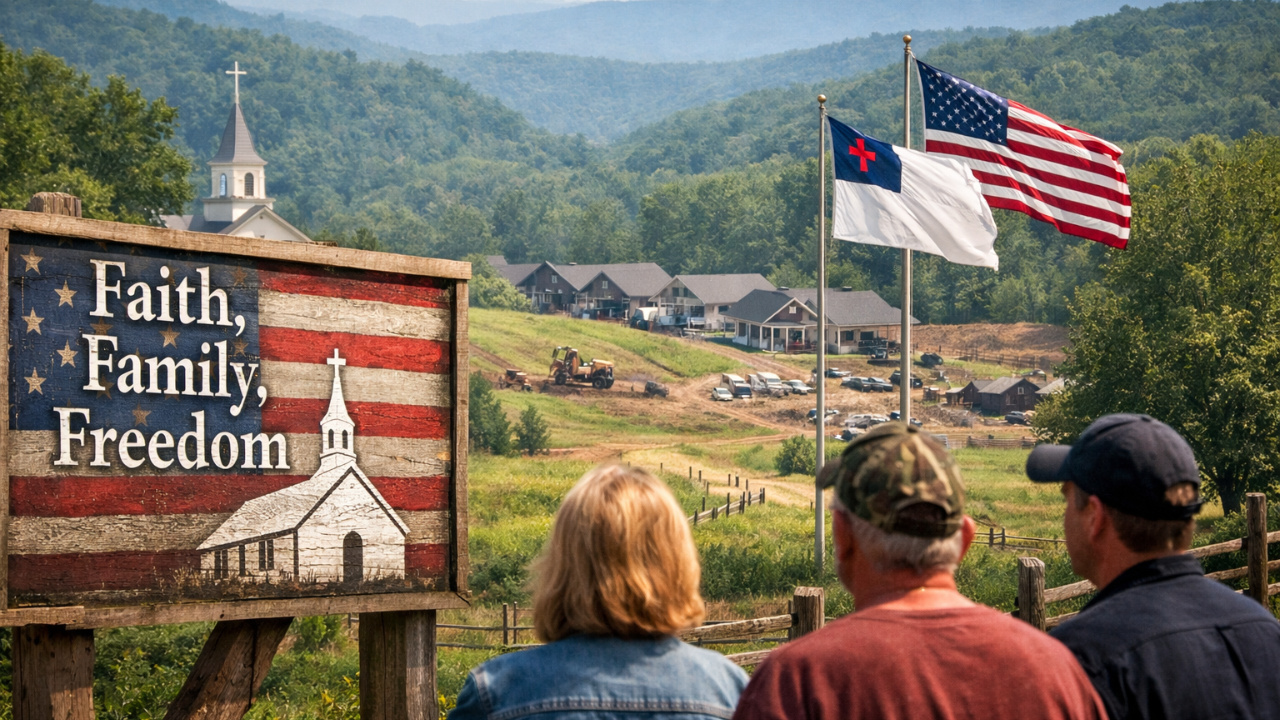
Ideological Urbanization Associated With The Far Right Transforms Small American Towns And Intensifies Regional Political Disputes.
A real estate project aimed at creating religious communities aligned with Christian nationalism is sparking political and social debates in the United States.
The initiative is led by developer Josh Abbotoy, founder of Ridgerunner, and began to gain national visibility in late 2024, after local reports revealed the ideological profile of some buyers.
The project is being developed in Jackson County, Tennessee, with planned expansion into Kentucky.
-
Spain challenges the USA and closes its airspace for operations against Iran, raising global tension and provoking the threat of a trade rupture.

-
While no other country manufactures tanks in Latin America, Argentina activates the TAM 2C-A2 and raises a curiosity about the technological lag in the region.

-
A Russian ship with 730,000 barrels of oil has just arrived in Cuba while Mexico negotiates fuel sales through private companies: the communist island is desperately seeking alternatives after losing its supply from Venezuela due to American military action.

-
Iranian drones and missiles destroyed a 270 million dollar American spy plane in Saudi Arabia, splitting the E-3 Sentry aircraft in half and injuring 12 military personnel in an attack that exposes the vulnerability of U.S. bases in the Persian Gulf.


The proposal combines housing, agriculture, and church in the same space, with the aim of bringing together residents who share conservative values — which, according to critics, represents a model of ideological urbanization with political impacts on the rural American landscape.
Religious Communities Planned Around Conservative Values
The project envisions the construction of dozens of residential lots distributed among hills and agricultural areas in the Appalachian Mountains.
At the center of the community, the church is regarded as the main structural axis.
Abbotoy defines the model as an “affinity-based community.”
The focus is not only on rural lifestyle but on the convergence of political and religious values.
“Faith, family, and freedom,” he states. “These are the values we aim to exalt.”
According to the developer, demand has been significant, with about half of the lots already contracted.
The expectation is that the first families will move in by early 2027.
Christian Nationalism And Internal Ideological Migration
A large portion of the buyers comes from traditionally Democratic states, such as California and New York.
The migration to conservative regions reflects a demographic reorganization motivated by ideology.
Experts believe this movement strengthens homogeneous political enclaves, increasing the influence of the far right in specific territories.
“People want to live in communities where they feel they share important values with their neighbors,” Abbotoy states.
However, he rejects the label of Christian nationalist and classifies the criticism as exaggerated.
Podcasters Expand The Political Reach Of The Project
National repercussions increased following the move of Andrew Isker and C. Jay Engel to Gainesboro.
Both are clients of the development and hosts of the podcast Contra Mundum.
From the studio set up in the Ridgerunner office, they encourage followers to migrate to small towns and seek local political influence.
“If we could create places where political power could be exercised, what that could mean is being part of the county commissioner board or even having influence over the county commissioners and the sheriff… achieving that is extremely valuable,” Isker declared.
Engel has also popularized the concept of “Americans for Legacy,” associated with descendants of Anglo-Protestant colonizers.
Controversial Statements Spark Reaction
The positions defended by the podcasters alarmed residents.
Among them are criticisms of women’s suffrage, civil rights, and proposals for mass deportations — including of legal immigrants.
In one of his statements, Engel claimed that “groups like Native Americans, Southeast Asians, Ecuadorians, and African immigrants are the least capable of integrating and should be sent home immediately.”
They have also declared: “Repeal the 20th century.”
Although they deny being white nationalists, their statements have been associated with agendas of the far right.
Local Resistance Tries To Halt Ideological Advance
Thus, the backlash mobilized part of the approximately 900 inhabitants of Gainesboro.
Informal resistance groups began to organize.
“I believe they are trying to label our town and our county as the headquarters of their Christian nationalist ideology,” says businesswoman Diana Mandli.
She then led protests and displayed a public message:
“If you are a person or group that promotes the inferiority or oppression of others, please eat elsewhere.”
Residents have also confronted representatives of the project in local establishments.
Fear About Political Influence
Nan Coons, whose family has lived in the area since the 18th century, expresses concern over institutional proposals advocated by newcomers.
“He explained to me that they promote what he calls ‘family voting’… one vote per family and, of course, it would be the husband of the family who would vote.”
Despite Engel stating later that he does not consider women’s voting wrong, he continues to support the family model.
“You don’t know who these people are, nor what they are capable of… And that is scary,” Coons remarked.
What Is Christian Nationalism?
Christian nationalism has no single definition.
In more radical branches, it advocates that the state be governed by a supreme religious authority.
Theorists like Stephen Wolfe speak of a “Christian prince,” responsible for politically and spiritually guiding society.
Less extreme versions advocate for laws based on Christian morals, greater participation of religious leaders in politics, or formal recognition of the Christian roots of the U.S.
According to analysts, this conceptual breadth has facilitated its insertion into the dominant public debate.
Ideological Urbanization On The Rise
The case of Gainesboro reflects a broader phenomenon. Projects of ideological urbanization have emerged as a strategy for sociopolitical organization.
Thus, Abbotoy, a Harvard Law graduate, is also involved in conservative initiatives like the New Founding fund and the American Reformer portal.
On the other side, opponents receive support from the organization States at the Core, focused on combating authoritarianism in small communities.
“No one paid me to say anything,” Coons responds.
Political Dispute In Rural America
The local clash occurs in parallel with growing electoral polarization in the rural United States.
In 2024, Donald Trump expanded his lead in these territories, reaching 69% of the votes.
In light of this, Democrats announced multi-million dollar investments to win back rural voters.
“Undoubtedly, there is renewed interest from the Democratic Party in involving rural people,” Abbotoy states.
Still, residents opposed to the project promise ongoing resistance.
“If we want to change this trend, we have to start with your street, your neighborhood, your small town,” says Coons. “I need to stand for something, and this is what I stand for.”
See more at: U.S.: The Rural Communities Being Built For Christian Nationalists – BBC News Brasil









Seja o primeiro a reagir!