





 Portuguese
  English
  Spanish
  3 min of reading
  2 comments




Screw Propulsion, With Its Innovative Engine, Revolutionizes Mobility in Challenging Terrain, Proving That Nothing Can Stop It.
In the 1970s, a team of cosmonauts landed in Siberia and awaited a conventional rescue. To their surprise, the rescue came in a vehicle with two gigantic screws, as if it had come out of a post-apocalyptic movie. This is the magic of screw propulsion.
The idea of using screws for mobility is not new. In the late 19th century, Jacob Morath developed an agricultural machine in the U.S. that used screws to move. Over the decades, various versions were created, ranging from steam locomotives to tractors designed to drive in snow. But it was in the Soviet Union that screw propulsion found its true home.
The Amazing Story of Screw Propulsion
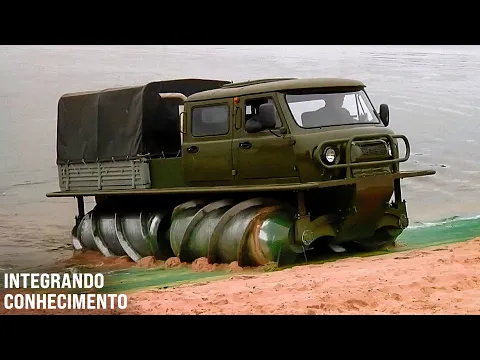

In the 1960s, the company Sasil developed the first Soviet vehicles with screw propulsion. The most impressive model, the ZIL 4904, was an 8.27-meter monster that could carry over 9 tons. It could navigate easily through snow and mud, but was difficult to transport on regular roads.
-
OMODA & JAECOO grows in Europe in 2026 with an integrated strategy of sales, innovation, local production, and technological advancement in the United Kingdom, Italy, and Spain.

-
OMODA & JAECOO expands after-sales service in Brazil with competitive maintenance, a 7-year warranty, and high availability of parts for technological SUVs.

-
OMODA & JAECOO appoints Alessandra Souza as executive marketing director in Brazil and accelerates brand expansion with a focus on innovation, networking, and hybrid portfolio.

-
Jaecoo 7 with super hybrid SHS system exceeds 1,200 km of combined range with a 1.5 turbo engine, high-density battery, and intelligent energy management.


To solve this, the ZIL 2906 was introduced in 1975. Smaller and more agile, it was used for years to rescue cosmonauts and their Soyuz capsules in the relentless Siberia. Imagine returning from space and being rescued by such a futuristic vehicle!
The Engine of Screw Propulsion
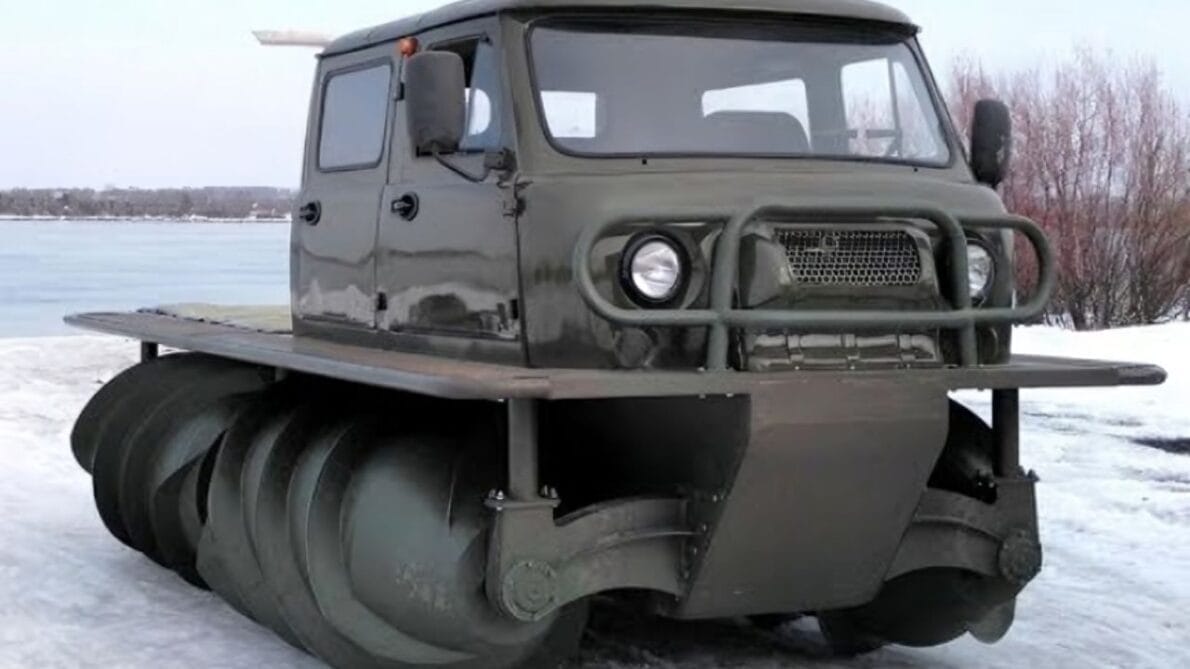
The heart of these vehicles is the engine that drives the helical drums. In Soviet models, such as the ZIL 29061, two engines were installed to improve performance. These engines are essential for converting power into rotational movement, which is then transformed into mobility by the drums.
The engines typically have significant power, with more modern models using diesel engines ranging from 120 to 137 horsepower. This type of engine is robust and capable of generating the torque needed to move the heavy helical drums through challenging terrains like snow, mud, and even water.
The efficiency of the engine on different terrains is remarkable. On soft soils, the vehicle can reach speeds of up to 45 km/h, while on water it can reach 16 km/h. This versatility is what makes screw propulsion so special, allowing it to traverse areas where conventional vehicles would fail.
The Future of Screw Propulsion
Although they are not common, these vehicles are irreplaceable in marshy and snowy terrains. Russia continues to produce modern versions, such as the CVM 2901, which is used in oil and gas operations in Siberia and has a powerful engine that makes it ideal for extreme conditions.
Screw propulsion is an engineering marvel that proves that, in challenging terrains, nothing can stop it. From rescuing cosmonauts to industrial applications, these vehicles demonstrate that innovation can overcome any obstacle. So, what did you think of this revolutionary technology?










Sensacional, seria ideal para utilizar contra incêndios no Pantanal!
Sempre bom ter alternativas em situações de catastrofes