





 Portuguese
  English
  Spanish
  5 min of reading
  0 comments


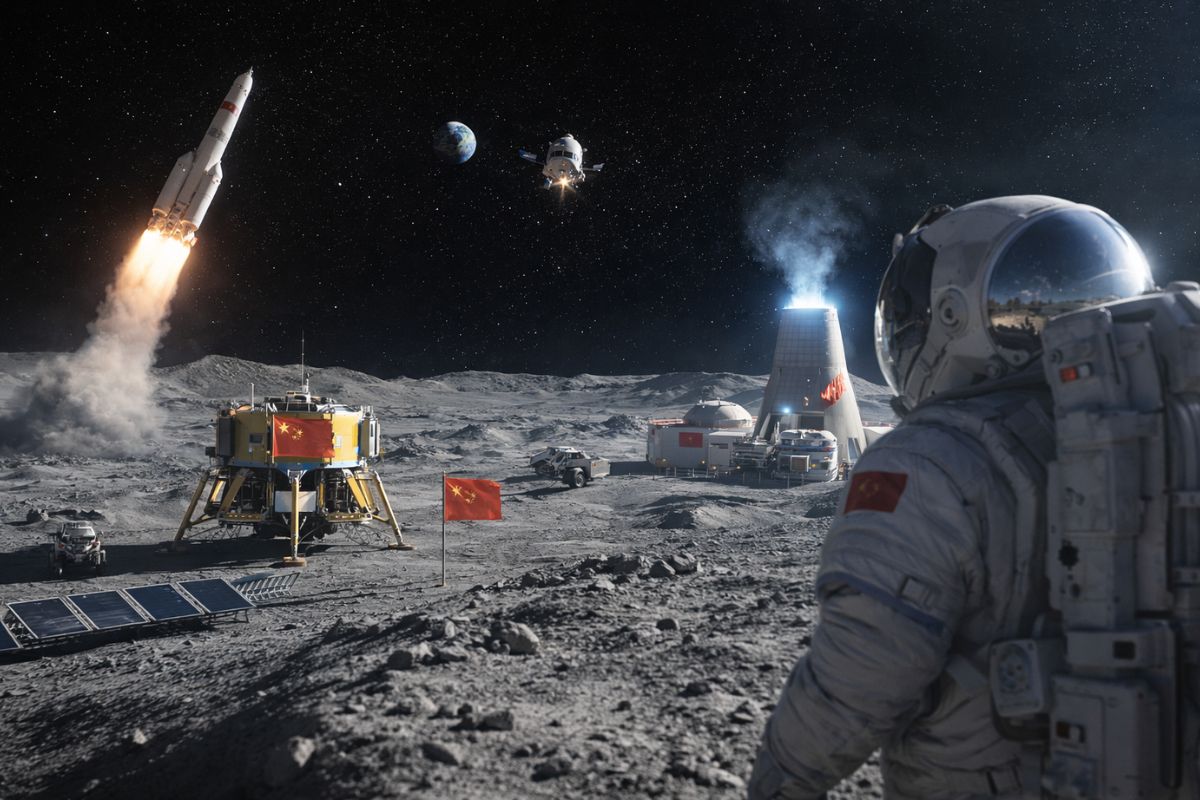
NASA acknowledges that China could surpass the United States in the space race to reach the Moon and build a nuclear energy base at the lunar south pole, with Administrator Jared Isaacman admitting that a single delay in the American schedule could hand leadership to its rival.
There is a new space race happening right now and, for the first time in decades, the United States publicly admits that it may not win. The NASA Administrator, Jared Isaacman, stated that China could surpass Americans in the race to land on the Moon and establish a permanent presence at the lunar south pole. This statement is not a rhetorical exercise. According to Isaacman, the difference between success and failure in this space race will be measured in months, not years. And the recent history of the Artemis program suggests that the United States may be falling behind.
The urgency is justified. The nation that reaches the lunar south pole first will have significant influence in defining the rules of exploration and access to lunar resources, especially if the existence of usable water is confirmed. Both the United States and China believe that there is water ice at the south pole, a resource that could provide drinking water and oxygen for crews, as well as hydrogen and oxygen for rocket fuel production intended for deep space travel. The 2026 space race is not about flags and prestige. It is about who controls the next outpost of humanity beyond Earth.
China’s advantage in the space race that worries NASA

China has something that the United States does not yet possess: a ready lunar lander. The Chinese space program has developed a vehicle called Lanyue, which loosely translates to “Embrace the Moon,” specifically designed to land astronauts on the lunar surface.
-
Ford’s CEO calls China an existential threat while Stellantis, Mercedes, and Volkswagen rush to adopt Chinese technology in their own cars, and what is happening now could determine who survives in the future of the global automotive industry.
-
While NASA resumes its path to the Moon, Elon Musk pushes SpaceX for a new leap towards Mars, millions of satellites, and a trillion-dollar scale, and Brazil emerges along the way as a billion-dollar market, regulatory pressure, and a space trump card with Alcântara.
-
Super El Niño gains strength in new forecasts and could cause droughts, floods, and extreme global heat, making 2027 the hottest year in history.
-
An invisible phenomenon in Antarctica on a continental scale reveals a direct impact on the polar climate by showing that penguin droppings release ammonia, form bright clouds, and raise an unexpected scientific curiosity about the balance of the icy atmosphere.

The United States, on the other hand, relies on SpaceX’s Starship and Blue Origin’s lander, neither of which is operational at the moment.
SpaceX claims that the Starship will not be ready before October 2028, while Blue Origin projects its landing modules for early 2029. China’s goal is to reach the Moon by 2030, and with a lander already in advanced development, the Chinese program has fewer critical steps to fulfill. Isaacman acknowledged this difference directly:
“We are facing a true geopolitical rival, challenging American leadership in the race for strategic positioning in space.” In the current space race, having the hardware ready may be more important than having the highest budget.
The Artemis program and the delays that put the U.S. at a disadvantage in the space race

The NASA plan is to land American astronauts on the Moon before the end of President Trump’s term in January 2029, through the Artemis program.
The Artemis 2 mission, which is currently taking a crew around the Moon without landing, is the next step in the schedule and represents the first crewed flight of the program. After that, Artemis 3 will attempt an actual landing on the lunar surface.
The problem is that Artemis has already faced multiple setbacks and budget overruns that have pushed the schedule forward repeatedly. Each delay of months brings China closer to surpassing Americans in the space race.
The difference between the two programs is structural: while the U.S. relies on a complex public-private partnership involving NASA, SpaceX, Blue Origin, and various suppliers, China operates with a centralized model where the government controls all stages. This concentration of command allows for quicker decisions and fewer contractual disputes.
What is at stake at the lunar south pole and why the space race matters
The lunar south pole is not an arbitrary destination. Scientists from both countries believe that permanently shadowed craters in this region harbor deposits of water ice, a resource that would transform the Moon from a destination for short visits into a permanent operational base.
Water on the Moon means oxygen to breathe, water to drink, and, when decomposed into hydrogen and oxygen, fuel for rockets that would travel to Mars and beyond.
Whoever establishes the first base at the south pole will have a strategic advantage in defining how these resources will be exploited. The 2026 space race has implications that go beyond science: it involves geopolitics, access to resources, and the ability to project power beyond Earth.
China’s plan includes building a nuclear power base that would provide constant electricity for lunar operations. NASA plans something similar, but first needs to resolve landing challenges before thinking about permanent infrastructure.
What comes after landing on the Moon in the space race between the U.S. and China
The space race does not end with the first landing. NASA stated that after returning astronauts to the Moon, it will launch missions every six months to maintain a continuous presence and build a permanent lunar base.
The United States estimates that it will take seven years after the first landing to complete this base. Missions to Mars, Jupiter, and beyond are part of the long-term vision, with the Moon serving as a staging ground and refueling station.
China has equally ambitious plans. The Lunar Research International Station, as the Chinese program is called, envisions the collaborative construction of a base at the south pole with capabilities for scientific research and resource exploration.
The current space race is, in fact, a race to define who will control the infrastructure that will allow humanity to expand its presence in the solar system. And at this moment, with NASA admitting it may fall behind, the outcome is far from decided.
What do you think about the new space race between the United States and China? Do you believe NASA will reach the Moon before 2030 or that China will take the lead? Leave your comments. The competition for space is more intense than at any time since the Cold War, and this time what is at stake goes far beyond a flag planted on the lunar surface.






Seja o primeiro a reagir!