





 Portuguese
  English
  Spanish
  3 min of reading
  0 comments


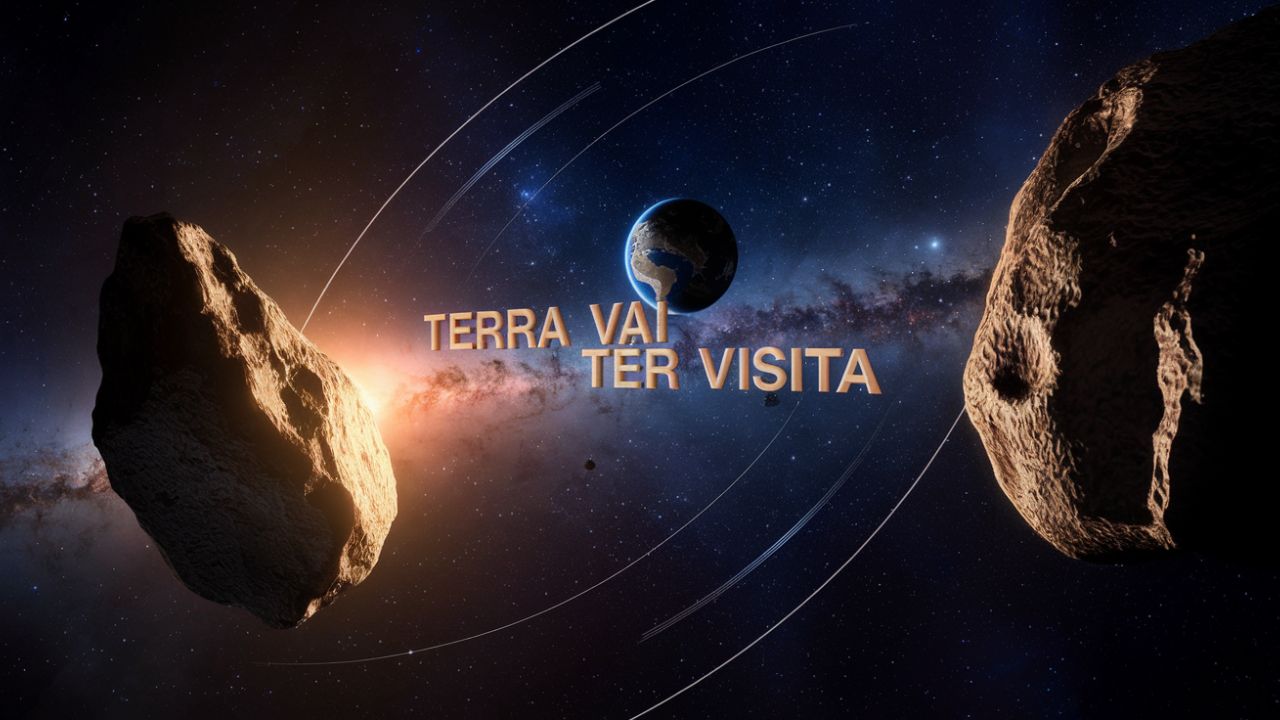
Celestial Bodies 2924 YF7 and 2024 YR9 Will Pass More Than 3 Million Kilometers Away in a Rare Event That Will Be Monitored by NASA to Deepen Studies on the Solar System.
Two giant celestial objects passing “close” to Earth in a matter of days? That is the reality recently announced by NASA. The asteroids 2924 YF7 and 2024 YR9 will pass by our planet in the first week of 2025. But don’t worry! Before you start imagining apocalyptic movie scenes, scientists assure us: there is no danger to us. These events, contrary to what many think, are a valuable opportunity for us to learn more about the universe.
The Arrival of 2924 YF7 and 2024 YR9
These asteroids may seem threatening due to their size and proximity, but they will be at a safe distance of about 3,347,435 kilometers from Earth. For comparison, this is almost nine times the distance between Earth and the Moon! The asteroid 2924 YF7 will pass closest on January 2, while 2024 YR9 will reach its peak approach the following day.
In astronomy, “safe distance” is a relative term. It may sound alarming to hear that something is millions of kilometers away from us, but in cosmic terms, that is practically a “walk in the backyard.” That is why scientists track these trajectories with millimeter precision, ensuring our safety.
-
Expedition 501: Scientists drill into the ocean floor and discover a giant reserve of fresh water hidden beneath the sea, extracting nearly 50,000 liters and revealing an invisible system that could reshape the map of water scarcity.

-
Archaeologists find an intact tomb over 2,500 years old, with more than 100 preserved objects, weapons, jewelry, and human remains never touched.

-
Volcanic lava transforms into threads as fine as human hair that travel over 30 kilometers by wind and fall like cutting rain on roofs and backyards in Hawaii and Iceland.
-
NASA issues a warning for the feared Godzilla El Niño that could change the planet’s climate in 2026 with extreme warming of the Pacific capable of causing devastating droughts in some regions and historic floods in others simultaneously.


Why Monitoring Asteroids Is Essential?

Monitoring asteroids is like keeping an eye on unexpected visitors. You never know when one of them might pose a risk. Fortunately, current technology allows for impact predictions years in advance, giving time for possible preventive measures.
These celestial bodies are time capsules, carrying information about the early solar system. Each analysis reveals details about the composition and processes that shaped the planets and other celestial objects.
The Role of NASA in Planetary Security
NASA leads the monitoring of these objects using space and ground telescopes, as well as artificial intelligence tools. This ensures that we can foresee any changes in the trajectories of asteroids in advance.
The passage of these asteroids is an opportunity to test new technologies, such as high-precision sensors and orbital simulation models. These advancements not only enhance monitoring accuracy but also help create solutions for potential future threats.
Learning Opportunities from the Passage of Asteroids
Every time an asteroid passes close to Earth, scientists take the opportunity to collect crucial data. This includes information about its composition, speed, and even possible changes caused by our gravity.
With the help of more advanced technologies and artificial intelligence, monitoring is becoming increasingly accurate. This means more safety and an ever-expanding knowledge about our place in the universe.
How Scientific Communication Helps Calm the Public
By understanding how NASA monitors and predicts these events, it becomes easier to avoid unnecessary panic. Clear and accessible information helps demystify these astronomical events.
Why not take advantage of these events to look at the sky? With amateur telescopes and even astronomy apps, you can track these asteroids and understand a little more about the mysteries of the universe.
NASA’s confirmation of the passage of asteroids 2924 YF7 and 2024 YR9 is yet another reminder of how vast and fascinating the universe is. Although there is no danger, these events are incredible opportunities to learn more about the cosmos. Science continues to advance, and each discovery brings us closer to unraveling the secrets of space.









-

-

-

6 pessoas reagiram a isso.