





 Portuguese
  English
  Spanish
  4 min of reading
  0 comments


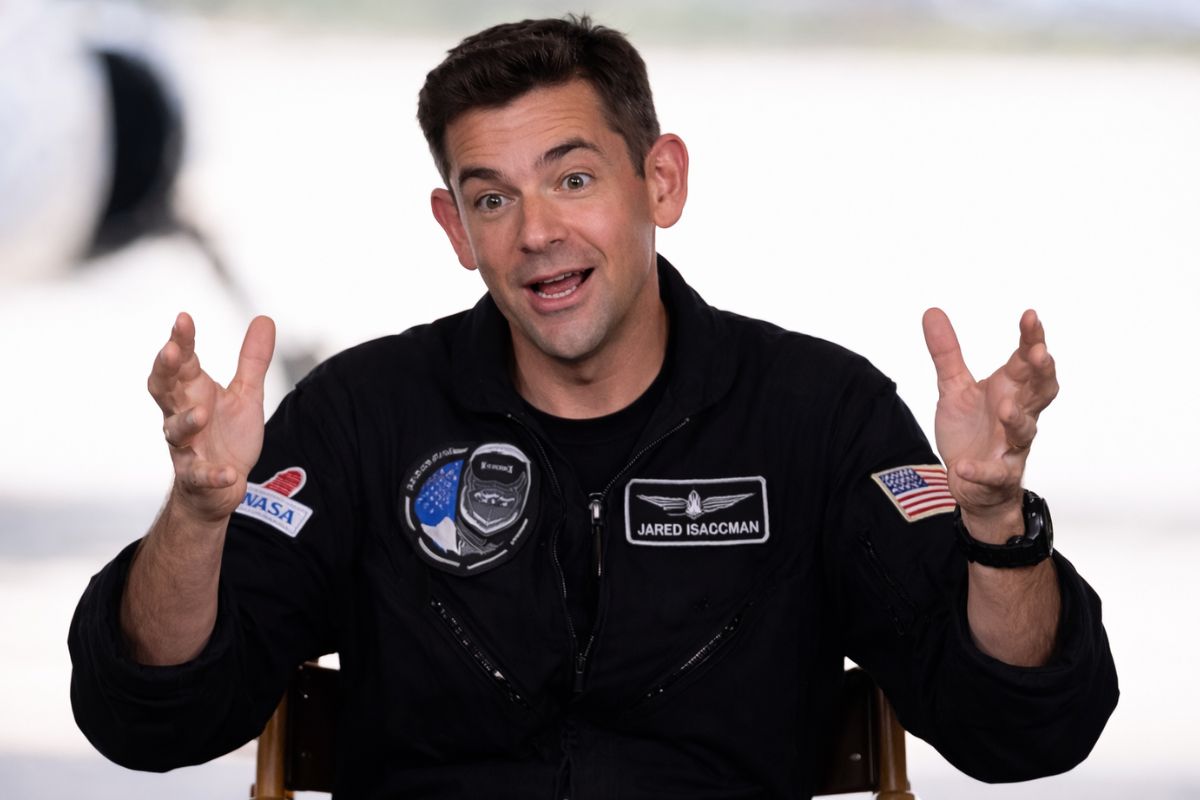
Jared Isaacman pointed out the 2 trillion known galaxies as evidence and announced that new telescopes like the Nancy Grace Roman will intensify the search for extraterrestrial life starting in 2027
The question that humanity has been asking for centuries may be closer to an answer than most people realize. In an interview with CNN this Sunday (5), NASA Administrator Jared Isaacman stated that the probability of finding evidence that we are not alone in the universe is “quite high.”
This was not a casual comment. Isaacman connected the search for alien life to the heart of everything NASA does, from scientific missions to crewed expeditions. According to him, “our job here is to go out and try to unravel the secrets of the universe, and one of those questions is: are we alone?”, as reported by the Gizmodo portal on April 6, 2026.
And he went further.
-
From the light bulb to the ENIAC: the Edison effect paved the way for diodes and triodes, amplified radio and telephony, turned into Boolean logic with relays, and created giant computers, leading to the leap towards modern silicon.

-
With more expensive oil and the risk of shortages, China is expanding the use of technology developed in Germany during World War II that transforms coal into plastics, fuels, and chemical products.

-
Toxic plant of 4 meters, banned in Spain, is already taking over gardens and parks in Thuringia, Germany: volunteers say that pulling it out is not enough, roots sprout again and seeds last for years; residents are asking for glyphosate to eradicate it.

-
Get the coat ready: after an extratropical cyclone brought storms to Brazil, an intense cold air mass is arriving in the country with lows of 0°C in the South and isolated frosts that could reach as far as the Southeast over the weekend.

Why does the NASA chief believe we are not alone?

Isaacman’s argument is straightforward and relies on numbers that challenge any skepticism. The observable universe contains about 2 trillion galaxies, each with billions of star systems. Given this scale, the idea that Earth is the only place with life seems statistically unlikely.
Isaacman made it clear that he is not speaking impulsively. He himself has been to space twice, commanding private missions in 2021 and 2024, according to Gizmodo. “I have been to space twice, I didn’t find any aliens up there. I didn’t see anything that suggests we have been visited by intelligent life forms,” he told CNN. “But when you think about it, we have 2 trillion galaxies out there, who knows how many star systems within each one.”
In other words: he hasn’t seen anything, but the numbers speak for themselves.
What does the search for extraterrestrial life have to do with Artemis?

This is the part that surprised many people. Isaacman did not treat the search for alien life as a separate project. He positioned it as an inseparable part of all NASA missions, including the Artemis program, which has just completed the crewed flight around the Moon with Artemis II.
“I would say this is inherent to each of our scientific endeavors, our exploration endeavors, even the construction of the lunar base at the south pole of the Moon,” Isaacman stated in the interview, as recorded by VIN News.
The logic is as follows: lunar missions serve as laboratories to test instruments, sample collection techniques, and surface exploration strategies. All of this will be essential for future astrobiology investigations on other bodies in the solar system, such as Mars and the icy moons of Jupiter and Saturn. Artemis is not just about the Moon. It’s about preparing humanity to search for life on other worlds.
But NASA does not intend to wait until it reaches Mars to intensify this search.
What is NASA’s next concrete step in the search for life?
In the same interview, Isaacman revealed that the agency will “incorporate telescopes that will help us continue this great search,” highlighting the Nancy Grace Roman Telescope, expected to be launched by 2027, according to Gizmodo.
The Nancy Grace Roman will be capable of observing large portions of the sky with unprecedented resolution, mapping galaxies, exoplanets, and cosmic phenomena on an unprecedented scale. For the scientific community, this telescope represents the next major tool in detecting potentially habitable worlds and analyzing exoplanet atmospheres in search of biosignatures, that is, chemical signals that may indicate the presence of life.
This instrument will complement the James Webb Telescope, which is already operational and has delivered revolutionary discoveries about the atmospheric composition of distant planets. Together, they form a technological front that can transform the search for extraterrestrial life from a philosophical question into an investigation with concrete data.
What does this change in practice?
Isaacman’s statement is significant for a reason that goes beyond the content. It is the first time that the NASA administrator, the highest position in the most important space agency in the world, publicly and explicitly connects the search for alien life to all of NASA’s operational fronts.
Until now, astrobiology was treated as a scientific arm within the agency, with its own funding and specific projects. What Isaacman did was elevate the topic to the level of institutional mission. It is no longer a department researching alone. It is the reason for everything NASA builds, launches, and explores.
The statement comes days after Artemis II completed its historic lunar flyby, breaking the record for distance from Earth (over 406 thousand kilometers), photographing the far side of the Moon, and witnessing a solar eclipse that no one on Earth could see. The moment could not be more symbolic: humanity has just proven that it can go further than ever, and the head of the agency responsible for this says that the ultimate goal is to know if there is anyone else out there.
The question “are we alone?” is as old as civilization itself. The difference is that now the one answering is not a philosopher or a science fiction writer. It is the man who controls the budget, the rockets, and the telescopes. And he thinks the chance is quite high.







Seja o primeiro a reagir!