





 Português
  Inglês
  Espanhol
  2 min de leitura
  0 comentários


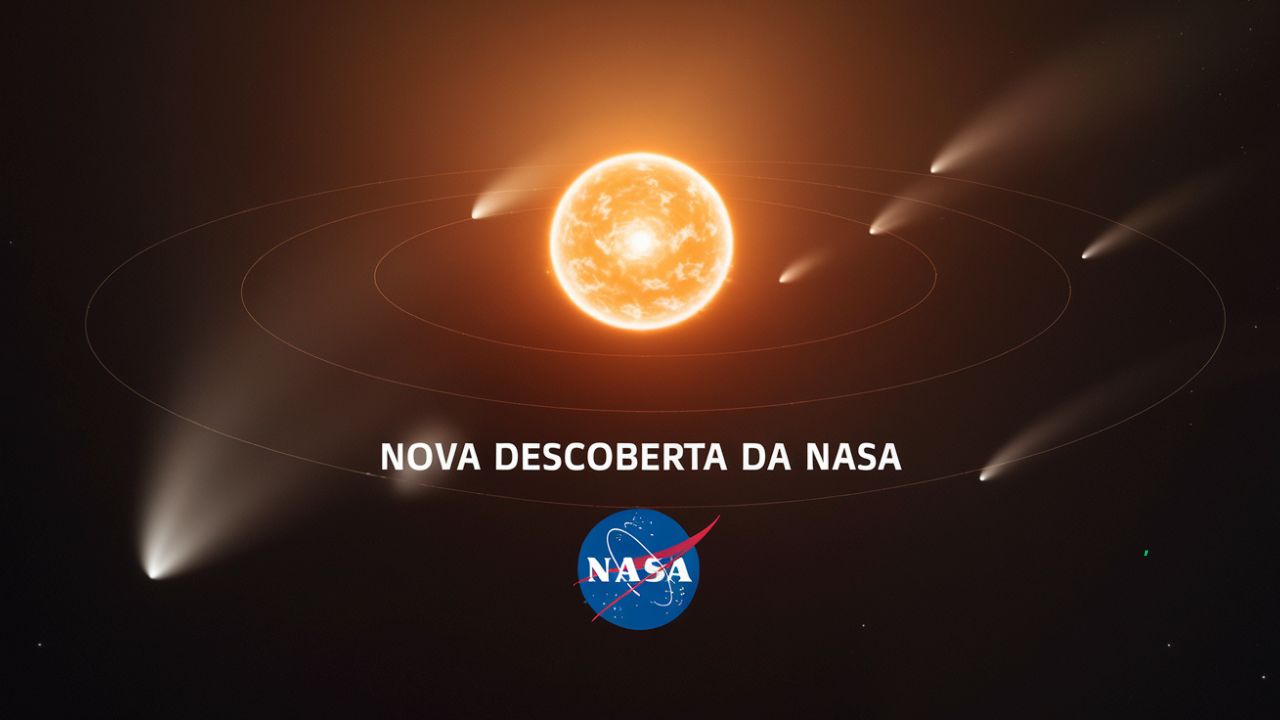
By December of this year, NASA had identified seven rare “black comets” in the Solar System. But on last Monday, the 9th, NASA announced the discovery of seven more of these intriguing celestial objects, doubling the total number to 14.
The research, conducted by postdoctoral researcher Darryl Seligman from Michigan State University and published in the Proceedings of the National Academy of Sciences, reveals that these “black comets” have unique behaviors. According to NASA scientists, the movement of these celestial bodies is driven by volatile materials that evaporate from their surfaces, maintaining an asteroid-like appearance.
What Are ‘Black Comets’ Discovered by NASA?
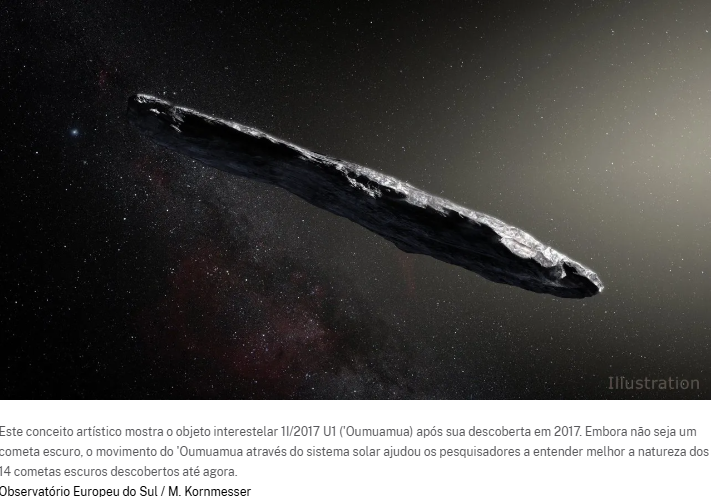
Despite the name, “black comets” have no relation to black holes. They are objects that combine characteristics of asteroids and comets: visually similar to asteroids but with the rapid movement typical of comets. The first discovery of these objects occurred in 2016, with the asteroid 2003RM, which exhibited a disturbed orbit like that of a comet, without showing a visible tail.
Two Types of “Black Comets”
NASA has identified two categories of black comets within the Solar System:
-
A traffic police robot has started operating at a school, technology from Omoda & Jaecoo expands the use of artificial intelligence in smart cities.

-
44 minutes on the cosmic scale: mysterious object in the Milky Way emits simultaneous radio and X-ray signals and raises an intriguing question about what is really happening in deep space.
-
Omoda & Jaecoo and AiMOGA Robotics advance in industrial artificial intelligence with a strategic debut in Thailand and a focus on advanced automation.

-
In a scenario of rising fuel prices, Omoda & Jaecoo enhance value for consumers with a range of up to 1,200 km, energy efficiency, and a new concept of worry-free mobility.


External Black Comets: These are larger, measuring hundreds of meters in diameter, and have elliptical orbits, similar to those of Jupiter family comets.
Internal Black Comets: Located in the inner part of the Solar System, they have nearly circular orbits and are smaller, usually measuring only tens of meters in diameter.
These classifications help NASA better understand the origin of these objects and their role in the evolution of the Solar System. There are indications that these comets may have provided essential materials for the formation of life on Earth.
New Questions for Astronomy
The discovery of the new “black comets” raises several questions for NASA scientists. How did these objects form? What causes the anomalous acceleration in their orbits? Is there the presence of ice in these comets, which could indicate a mechanism for transporting materials through the Solar System?
Darryl Seligman emphasizes that understanding these celestial bodies may be crucial for deciphering how fundamental elements for life arrived on Earth. With the new discoveries, NASA opens doors for deeper studies on the origin and evolution not only of our planet but also of the entire Solar System.
NASA’s recent discoveries promise to revolutionize our understanding of the mysteries of the Solar System, bringing to light new knowledge about the celestial bodies that share our space.








-

-

2 pessoas reagiram a isso.