Portuguese
  Spanish


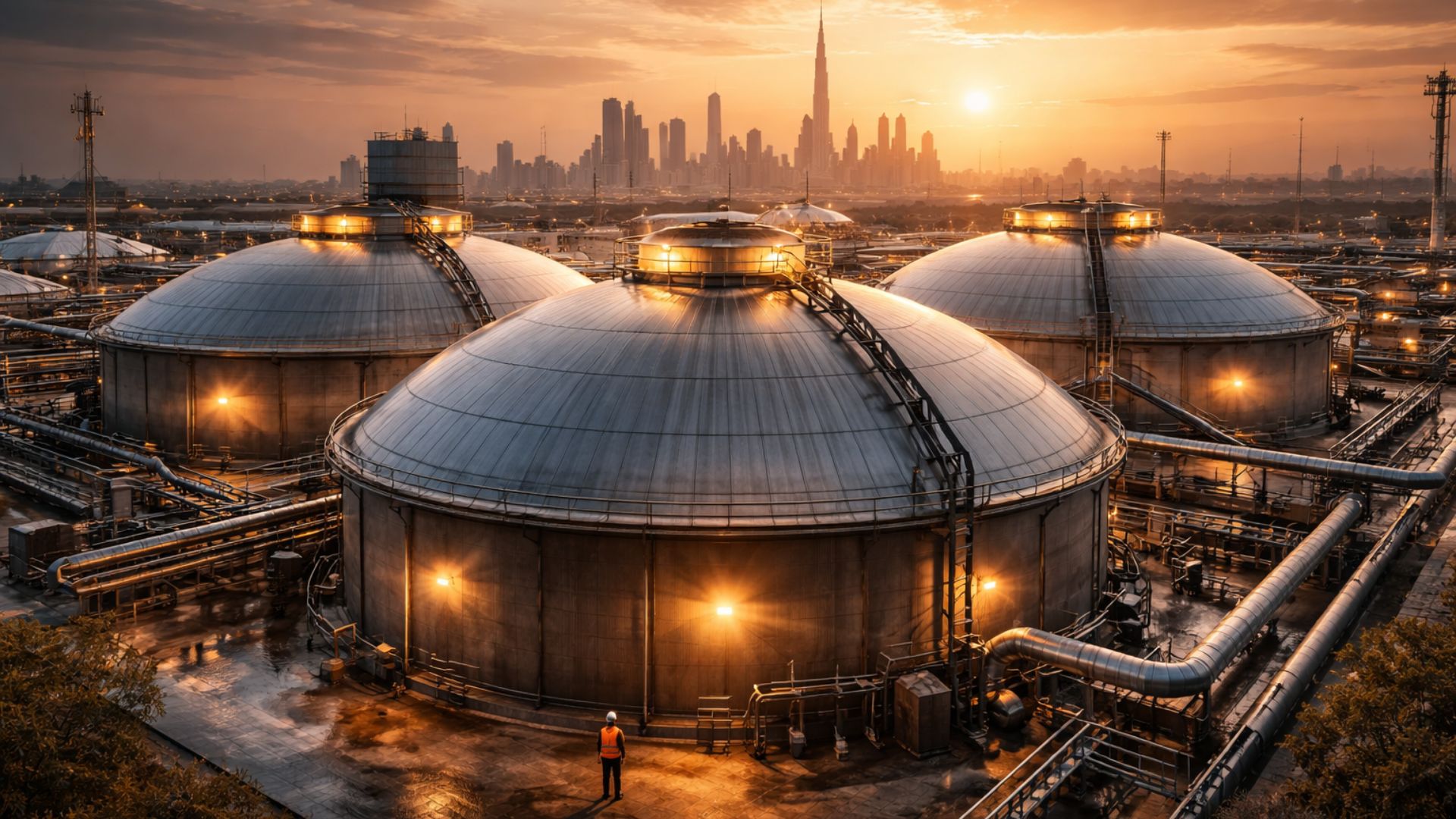

Invisible infrastructure transforms sewage into clean energy and reduces operational costs while expanding large-scale water reuse in the city, integrating sanitation, sustainability, and electricity generation in a single highly automated urban system.
Dubai has started using part of the treated sewage at the Warsan station to produce energy within the unit itself.
Transforming a continuous urban waste into an operational input.
Official data released by the Dubai Municipality and reproduced by the state agency WAM indicate a production of 57,000 m³ of biogas per day, with an annual generation of 44,250 MWh, enough to cover 50% of the plant’s electricity demand.
-
Bruno Guimarães, 28, Misses Crucial Penalty Against Norway in World Cup After Replacing Vinicius Jr.

-
Inspired by a school lesson on Africa’s water crisis, a young boy raised money through chores to fund a well that transformed a Ugandan community.

-
Brazilian Construction Worker Moves to France, Earns Up to €2,500 Monthly with Home Renovations, Gains Social Media Attention

-
US Navy Sinks USS Oriskany with 230 kg of C-4, Creating World’s Largest Artificial Reef in 37 Minutes




The initiative brings together sanitation, electricity generation, and waste recovery in a single public structure.
Without relying solely on external supply to maintain the station’s routine.
According to the municipal administration, the project is also expected to reduce about 31,000 tons of carbon emissions per year.
In addition to cutting operational costs by AED 320 million over 25 years.
How sewage turns into energy in Warsan
The scale of the operation helps explain the project’s significance in Dubai’s urban system. Warsan is part of a sewage network with over 3 million meters of connections.

It also has 56 rainwater pumping stations, 110 substations, and 13 main stations.
While the treatment unit has a daily capacity of up to 325,000 m³. After the conventional treatment stages, the sludge goes to anaerobic digestion.
A process used by the municipality to generate biogas from the organic matter removed from sewage.
Then, about 54,800 m³ per day of this volume feeds electricity production.
With an average of 121 MWh daily.
And permanent monitoring by more than 350 automated tools installed at the plant.
With this arrangement, the station stops acting solely as a technical destination for wastewater. And starts to operate as part of an internal energy recovery chain.
The Dubai Municipality itself presents the complex as a circular economy asset.
Where the treated waste returns to the system in the form of electricity necessary to sustain a significant part of the infrastructure that processes it.
Water reuse and biogas integrated in Dubai
The energy generation in Warsan connects to a broader strategy of resource reuse in the emirate.
In an official balance published by the Dubai Media Office, the municipality reported that Dubai achieved a rate of 90% of treated water reuse.
And began to employ this volume in irrigation, central cooling, fire fighting, and internal operations.
In the case of non-potable urban supply, the city maintains a network of about 2,400 kilometers.
To distribute reused water to a large part of the territory.
The average reported by the municipal administration is approximately 22 million m³ per month allocated for irrigation.

Which reduces dependence on desalinated water and underground reserves.
This context helps to understand why Warsan gained relevance beyond the sanitation sector.
The plant began to concentrate, in the same operation, the treatment of effluents. The recovery of water for non-potable uses. And the generation of renewable energy from sludge.
In addition to irrigation, the recovered water is also directed to central cooling stations.
Artificial lakes, operational washings, and fire fighting. Within a logic of continuous reuse.
In 2022 alone, more than 6 million m³ were used in central cooling systems.
With savings of about 47%, equivalent to AED 7.1 million. The anaerobic digestion adopted in the treatment plants also serves another important role.
By reducing emissions associated with methane released by organic sludge. Part of the biogas can still be used for heating tanks.
And in drying the sludge, which is then converted into thermally treated organic fertilizer.
Expansion of sanitation and reuse in Dubai
The advancement of Warsan accompanies the expansion of the emirate’s reuse system over the last few decades.
Dubai began its water recovery journey in the late 1960s. It inaugurated the Warsan plant in 1981. Expanded the unit to 325,000 m³ per day in 2015.
And consolidated a treatment park that also includes the Jebel Ali station.
With a capacity of 675,000 m³ daily. The effects of this policy appear on an accumulated scale.
According to the municipality, the emirate produced more than 4.5 billion m³ of reused water between 1980 and 2022.
A movement that generated an estimated annual savings of AED 2 billion. By containing the consumption of desalinated and underground water.
In a region where water security has permanent strategic weight. In this scenario, Warsan has come to symbolize a less visible infrastructure.
But crucial for the daily functioning of the city. The station shows, on an industrial scale.
How sewage, sludge, biogas, treated water, and electricity can integrate into a single public operation. While still fulfilling the central function of sanitation.