





 Portuguese
  English
  Spanish
  6 min of reading
  0 comments


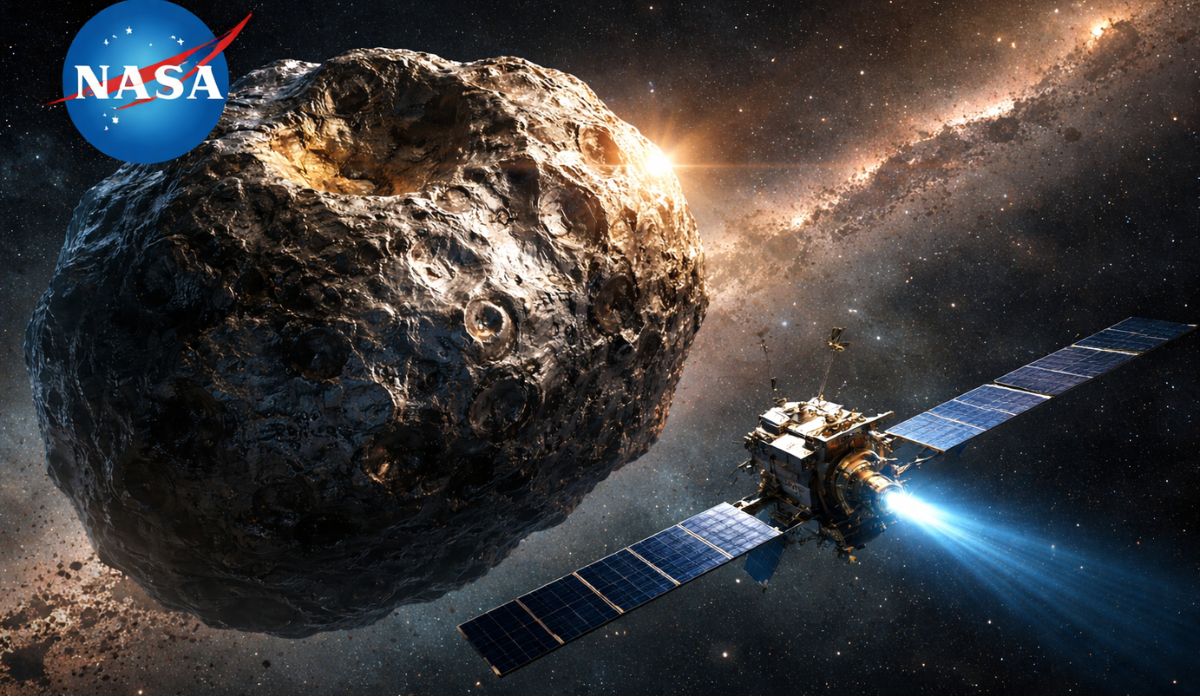
NASA mission targets a rare metallic asteroid and gathers attention for its scientific potential, the billion-dollar cost of the journey, and speculative estimates about its composition, on a path that could expand understanding of the formation of rocky planets.
Psyche mission and NASA’s interest
The Psyche mission, from NASA, was launched on October 13, 2023, with an approximate budget of US$ 1.2 billion and is destined for the asteroid 16 Psyche, located in the main belt between Mars and Jupiter.
The agency’s stated goal is to study a celestial body with unusual characteristics, rich in metallic material, to obtain data about the formation of rocky planets in the early Solar System.
The scientific interest in the asteroid arises from the fact that it is one of the most unusual targets ever visited by a mission of this type.
-
Tons of ash from the highest and most active volcano in Europe, which once covered crops and worried farmers, are now being used as natural fertilizer in Sicily, increasing productivity, improving soil quality, and reducing costs, in a transformation that draws the attention of experts in sustainable agriculture.

-
Scientists discover in Alaska a 350,000-year-old ice block that has survived multiple periods of global warming and is now melting so quickly that it may disappear before revealing all its secrets.

-
While Starlink supports SpaceX’s trillion-dollar scale, Elon Musk encounters issues in Namibia due to local control regulations, digital sovereignty, and denied licenses, and the orbital internet race faces political limits outside the United States.

-
The USA accelerates tests on the A-10 with an adapter that allows refueling from multiple tanks, installed in a few hours, increasing compatibility with up to 5 aircraft, reducing dependence on the KC-135, and creating strategic space for Embraer’s KC-390.

According to NASA, 16 Psyche is about 280 kilometers at its widest point and is the first asteroid with a predominance of metal to be studied closely by a dedicated probe.
What is known about the composition of 16 Psyche
For years, part of the scientific community worked with the hypothesis that the object could be the exposed core of a planetesimal destroyed by collisions that occurred billions of years ago.
Today, the interpretation adopted by NASA itself is more cautious.
The agency reports that the asteroid may preserve traces of a metallic interior, but it may also represent another type of iron-rich body formed in the early stages of the Solar System.
This distinction is relevant because it alters the way 16 Psyche has been described in outreach texts.
Instead of a block composed almost entirely of metal, official estimates indicate a mix of rock and metal.
According to NASA, the metallic fraction may vary between 30% and 60% of the volume, which moves away from the simplified reading of a homogeneous and entirely metallic body.
Studies associated with the mission also indicate that the surface of the asteroid may be more irregular and diverse than popular descriptions suggested.
Researchers are evaluating, for example, the possibility that the body exhibits significant porosity, which contradicts frequent comparisons with a compact and uniform mass of metal.

When the probe arrives at the asteroid
According to the schedule released by the mission, the spacecraft is expected to perform a flyby of Mars in May 2026 to gain speed and correct its trajectory.
The arrival at 16 Psyche is scheduled for the end of July 2029, with the start of scientific operations in August 2029.
The main observation phase is expected to last about 26 months, in successively lower orbits.
As it approaches the target, the probe will map the topography, gravity, and chemical composition of the surface.
It will also investigate the presence of signs indicating a possible remnant magnetic field.
This data is considered relevant because it may help scientists test models about planetary differentiation, a process in which denser materials migrate to the interior of rocky bodies in formation.
Mission instruments and expected data
To this end, the mission carries a set of instruments aimed at the physical and chemical analysis of the asteroid.
The magnetometer will be used to detect possible traces of magnetization.
The gamma-ray and neutron spectrometer will identify elements present on the surface.
The multispectral imager will record the topography and distinguish different materials, including metallic and silicate regions.
Combined, these instruments should allow for a more precise reading of the structure of 16 Psyche.
From these measurements, researchers intend to verify whether the object is related to the interior of a larger body destroyed in the past or if its origin is different from the most widely spread hypothesis to date.


Estimated value of the asteroid and speculation about metals
The economic dimension of the asteroid, in turn, often appears in hypothetical estimates reproduced in reports and publications on social media.
The figure of US$ 10 quadrillion is frequently cited based on projections about the value of metals that could be present in the celestial body, in estimates that describe it as more valuable than all the wealth produced by humanity on the surface of the Earth.
This number, however, does not correspond to an official assessment from NASA nor does it represent a consolidated scientific data about the composition of the asteroid.
At the launch of the mission, the agency and researchers linked to the project emphasized the scientific nature of the journey.
In interviews published during the coverage of the mission, Lindy Elkins-Tanton, principal investigator of the Psyche project, stated that if it were possible to bring this material to Earth, the supply would be so large that the metals market would be flooded and the value currently attributed to the asteroid would lose economic sense.
This statement aligns with NASA’s official position, which presents the mission as a scientific investigation, not as a project aimed at the commercial viability of space mining.
Furthermore, the economic exploitation of such a resource remains outside the practical horizon.
The exact composition of the asteroid is only expected to be closely measured when the probe enters orbit in 2029.

Even in a hypothetical extraction scenario, the operation would require technology, operational costs, and international regulations that do not yet exist on a commercial scale.
The proposal is not to measure the commercial viability of mineral exploration, but to understand the nature of the object and what it can reveal about the formation of the first bodies in the Solar System.
As the exact composition of 16 Psyche has not yet been directly determined, broad financial projections remain in the realm of hypotheses.
The immediate association between the asteroid and a potential space mining race also finds no support in the central information of the mission.
Even in theoretical scenarios, experts point out that extracting resources from a body located in the main belt would require technology, operational costs, and a regulatory framework that are not yet available on a commercial scale.
Embedded technology and impact for future missions
In addition to the scientific aspect, the mission has technological relevance.
The spacecraft uses solar-electric propulsion to travel a route of about 3.6 billion kilometers to its destination.
On board, it also carries the Deep Space Optical Communications experiment from NASA, created to test optical communication via laser in deep space.
This component of the mission expands the project’s interest beyond the asteroid itself.
The technology being tested could provide information for future interplanetary missions, especially in operations that require data transmission over long distances more efficiently than traditional radio systems.
Why 16 Psyche sparks scientific interest
In the scientific field, the value attributed to 16 Psyche is mainly linked to the potential for observing materials that remain directly inaccessible on Earth.
As the Earth’s core is thousands of kilometers deep, metallic bodies like this offer an important reference for research on the internal structure of rocky planets.
Therefore, the expectation surrounding the arrival of the probe in 2029 is less related to theoretical figures and more to the data that can be obtained from direct observation.
The main expected outcome is the reduction of uncertainties about the composition, origin, and evolution of the asteroid, a topic that remains open even after decades of observation by telescopes and radar.
The mission should therefore allow for a more precise description of an object that to this day is known primarily through remote estimates and partial interpretations.
When it begins to operate around 16 Psyche, the probe will be able to indicate more confidently whether the asteroid holds remnants of an ancient planetary interior or if it represents another type of remnant formed in the early stages of the Solar System.






Seja o primeiro a reagir!