





 Portuguese
  English
  Spanish
  5 min of reading
  38 comments




From Los Angeles to Iceland, Systems Already Remove Up to 50 Tons Daily from Rivers, Process More Than 45 Tons per Hour in Automated Plants, and Show That Giant Ships, Autonomous Sensors, and Direct Carbon Capture Have Gone from Promise to Operate Now, with Measurable Impact on Different Local Scales.
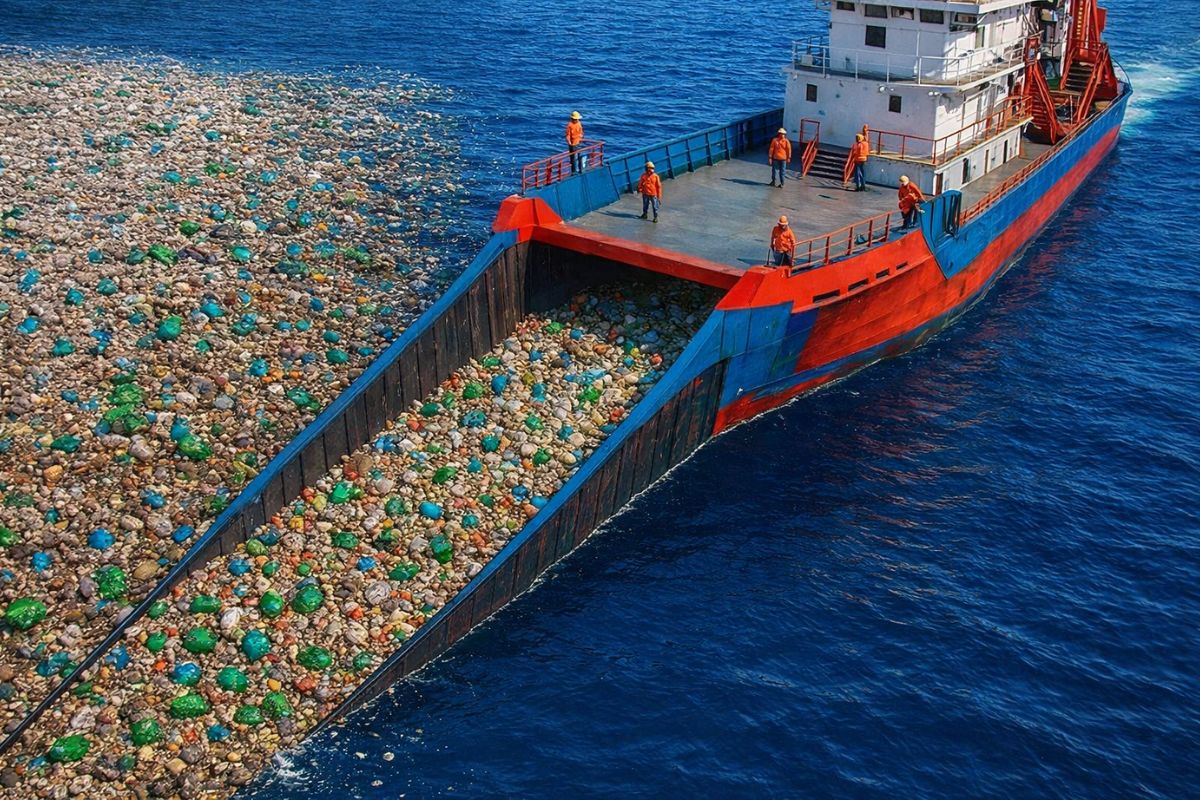
Giant ships have ceased to be a metaphor for innovation and have come to operate as active environmental infrastructure. In the North Pacific, between California and Hawaii, systems with floating barriers over 2 km and a 4-meter submerged curtain are already continuously collecting plastic, with removal routines every four to five days.
What is changing is not only the size of the machines but the logic: cleaning has become an integrated chain, from containment in rivers to robotic sorting and energy recovery. In this arrangement, giant ships, modular barriers, artificial intelligence, and carbon capture connect to reduce waste, emissions, and pressure on coastal areas.
From Open Pacific to Industrial Scale Collection

In the North Pacific, the operation of System 03 combines two boats, a “U” shaped barrier, and speed below 5 km/h to maintain collection without blocking marine wildlife escape. Plastic is concentrated in the center of the structure and moves on for separation. The area covered per hour is equivalent to more than 14,400 football fields, showing rare operational scale for ocean cleanup.
-
The village where two rivers run side by side without mixing in Santarém and Alter do Chão reveals some of the most beautiful freshwater beaches on the planet.

-
Brazil’s nuclear submarine with a speed 5 times greater than normal advances after nearly 50 years and R$ 40 billion spent.
-
A Brazilian island charges R$ 0.50 to receive visitors and prohibits any new residents.
-
Why was the Great Wall of China built? The truth that many are unaware of!



Meanwhile, the Manta catamaran broadens this model with another approach to giant ships: 70 meters long, almost 50 wide, and capable of collecting between 1 and 3 tons of waste per hour. The collection can reach up to 1 meter deep and includes auxiliary boats for mangroves and shallow rivers. Onboard, the material is sorted; part becomes recyclable bales, and the non-recyclable fraction is fed into pyrolysis, covering up to 75% of the ship’s own energy.
Rivers: Where the Problem Starts and Where the Response Accelerates

In Los Angeles, at the Ballona creek drainage channel, Interceptor 007 acts as an autonomous continuous retention machine. Floating barriers direct waste to the system’s entrance; a solar-powered conveyor lifts the material to containers, monitored by internal sensors.

During rainy periods, the capacity reaches 50 tons per day, with a reduction of up to 75% of plastic on nearby beaches, reinforcing the role of giant ships and autonomous platforms before reaching the open sea.

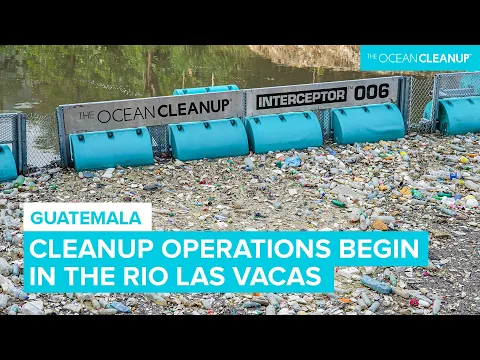
In Guatemala, Interceptor 006 was installed to contain the flow of waste descending to the Las Vacas river and heading toward the Motagua toward the Caribbean.
The design with two sequential barriers concentrates the material at a single pickup point, with an average estimate of 1.5 million kilos per year, equivalent to about 300 full trucks. Meanwhile, in Italian rivers, floating modules of the River Cleaning system divert waste via the current itself, capturing up to 85% of floating debris and over 90% of visible macroplastics, without interrupting the passage of fish.

Automated Sorting: When Waste Becomes Data, Decision, and Value
Collection only closes the cycle when there is efficient separation, and this is where industrial robots come into continuous operation. ZenRobotics systems, developed since 2007 and in commercial use since 2012, combine multispectral sensors, 3D cameras, and metal detectors to classify heterogeneous waste. The robotic arms can perform up to 4,000 selections per hour, lift objects weighing up to 30 kg, and maintain lines above 45 tons per hour.
The technical gain appears at two levels. First, recovery of valuable materials at rates of up to 98%, reducing final disposal in landfills. Second, occupational safety: automation displaces part of the manual sorting work in critical environments. This explains why the conversation about giant ships cannot be restricted to the ocean; without high-precision sorting on land, removal loses economic and environmental efficiency.
Air and Carbon: The Less Visible Front of the Same Technological Race

While giant ships clean water and coastline, another front acts on the atmosphere. In Xi’an, a purification tower over 100 meters uses greenhouses at the base to heat polluted air with solar energy, create upward flow, and filter it internally. In initial tests, the system produced more than 10 million m³ of clean air per day, affecting an area of 10 km², reducing local pollution levels from critical to moderate ranges.
In Iceland, the Climeworks Mammoth plant follows a different logic: direct CO₂ capture from the air, concentration of the gas by heating the filters with geothermal energy, and injection into basalt formations, where carbon mineralizes and turns to stone in less than two years.

The annual capacity reaches 36,000 tons of CO₂, equivalent to the annual emissions of about 8,000 vehicles. Compared to the global volume of emissions, it is still a limited step in total scale, but relevant for proving continuous industrial viability.
What Works, What Still Limits, and Why Integration Decides the Outcome
The central question has shifted from “if it works” to “under what conditions does it work best.” These solutions deliver results when there is regular operation, quick maintenance, logistics for removal, final destination, and governance between city, river, and coast. Without this, even giant ships and advanced robots become islands of efficiency surrounded by a constant flow of new waste.
There is also a structural limit: cleanup technology does not replace prevention. Reducing plastic entry into the water system, improving urban collection, and expanding recycling remain decisive levers. The difference now is that there is real infrastructure to buy time and reduce accumulated damage while upstream policies advance. The race against environmental collapse is no longer abstract; it is in daily operation.
In practice, the scenario shows that giant ships are a powerful, but not unique, piece within a larger architecture that includes rivers, sorting centers, energy, and carbon capture. The decisive factor becomes coordination between technologies that operate at different stages of the same problem.
If you had to prioritize one front for your region in the next five years, containment in rivers, robotic sorting, ocean cleaning ships, or CO₂ capture, which would you choose first and why, based on your local reality?







Keep forging ahead with love ❤️
It’s about time!! Stop the use of single use plastic!!!
Anyone can learn more about this project and donate at theoceancleanup.com
This project has been in the works for years and it has been amazing watching it become what it is today!
I have been fascinated and so heartened to read about these incredible projects to fight pollution and global warming. So hard to choose but cleaning up the oceans is probably my top choice. Huge thank yous to all the scientist and engineers working on this. I’m wondering why there isn’t more publicity for this!!
Anyone can learn more about this project and donate at theoceancleanup.com
This project has been in the works for years and it has been amazing watching it become what it is today!
Anyone can learn more about this project and donate at theoceancleanup.com
This project has been in the works for years and it has been amazing watching it become what it is today!