





 Portuguese
  English
  Spanish
  3 min of reading
  0 comments


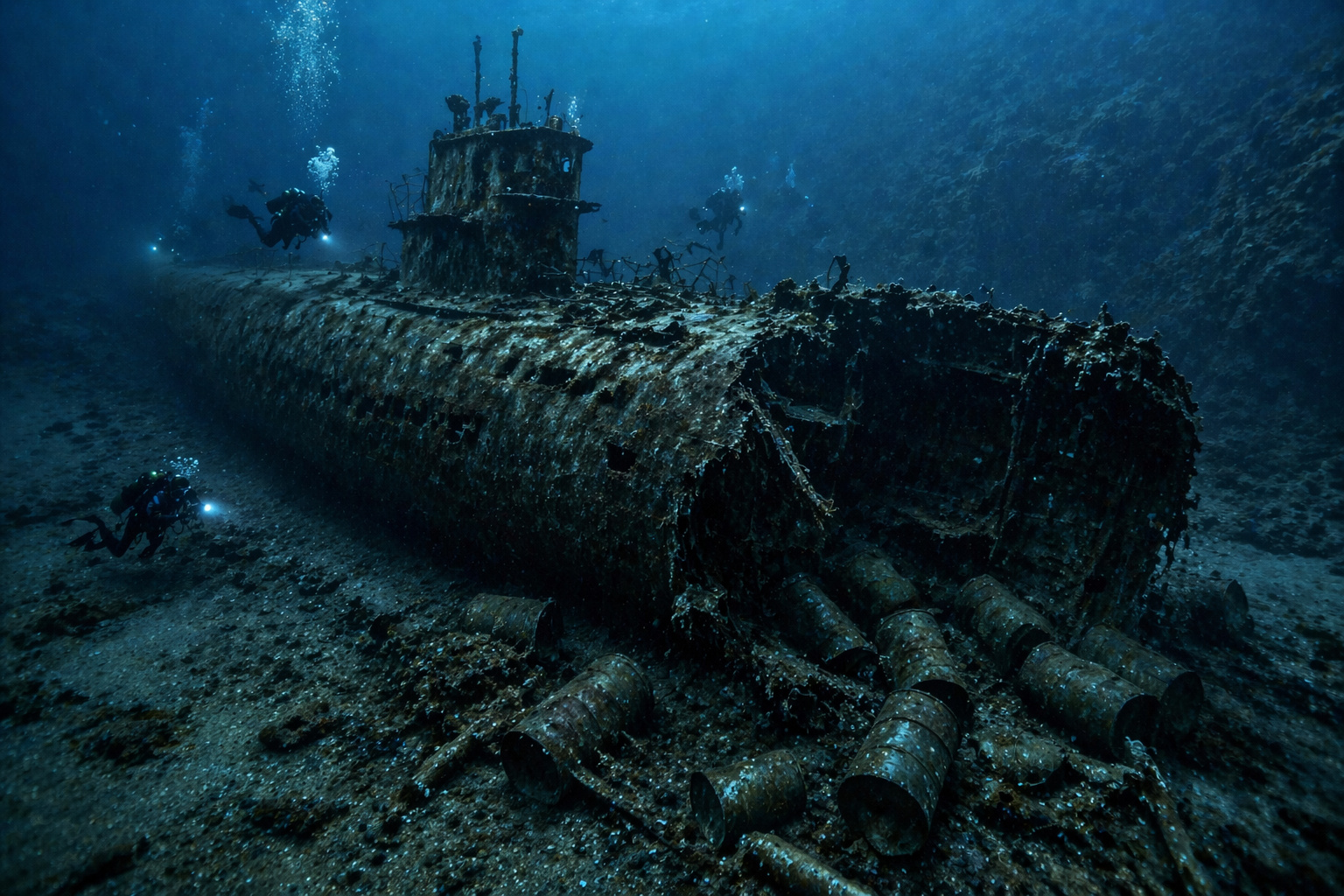
Toxic mercury load, discovered in World War II wrecks, threatens marine ecosystem and challenges Norwegian government strategy
A military structure submerged for decades has returned to the center of environmental discussions in Europe, as silent risks grow at the bottom of the ocean.
Additionally, the Nazi submarine U-864, sunk in 1945, carried 65 tons of mercury, making the case a significant environmental threat.
Consequently, Norwegian authorities face a technical and environmental dilemma, as any decision involves high risks.
At the same time, the advancement of corrosion increases concerns about possible ongoing leaks, which could impact the local ecosystem.
Historic shipwreck and discovery on the seabed
Initially, during the final phase of World War II, in 1945, the U-864 submarine was hit by a torpedo, according to information released by UOL.
-
It seems like something out of a movie: “Cotton Castle” in Turkey, formed by minerals over the centuries, features thermal pools, ancient history, and one of the most surreal landscapes in the world / discover Pamukkale.

-
Psychology states that the rarest mental strength today is not resilience or determination, but rather the ability to cope with uncertainty without immediately seeking distractions, explanations, or the opinion of someone else.

-
Bavarian archaeologists unearthed a medieval skeleton that had an articulated iron hand in place of its left arm, and the discovery reveals that doctors were already creating sophisticated prosthetics over 500 years ago.

-
You will be able to enter for free a 1,680-ton military ship of the Brazilian Navy that conducts rescues and patrols at sea, but only on three special days during the 368th anniversary of São Francisco do Sul in Santa Catarina.

Moreover, the episode became unique, as it was the only confirmed case of a submarine sinking another while both were submerged.
As a result, the vessel split in half, while the 73 crew members died immediately.
Subsequently, the wreckage remained at about 150 meters deep, along with active munitions and human remains.
For decades, however, the exact location remained unknown, preventing any direct intervention.
Only in 2003, according to records cited by UOL, the wreck of the submarine was identified on the seabed, reopening technical discussions.

Mercury in the ocean increases environmental risk
Currently, the main concern involves the load of 65 tons of mercury stored in steel containers.
Over time, however, these structures have begun to rust, while signs of deterioration have already been observed.
Therefore, there is a risk of gradual release of the toxic substance into the marine environment, which worries experts.
Additionally, mercury can directly affect marine organisms and contaminate food chains.
At the same time, studies indicate that exposure to mercury compromises the human nervous system.
Moreover, the substance can also cause severe fetal malformations, increasing health risks.
In light of this, fears grow of a scenario similar to the Minamata disaster, which occurred in Japan in the 1950s.
Technical decision challenges Norwegian government
In this context, the Norwegian government is evaluating alternatives to deal with the wreckage of the U-864.
On one hand, removing the submarine involves high risks, especially due to the presence of still-active explosives.
Thus, any mistake could intensify contamination and generate irreversible impacts on the marine environment.
On the other hand, keeping the submarine in place and trying to seal it does not guarantee total safety in the long term.
In this sense, experts believe that no solution completely eliminates the existing risks.
Additionally, the site is treated as a war grave, which imposes additional ethical limitations.
Meanwhile, ongoing corrosion increases the urgency for a strategic decision, before leaks intensify.
Therefore, Norway needs to balance technology, environmental safety, and historical responsibility — but which alternative will be able to prevent a silent environmental impact at the bottom of the ocean?






Seja o primeiro a reagir!