






 Portuguese
  Spanish


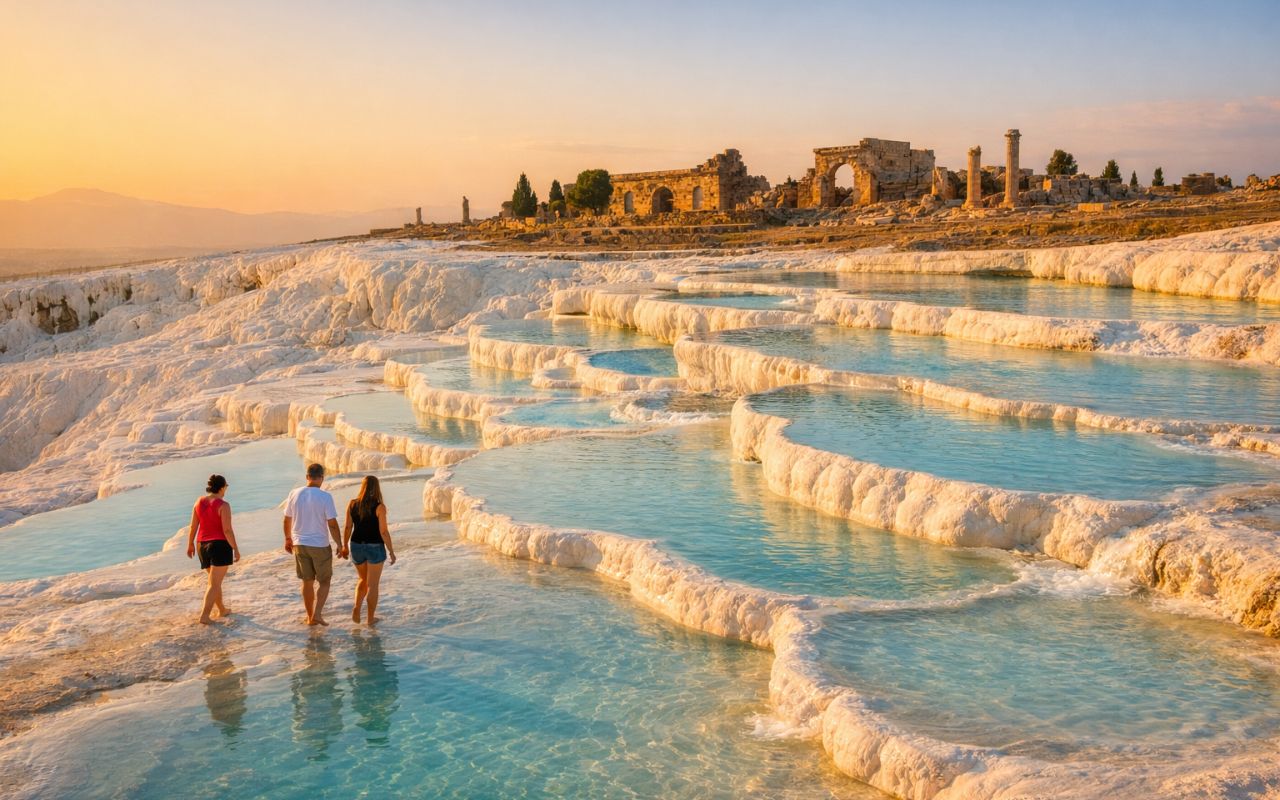

Pamukkale enchants with thermal pools, travertine terraces, and millennia of history in Turkey; understand why the destination is unique in the world.
Located in the province of Denizli, in southwestern Turkey, Pamukkale is one of the most impressive natural settings on the planet. The site features thermal pools, limestone formations, and an ancient archaeological site, attracting visitors year-round. Formed over thousands of years, the phenomenon occurs due to the continuous flow of mineral-rich waters that create unique white terraces.
Moreover, Pamukkale stands out for combining natural beauty, historical significance, and therapeutic properties. Therefore, it has become one of the most iconic tourist destinations in the world.
How did Pamukkale form over thousands of years?
The appearance of Pamukkale, resembling a “cotton castle,” is the result of a slow and continuous geological process. The thermal waters, rich in calcium, flow down the slopes and deposit calcium carbonate over time.
-
Brazilian Entrepreneur Turns Door-to-Door Jewelry Sales into a Family Business Empire with Over 70 Stores

-
$75 Million Bridge in Brazil Opens to Connect Cities, Create Jobs, and Cut Travel Time from 30 to 2 Minutes; Spanning 1.24 km, It’s Among the Country’s Largest and Ends Decades of Ferry Queues.

-
Brazilian Farmer Builds 8-Ton Tractor from Army Truck Engine, Plants Over 100 Hectares of Soybeans
-
11-Year-Old Entrepreneur Turns Fear of Bees into Honey Lemonade, Wins $60,000 on Shark Tank, Secures Whole Foods Deal, and Expands Brand Across U.S. Stores




This material hardens and forms what is known as travertine, a type of white limestone. Thus, the famous step-like terraces emerge, creating natural cascading pools.
Over the centuries, the accumulation of these minerals gave rise to the structures that today are one of Turkey’s greatest postcards.
The pools of Pamukkale are not only beautiful but also known for their health benefits. The waters contain minerals such as calcium and magnesium, associated with skin care and muscle relaxation.
In total, the site has about 17 thermal springs. The temperatures range from 19 °C to 57 °C, although some may reach even higher levels in deep geothermal areas. Therefore, since ancient times, people have visited Pamukkale in search of treatment and well-being.
Pamukkale and Hierapolis: millennia of history alongside the thermal waters
Next to Pamukkale is the ancient city of Hierapolis, founded in the 2nd century BC. The site was known as an important healing center in the ancient world.

At that time, people from various regions traveled there to enjoy the thermal waters. Today, the ruins include a well-preserved theater, temples, and a vast necropolis with sarcophagi.
This combination of nature and history led the area to be recognized as a UNESCO World Heritage Site in 1988.
Rules and curiosities for visiting Pamukkale
- To preserve the natural terraces of Pamukkale, it is mandatory to remove shoes before walking on the travertine.
- The ground can be slippery in some areas, requiring extra attention from visitors.
- In certain sections, especially near the natural pools, the surface tends to be firmer.
- The sensory experience is one of the major attractions, with warm water and a unique mineral texture underfoot.
- The site is frequented by both tourists and locals, who take the opportunity to relax in the thermal waters.
- In addition to bathing, contemplating the white landscape contrasting with the blue sky is one of the most memorable moments of the visit.
Why is Pamukkale considered one of the most impressive places in the world?
The great differentiator of Pamukkale lies in the rare combination of natural and historical factors. On one side, there are the bright white formations under the sun; on the other, turquoise waters that create a striking visual contrast.

Additionally, the presence of archaeological sites further enhances the cultural value of the region. Thus, the destination becomes attractive for both those seeking leisure and knowledge.
Therefore, Pamukkale remains one of the most fascinating examples of how nature and history can coexist in perfect harmony.
With information from the UNESCO


