






 Portuguese


Maeslantkering Uses Two 210-Meter Doors and 680-Ton Hinges to Automatically Close Access to the North Sea During Extreme Storms.
In 1997, the Netherlands completed the Maeslantkering, a storm barrier built on the Nieuwe Waterweg near Hoek van Holland, to tackle a seemingly contradictory problem: to protect Rotterdam and other densely populated areas from the encroachment of the North Sea without permanently closing the route used by large ships accessing the port. The solution was to construct two colossal mobile structures. Each door measures 210 meters wide, 22 meters high, and 15 meters deep, operated by a spherical joint with a diameter of 10 meters and weighing approximately 680 tons.
When a storm threatens to dangerously raise sea levels, these two structures leave their enormous side compartments and begin to pivot towards the center of the waterway. Once positioned, they are filled with water and sink to the bottom, creating a temporary barrier between the North Sea and the interior of the country.
The Rijkswaterstaat, the Dutch water infrastructure agency, states that no flood barrier in the world has larger movable components and that the Maeslantkering helps protect approximately 2 million residents of South Holland.
-
After Filament Breaks Shut Anita Garibaldi Bridge for Ten Days, MPF Expands Investigation into Structural Failures and Demands Full Project History, While DNIT Maintains 2015 Tests Confirmed Compliance and Changes Don’t Indicate Construction Error

-
Two-Bedroom Home Completed in Six Months with Metal Structure, Saving R$24,000 and Reducing Water Use

-
Santa Catarina Highway Project: First Kilometer of Asphalt Completed, Connecting Historic District to Içara

-
Modular Homes Gain Traction with Affordable Basic Models in Argentina


Two 210-Meter Doors Remain Open Most of the Time
The most ingenious feature of the Maeslantkering is that, for most of the time, it virtually disappears from the shipping route.
Its two gigantic doors remain stationed in docks on the banks of the Nieuwe Waterweg. This way, oil tankers, cargo ships, and other vessels can continue to move in and out of the Rotterdam port area as usual.

This was essential for the project. The Nieuwe Waterweg is a vital link between Rotterdam and the North Sea. Rijkswaterstaat itself points out that this waterway was crucial for Rotterdam to become one of the largest port centers in the world.
Building a permanent dam at that point would solve part of the storm problems, but it would create another enormous economic issue.
The Maeslantkering was designed to offer the best of both worlds: a completely open passage for navigation during normal conditions and a monumental barrier when the sea threatens to surge into the country.
Each Door is Essentially an Entire Industrial Structure in Motion
The dimensions of the two gates help to understand why Rijkswaterstaat regards the project as exceptional.
Each measures 210 meters wide, 22 meters high, and 15 meters deep. A single door is longer than many tall buildings when laid down.
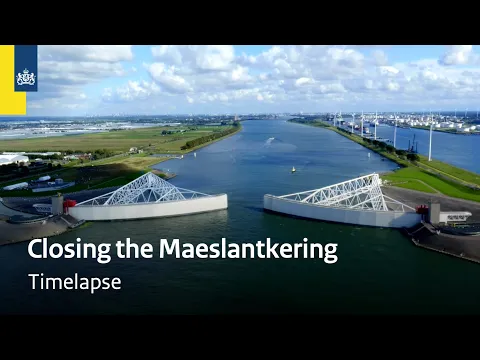

However, it does not move like a conventional gate that simply goes up or down vertically.
Each wall is connected to a massive articulated metal structure that allows it to rotate horizontally, moving away from the bank and advancing over the water. The two halves depart simultaneously from opposite sides.
As they approach the center, what was just a few minutes ago an open waterway begins to transform into a barrier against the ocean.
Spherical joints measure 10 meters in diameter and weigh 680 tons
Perhaps the most extraordinary piece of the entire construction is located at the ends of the arms. The Maeslantkering uses spherical joints that are approximately 10 meters in diameter and weigh 680 tons.
Essentially, each unit functions in a manner similar to a gigantic joint in the human body.
The difference is the scale. Instead of moving an arm or a leg, each joint needs to allow controlled movement of a metal structure hundreds of meters long, subjected simultaneously to gravity, wind, current, and water pressure.
The 10-meter diameter means that the sphere itself is comparable in height to a building of approximately three stories. Each unit weighs more than several large commercial airplanes combined.
When it reaches the center, the door still needs to sink
Moving the structures horizontally is not enough to stop the flow of water. When the two gates reach the closing position, internal compartments begin to receive water.
The additional weight reduces buoyancy and causes the doors to slowly sink until they rest on the prepared structure at the bottom of the waterway.
According to Rijkswaterstaat, the entire process takes approximately two hours.
It is only after this sinking that the barrier fully assumes its function against the storm.
Once the threat has passed, the water used as ballast is removed. The doors float again and can be moved back to their lateral docks, reopening the navigation route.
Structure designed to withstand a rise of up to 5 meters above the reference level
Rijkswaterstaat reports that the Maeslantkering was designed to withstand a storm tide of up to 5 meters above NAP, the reference level used in the Netherlands.
When strong winds push large volumes of water from the North Sea toward the Dutch coast, sea levels can rise rapidly.
At the same time, rivers need to continue flowing water toward the ocean. This combination can dangerously elevate levels in the regions around Rotterdam and Dordrecht.
The function of the barrier is to temporarily halt the additional entry of seawater before it further pressures the dikes and low-lying areas inland.
Computers can decide when to close the two structures
Another unusual feature is that the system was designed to operate automatically. Rijkswaterstaat establishes official closing levels. If forecasts indicate that water will reach 3 meters above NAP in Rotterdam or 2.9 meters in Dordrecht, the Maeslantkering begins the automatic closing procedure.
This does not mean that engineers simply abandon control.
When there is a forecast of high water, specialized teams are present to monitor all systems and intervene manually in case of any anomalies.
However, the operational decision and normal closing sequence were designed to be carried out by the system itself.
In a structure that needs to operate precisely during some of the most severe weather conditions, the reliability of automation is just as important as the size of the steel used.
In December 2023, the giant gates automatically closed against the North Sea
On the night of December 21, 2023, the Maeslantkering effectively came into action under the conditions for which it was built.

At 10:15 PM, both structures were closed. It was the first time that the barrier completed a closure automatically prompted by the actual water level exceeding the normal operational limit.
The episode also led to an unprecedented situation. The six storm barriers managed by Rijkswaterstaat remained closed that night in response to the elevated water conditions.
After the storm passed and the water level subsided, the Maeslantkering reopened. Decades of maintenance, simulations, and annual tests had served precisely for that moment.
About 2 million people depend on the protection system
The importance of the work cannot be understood solely by looking at the gates. Rijkswaterstaat claims that the Maeslantkering helps protect approximately 2 million residents of South Holland from flooding caused by the North Sea.
The region includes Rotterdam, Dordrecht, and extensive urban, industrial, and agricultural areas.
The Netherlands has a particularly delicate relationship with water because large areas of the territory are close to or below sea level.
Therefore, the Maeslantkering does not operate in isolation.
It is part of the Deltaworks, the vast Dutch system of dams, dikes, sluices, and barriers developed to reduce the risk of further disaster.
The 1953 tragedy forever changed the country’s hydraulic engineering
The historical backdrop is the devastating North Sea flood of 1953, which primarily affected the Netherlands, the United Kingdom, and Belgium.
In the Netherlands, the disaster revealed that the existing protection system was inadequate in the face of an extreme combination of storm and tide. In the following decades, the ambitious Delta Works program emerged.
Several maritime entrances have been closed, dams have been constructed, and mobile barriers have started to alter the physical relationship between the country and the sea.
The Maeslantkering was the last major project completed within this historic ensemble.
It was built between 1991 and 1997 and, together with the Hartelkering and the reinforcement of the Rozenburg dike, forms the so-called Europoortkering.
Every year, the Netherlands closes the structure just to check if it still works
A rarely used barrier faces a peculiar problem: it needs to be ready even after long periods without executing its real mission.
For this reason, Rijkswaterstaat conducts an operational test every September, before the start of the storm season.
The two gates are effectively operated.
Control systems, motors, joints, metal structures, and team procedures are all verified.
There is also a so-called closing verification when seven years pass without a storm operation suitable for this type of assessment.
The logic is simple: a structure designed to protect millions of people cannot discover that a part has stopped working just when the sea is rising.
Maintenance of a structure of this size never ends
The scale transforms even anti-corrosive painting into an engineering project. In 2024, Rijkswaterstaat began applying a new protective layer to the metal structures of the Maeslantkering.
The work was planned to last three years, largely because large-scale interventions can only occur during the window between April 15 and August 15, outside of the main storm season.
After that, everything needs to be available again for the annual September test and for the high-risk period starting in October.
The new protection is designed to offer approximately another two decades of service before another major similar intervention is needed.
Two 210-meter structures transform an open waterway into a wall against the ocean
The Maeslantkering is an unusual megastructure because it spends most of its existence not blocking anything.
Its everyday function is precisely to allow one of the most important shipping routes in Europe to remain open. But when the North Sea threatens the interior of the Netherlands, the scale of engineering becomes apparent.
Two gates 210 meters wide and 22 meters high leave their docks. Ten-meter spherical joints weighing 680 tons allow for movement. The structures are positioned over the waterway, take in water within the compartments, and sink to the bottom in a process that takes approximately two hours.
Behind them are Rotterdam, Dordrecht, and a region where approximately 2 million people live.
Ahead lies the North Sea.
And between them stands one of the largest movable structures ever constructed by hydraulic engineering, designed to achieve something that seems simple until you observe its numbers: temporarily close an entire ocean path without permanently closing the pathway for ships.


