Portuguese


China has sunk 18 concrete structures, each weighing up to 60,000 tons and measuring 180 meters in length, fabricated on land, floated, towed through Dalian Bay, and submerged one by one to form over 3 kilometers of tunnel on the seafloor. According to Xinhua, the installation of the segments for the Dalian Bay Undersea Tunnel was completed in 2022, creating the first major submerged tube crossing in northern China.
The most impressive aspect is the pace of the operation. China completed the installation of the 18 elements in just 20 months, with each segment compared by the contractor China Communications Construction Company (CCCC) to the displacement of a medium-sized aircraft carrier. The tunnel was opened to traffic in 2023, featuring a total length of 5.1 kilometers, six lanes, and a designed speed of 60 km/h, establishing a new connection between the northern and southern sides of Dalian.
Each Piece of the Tunnel Weighed About 60,000 Tons
The Dalian Bay Undersea Tunnel was not fully excavated beneath the bay floor like tunnels constructed with large tunnel boring machines. Instead, the solution for the subsea section was the so-called immersed tube tunnel.
-
2,000-Ton Tunnel Boring Machine Carves 1.6 km Railway Tunnel Beneath English Forest, Moves 250,000 m³ of Earth
-
Over 8,000 PET Bottles in Granados, Guatemala, Reused to Build School Walls Using a Community Approach

-
Wood Tower Challenges Concrete and Steel Dominance with Innovative Glulam Structure

-
18-Meter-Wide, 30-Meter-High, 1.18-Kilometer-Long Bridge Over the São Francisco River to Replace Ferry and Establish New Road Connection Between Alagoas and Sergipe; R$205 Million Investment, Over 50% Complete, Expected Completion by December 2026


In this method, massive segments are pre-fabricated in a controlled environment. Once completed and temporarily sealed, they are made to float, transported to the planned position, and carefully sunk into a prepared trench on the sea floor.
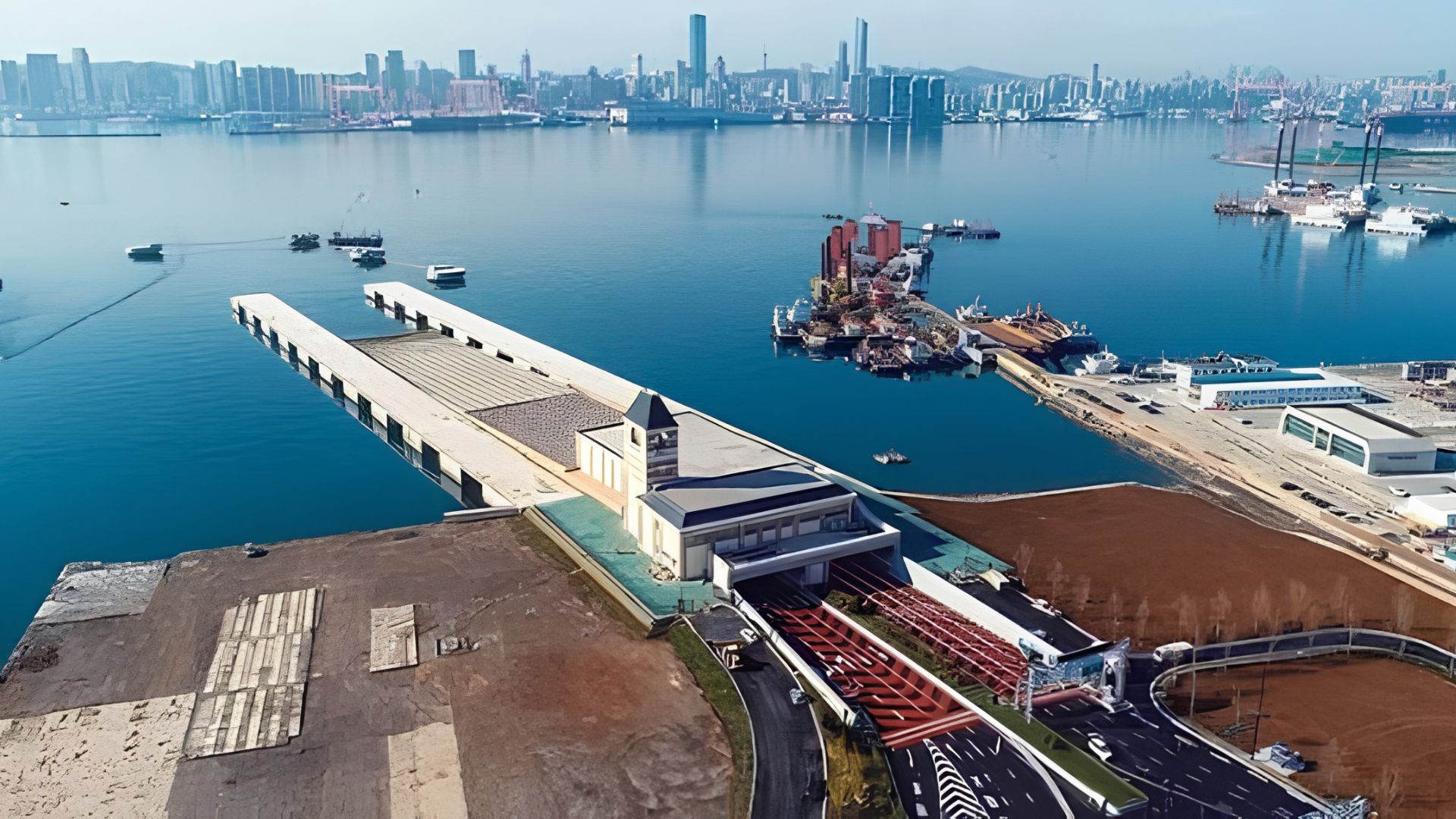
In the case of Dalian, the immersed section spans 3,035 meters and consists of 18 large elements, in addition to the final closing structure. Each standard section measures 180 meters in length, approximately 33.4 meters wide and 9.7 meters tall, weighing around 60,000 tons.
A Single Structure Was Comparable to the Displacement of an Aircraft Carrier
The scale presents an obvious challenge: there is no conventional crane simply lifting a 60,000-ton piece and placing it at the bottom of the bay.
The solution lies in buoyancy. The tubes are hollow structures that can function, during installation, similarly to huge hulls. A publication linked to CCCC describes how water was used to elevate the elements within the manufacturing area before their departure to the sea.
When the segment reaches the correct position, ballast systems control its descent. The structure is gradually lowered to the bottom while vessels, cables, positioning systems, and engineering teams manage its orientation. Only then does it connect with the previously installed piece.
The 18 Giants Were Installed in Just 20 Months
The first major sequence of elements began moving at the end of 2020. On August 5, 2022, CCCC completed the installation of section E18, the last of the 18 main structures.
According to the contractor, it took 20 months to precisely install all the elements, a result presented by the company as a record speed for executing immersed tube tunnels.
The simple average approximates to one piece installed every little over a month. However, the operation was not repetitive like assembling identical blocks on land. Wind, ocean currents, depth, space available for vessels, and the position of already installed structures altered the conditions for each descent.
The Last Piece Had Only About 1 Meter of Space to Enter
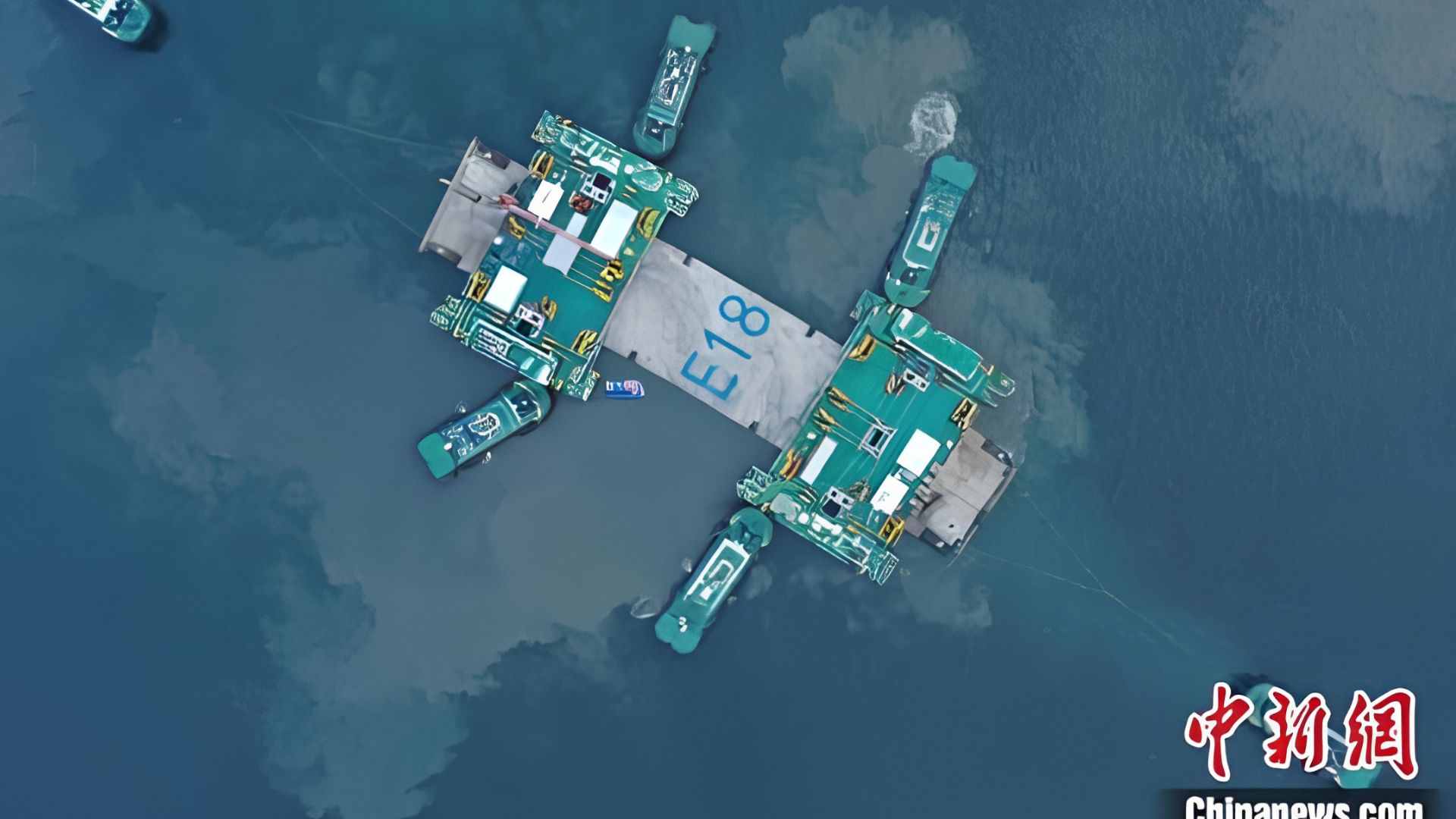
Section E18 became particularly complicated as it needed to fit the space left between element E17 and the final joint area.

According to technical descriptions published during the completion of the installation, the gap available between the ends was only about 1 meter. The piece had to descend within this interval without compromising the structures that were already positioned.
The team had to repeatedly reorganize the anchoring system and adapt operations to the restricted area. It was not enough to move 60,000 tons to the approximate point. The tube had to arrive at the intended orientation to ensure structural continuity and sealing of the tunnel.
The Tunnel Still Needed to Curve Under the Sea
Another factor made the project more complex. The immersed section was not designed as a perfectly straight sequence.
The CCCC states that the curved region of the tunnel has a radius of 1,050 meters, a configuration described by the company as the curved section with the highest curvature and lowest radius among immersed tunnels constructed in China at that time.
This means that the positioning of the pieces had to progressively respect the geometry of the curve. Small errors accumulated over many elements could create massive problems when the work reached the closing point.
The size of the structures makes this precision even more remarkable. Each element was nearly the length of two football fields lined up.
The Final Joint Required Precision of Only 3 Millimeters
After the installation of the 18 tubes, there was still the need to seal the passage between the submerged section and the next structure.
CCCC claims that the project used a pipe jacking segmentation technique at the final joint, an application considered unprecedented in the country at that context. Even more impressive was the declared tolerance: the installation precision of the final joint was controlled to up to 3 millimeters.
Three millimeters are less than the thickness of many everyday objects. The scale difference is extreme: an infrastructure composed of tens of thousands of tons ultimately depended on adjustments measured in millimeters.
The company claims the project generated 197 patent applications, including 77 related to inventions.
Concrete Needed to Last Decades in Cold, Salty Water
Placing a tube on the seabed is only part of the problem. The structure must remain operational for decades in an aggressive environment for concrete and steel.
The Dalian Bay Undersea Tunnel was designed for an expected structural lifespan of 100 years, according to CCCC. Dalian is in a region with high latitude, experiencing harsh winters and maritime conditions different from projects built in warmer areas of China.
After the tunnel’s opening, engineers involved in the project emphasized that one of the main challenges was increasing the durability of concrete structures exposed to the cold sea water. A subsequent technical study specifically examined the high-performance concrete used in the immersed tubes of Dalian.
The Project Leveraged Experiences from the Hong Kong-Zhuhai-Macau Bridge to the North
China had already accumulated experience with massive immersed structures at the Hong Kong-Zhuhai-Macau bridge complex, which was inaugurated in 2018.
But simply repeating the technique would not solve Dalian’s issues. According to engineers quoted after the opening, the geological conditions of the seabed and the climate were different, requiring new solutions for construction and durability.
CCCC itself classifies Dalian as another megaproject of high technical complexity, following the Hong Kong-Zhuhai-Macau connection. The lessons learned from large maritime crossings were adapted for a cold environment in the northeast of China.
Six Lanes of a Highway Run Under the Sea
After all the manufacturing, transportation, sinking, fitting, and sealing operations, the massive elements ceased to appear as independent pieces.
Internally, they form a six-lane urban expressway, with three traffic directions in each direction and a design speed of 60 km/h. The entire tunnel measures approximately 5.1 kilometers.
The project connects the Renmin Road area in the south to the Suoyu Bay region in the north. The passage was designed to create an additional north-south route within Dalian and reduce reliance on existing routes around the bay.
A Journey That Used to Take an Hour Now Takes Just Minutes
The Dalian Bay Undersea Tunnel was opened to traffic in May 2023, along with a road connection of about 7 kilometers.
A report published at the time by China Daily stated that the new connection could reduce the travel time on a certain route between the regions connected by the project from approximately one hour to five minutes.
The infrastructure was also designed to alleviate congestion in downtown Dalian and connect urban areas separated by the geography of the bay.
This is the economic rationale behind the enormous complexity of sinking structures comparable to buildings beneath the sea: instead of forcing vehicles to circumvent the water, the city created a nearly direct path beneath it.
The Tunnel Disappeared After the Construction Was Completed
One of the most curious features of immersed tube engineering is that the most spectacular part of the project becomes invisible after completion.
During construction, elements weighing 60,000 tons and measuring 180 meters appear to float like gigantic ships. Once sunk, aligned, connected, and covered, they become part of the seabed.
Drivers traveling today on the six lanes do not see the 18 independent modules that made up the structure. For those inside the tunnel, they have transformed into a continuous passage.
It was precisely this sequence of operations that made Dalian a benchmark in heavy engineering. In 20 months, 18 pieces weighing approximately 60,000 tons were transported to sea and fitted one after the other, creating an immersed stretch of over 3 kilometers. Upon completion, the most delicate joint required a control measurement of just 3 millimeters.
The project demonstrates how a subsea tunnel can be constructed without deeply excavating the entire passage through the rock.
China opted to manufacture giant parts on land, have them float like vessels, and then make them disappear into the bay’s bed, until over 1 million tons of structural elements formed a single road under the sea.