





 Portuguese
  English
  Spanish
  4 min of reading
  6 comments


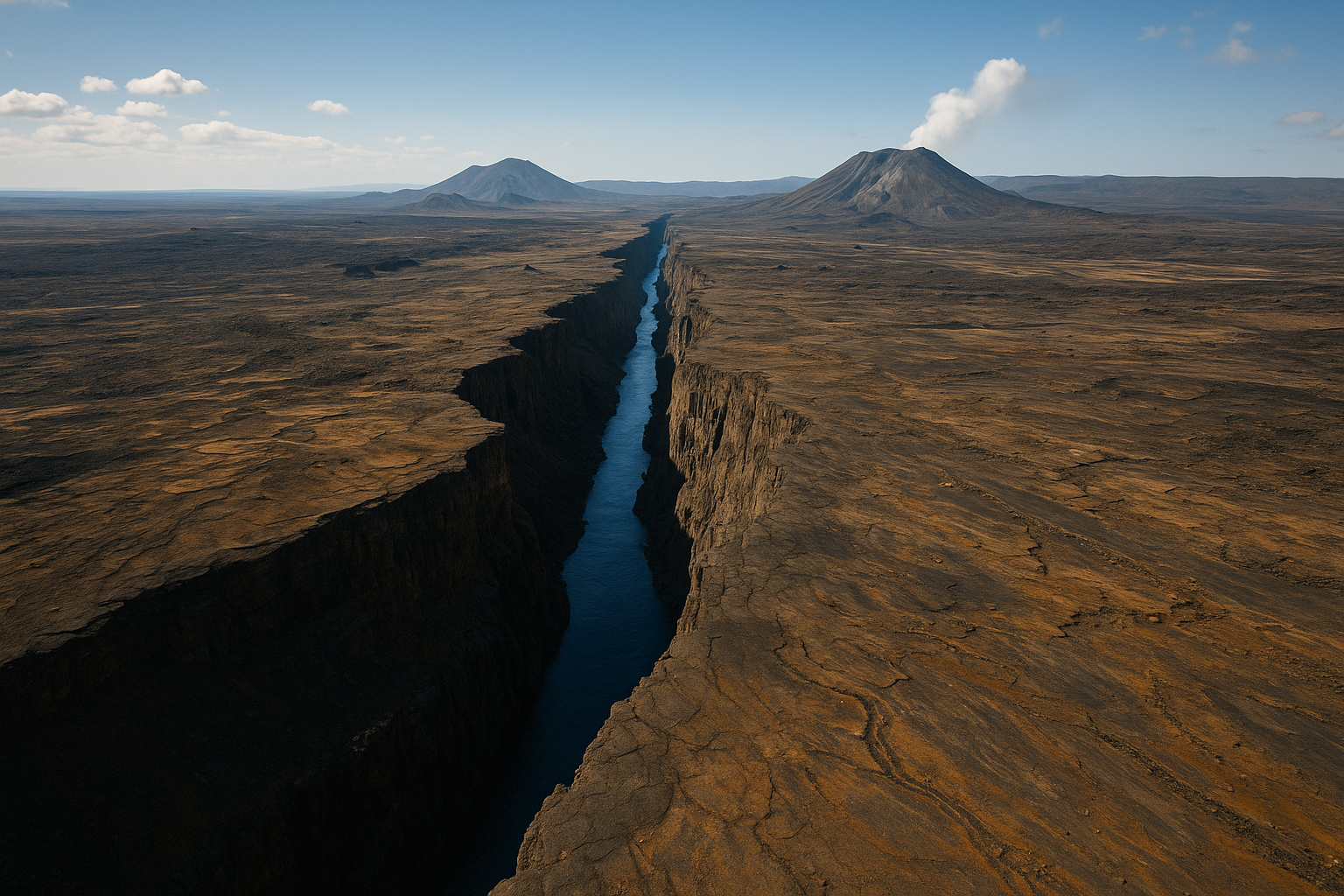


The Rift That Crosses Ethiopia Reveals Pulses From the Earth’s Mantle That Could Create a New Ocean in East Africa
Research published in 2025 in Nature Geoscience reveals that rhythmic pulses of molten rock are rising from the Earth’s interior beneath the Afar region in Ethiopia.
These underground movements are tearing the African continent in half. Furthermore, the study conducted by scientists from The Universities of Southampton and Swansea in the UK indicates that the phenomenon is ongoing and extremely deep.
As such, the researchers concluded that these mantle movements slowly shape the Earth’s crust and, over time, may give rise to a new ocean. Therefore, the work points to a unprecedented geological future on the planet.
The Heart of the Earth Pulses Beneath Ethiopia
According to the lead author of the study, Emma Watts (University of Swansea), the mantle beneath Afar is not static.
On the contrary, it behaves like a “pulsating geological heart,” sending waves of heat and molten material upward. As a result, these pulses weaken the Earth’s crust and accelerate the separation of tectonic plates.
Additionally, Watts explained that these mantle pulses have distinct chemical signatures, revealing a strong interaction between the Earth’s interior and its surface.
Thus, the discovery broadens the understanding of how the planet transforms internally over time and reinforces the importance of multidisciplinary studies to understand such processes.
ARTICLE CONTINUES BELOWSee also
Technology developed to protect military communications in the 1940s scrambled voices and today gives rise to the robotic sound that dominates current music.

If you look at the sky this Wednesday, you will see the Pink Moon shining at its peak at 10:11 PM, but before you get disappointed, know that the name has nothing to do with the color and instead refers to flowers that bloom at this time in the United States.

Discovery at USP reveals how Brazilian arnica can revolutionize the production of silver nanoparticles with less environmental impact.

Harvard scientists have created a tissue exoskeleton that does not look like an exoskeleton, with no rigid parts and reduced weight, using flexible cables and miniaturized motors to assist the ankle and hip, reducing the effort of walking by up to 23% in controlled tests.
The Most Unstable Region on the Planet
The Afar region is considered one of the most geologically unstable areas in the world, as it hosts the convergence of three major tectonic faults: the Red Sea Rift, the Gulf of Aden Rift, and the Great Ethiopian Rift. Thus, this triple junction has become the ideal scenario for continental rupture.
As the plates move apart, the Earth’s crust stretches and thins, making way for the emergence of a new ocean basin. However, this process is expected to take millions of years to reach its complete form.
During collections conducted between 2022 and 2024, scientists analyzed more than 130 samples of volcanic rocks from the region. As a result, they discovered repeating chemical patterns, similar to “geological barcodes”.
These patterns reveal that the mantle pulses in a constant and organized manner, with behavior similar to a heartbeat. According to researcher Tom Gernon (University of Southampton), in rifts that are expanding more rapidly, the pulses propagate more efficiently, as if they were currents of energy flowing through a narrow artery.
Thus, the phenomenon demonstrates how the Earth’s interior directly influences the exterior.

A Continent in Transformation
As highlighted by Derek Keir (University of Southampton), the continuous movement of the mantle heats and wears down the Earth’s crust, causing intense volcanism and frequent earthquakes. In this way, scientists point out that the African continent is slowly splitting in half, which represents a milestone in the geological evolution of the Earth.
Furthermore, the evolution of these deep mantle upwellings is directly linked to the movement of tectonic plates, allowing for a more precise understanding of the rate of volcanism and continental fragmentation.
Although the process occurs on an extremely slow timescale, scientists assert that the result is inevitable. Thus, the Horn of Africa will separate from the rest of the continent, and the opened rift will be filled with seawater, creating a new ocean. In this way, the landscape will resemble the primitive Atlantic, formed tens of millions of years ago.
A Look to the Future of the Earth
The study reinforces that the African rift began to open about 31 million years ago, during the Oligocene. Additionally, the main phases of expansion occurred between 35 and 11 million years ago, in the systems of the Gulf of Aden, the Red Sea, and the Great Ethiopian Rift.
The samples analyzed, with ages of less than 2.5 million years, confirm that the process is still active. Therefore, researchers believe it will continue for millions of years, completely reshaping the map of the African continent.
For Emma Watts, this is just the first step towards a new understanding of the internal workings of the planet.
Thus, the researcher emphasized that, without the use of various combined techniques, it would be “like assembling a puzzle without all the pieces.” Therefore, cooperation among universities from different countries is essential for understanding Earth dynamics and predicting how the planet will continue to evolve in the coming geological eras.







Deus continua fazendo a terra, que não está pronta.
É incompreensível e inaceitável que alguns ainda reajam com risadas sobre isso . ****, só pode.
Mais Incompreensível e inaceitável ainda, é a palavra “n3gaci0nist4” do meu comentário ser censurada
Incrível!! Nova Gaya🌸, o nosso planeta, ainda tem muito a se transformar e a humanidade a se rever, se reavaliar e se readaptar.
Fico encantada!! Sei que reverbera em destruição, porém vivemos momentos limites.
Se faz extrema a necessidade de mudanças profundas.
Se não as fazemos, a natureza nos impulsiona a fazer, sem tempo ou jeito de reclamar…
Apenas aceitar, se adaptar, cuidar dos feridos, e seguir evoluindo.
Somos um único coração e muitos corpos, muitas consciências. Ter clareza disto e nos transformar numa unidade é o que estamos a caminho de realizar inevitavelmente.
Faço de suas minhas palavras, somos habitantes e não Dono de um corpo vivo como nosso, que quando se sente invadido reage. Devemos ser gratos sempre por termos de onde tirar nossa sobrevivência. Não falo pelos nossos trabalhos porque cada um tem o seu, mas porém de termos a oportunidade de ter tudo em um só lugar. Se todo mundo soubesse o que significa gratidão, e ser grato já Faria muita diferença na vida que sustenta a vida.
Palavras reais! o ser humano precisa de se reinventar e puruficar a alma! A Terra se molda por natureza própria, o ser humana; cada vez mais se confundindo!