





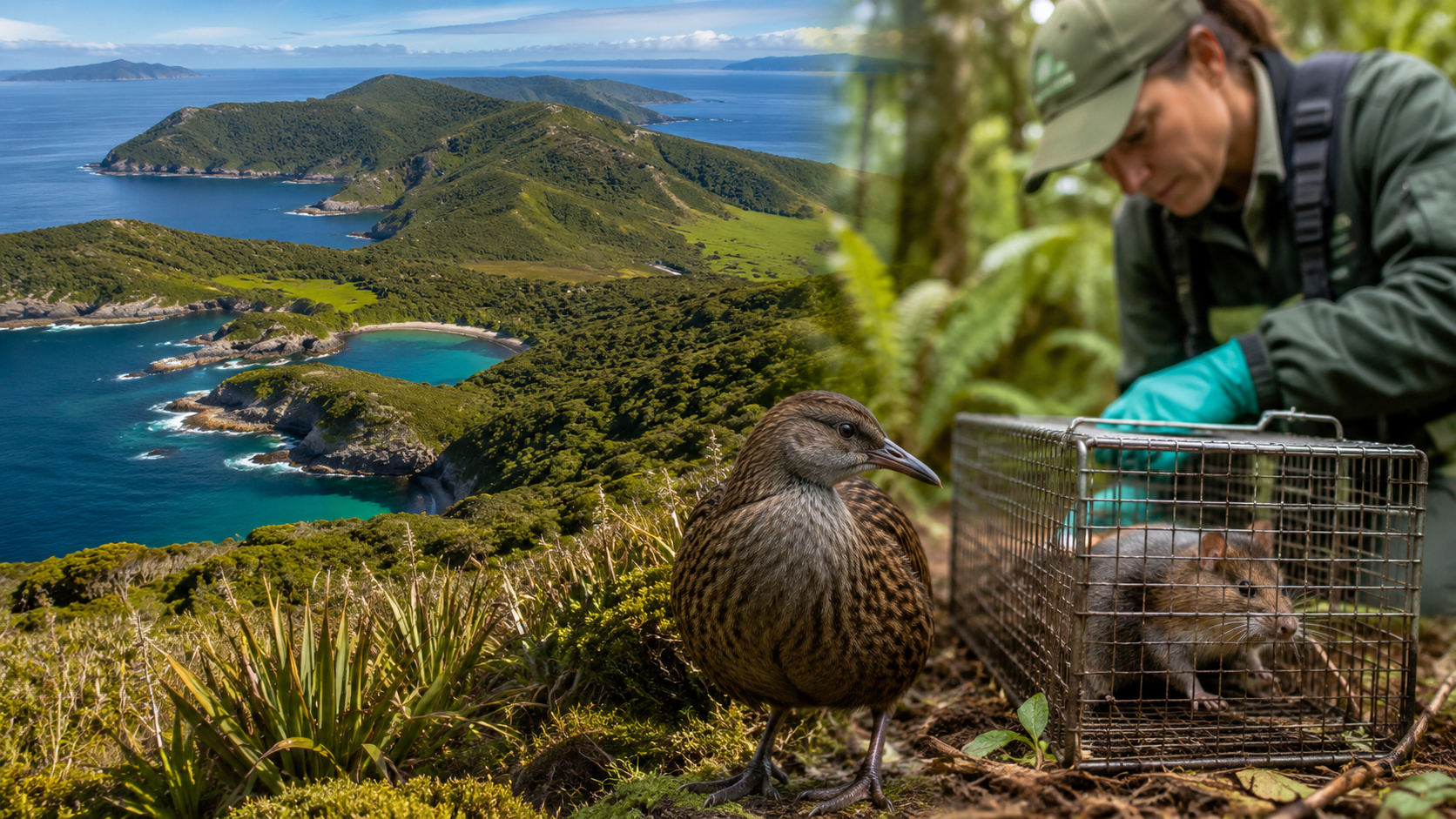

New Zealand wants to eliminate invasive mammals from Maukahuka, Rakiura, and Chatham in a plan of NZ$ 202 million to protect native species.
New Zealand has launched one of the largest ecological restoration projects in its history by attempting to eliminate invasive mammals from Maukahuka/Auckland Island, Rakiura/Stewart Island, and the Chatham archipelago. According to the New Zealand Department of Conservation, the package brings together the government, local communities, and indigenous organizations in an operation designed to return these islands to native species that evolved without mammalian predators and have come under strong pressure since human arrival.
The scale of the plan is unusual even by New Zealand standards. The DOC reported that the three projects have an estimated cost of NZ$ 202 million, have already received NZ$ 54 million from the government, and still require significant funding mobilization. The same initiative states that each of these islands is 4 to 15 times larger than the largest island the country has managed to clear of pests to date.
Ecosystem without predators became an easy target after the arrival of invasive mammals
For millions of years, New Zealand’s fauna and flora evolved in isolation, without terrestrial mammalian predators.
-
For more than a decade, level 1 autism has been part of the spectrum; now researchers advocate for its removal from the autism spectrum.

-
Galápagos used goats to track other goats, removed more than 140,000 invasive ones, and saw plants and birds return to three devastated areas.

-
Unicellular microorganism grows more than double, becomes a cannibal predator, devours its own clones in minutes, and then returns to normal size.
-
Alaskan company prepares a tidal turbine composed of small units to face strong currents in Massachusetts and obtain the necessary data before taking the technology, designed to facilitate construction, installation, and maintenance in remote coastal regions, to commercial use.


According to Island Conservation, this process created a unique and extremely vulnerable ecosystem, in which many birds began nesting on the ground, lost the ability to fly, or did not develop effective escape responses against such threats.


With the introduction of rats, mice, feral cats, pigs, possums, and hedgehogs, this balance was disrupted. What was once a natural refuge has turned into a hostile environment for species that exist only there. In the case of Maukahuka/Auckland Island, the DOC states that the island is home to more than 100 species found nowhere else in the world, now threatened by mice, pigs, and feral cats.
Maukahuka, Rakiura, and Chatham concentrate species that New Zealand is trying to save from extinction
Each of the three areas entered the plan for very specific biological and ecological reasons. According to the DOC and Island Conservation, the vision for Maukahuka includes the return of subantarctic megaherbs landscapes, while Rakiura is treated as a candidate for a future refuge for the kākāpō, one of the rarest birds on the planet. The Chatham Islands appear as a critical area for seabirds, including the tāiko and different species of albatross.

In Rakiura, the project aims to remove feral cats, rats, possums, and hedgehogs. According to Predator Free Rakiura, the island is the third largest in New Zealand, with about 90% of its territory in public conservation area and is surrounded by smaller islands already free of pests, where seabird populations are recovering.
In the Chatham archipelago, the initial goal is to advance in the removal of possums and feral cats in key parts of the island system. According to Predator Free Rakiura, the long-term goal is to remove possums, feral cats, and rats from the entire archipelago and allow the seabird-driven ecosystem to thrive again.
Māori and Moriori leadership is treated as a central part of the restoration project
The restoration of these islands was not presented solely as an environmental action. According to the DOC, Rakiura and Maukahuka lie within the traditional territory of Ngāi Tahu, and the role of kaitiaki, or guardians, of these lands is treated as a central element of the project. The agency also states that the current work was made possible by previous success on smaller islands around Rakiura.
In the case of Chatham, the arrangement includes participation from the Hokotehi Moriori Trust and Ngāti Mutunga o Wharekauri, as well as local entities and the government itself. According to the DOC, the list of signatories to the initiative shows that the restoration was structured as a partnership between the state, science, local communities, and indigenous leadership.
Recovering seabirds can even strengthen the ocean around the islands
The expected gains are not restricted to dry land. According to Island Conservation, islands free of invasive species tend to recover large populations of seabirds, and this return helps reactivate the flow of nutrients between the ocean and the soil through guano. This material fertilizes the land and, carried by rain, also enriches coastal marine environments.

The same source states that island areas free of invaders can have up to 50% more fish biomass and show recovery up to four times faster after coral bleaching events. This amplified effect helps explain why the project was framed not only as a defense of terrestrial biodiversity but also as an action for oceanic and climatic resilience.
Operation faces remote terrain, severe climate, high cost, and human presence in parts of the islands
The plan is far from simple. According to the DOC, the three projects are among the most complex ever attempted in the country due to the size of the islands, the distance from the mainland, the difficult terrain, the severe climate, and the presence of human communities in Rakiura and the Chatham Islands.
In Maukahuka/Auckland Island, the challenge already has its own financial aspect. The DOC reported that the project aimed at removing mice, pigs, and feral cats was estimated at NZ$ 78 million. The overall design foresees years of planning, heavy logistics, and coordination among multiple partners.
Moreover, the country still needs to close the funding gap for the entire offensive. According to the DOC, after public funding and donations already received, there was still a significant portion to be raised for the three projects to fully advance.
New Zealand tries to expand an experience that has already become a world reference in pest eradication
The ambition of the plan relies on a history accumulated over decades. According to the DOC, New Zealand has already achieved more than 110 successful pest eradications on islands and maintains the national goal Predator Free 2050, aimed at eliminating introduced predators on a much broader scale.
On the official program page, DOC states that the country has already removed predators from two-thirds of its offshore islands and presents itself as a world leader in this type of restoration. This history supports the attempt to now advance to much larger, more remote, and ecologically more sensitive territories.
If the project works as planned, New Zealand may restore landscapes, bird colonies, and iconic species to the three islands that currently survive under heavy pressure.
What’s at stake is not just the removal of invasive animals, but the attempt to reopen space for entire ecosystems to function as they did before the disruption caused by the introduction of mammals.


