






 Portuguese
  Spanish


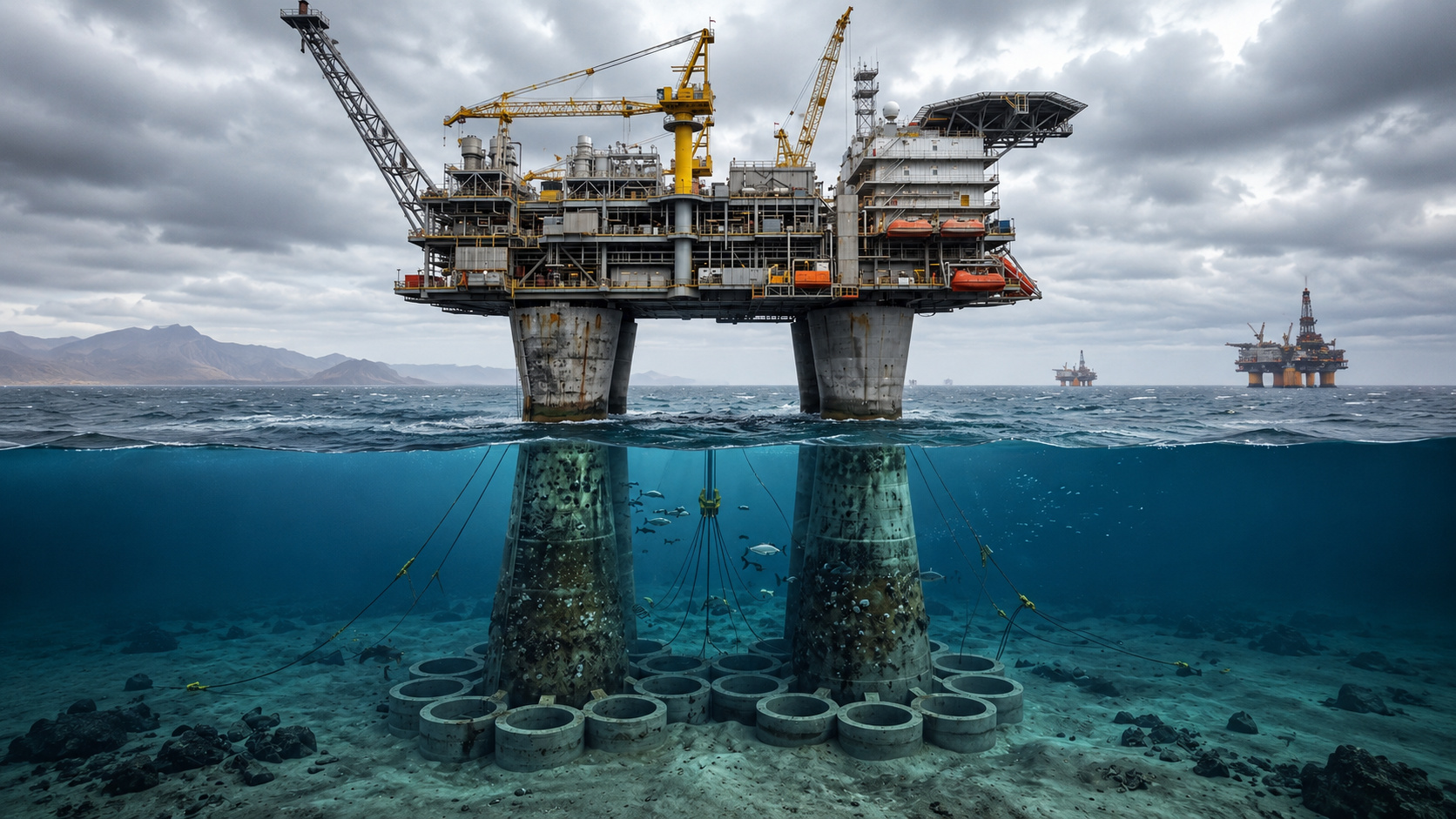

Troll A used 245 thousand m³ of concrete and 100 thousand tons of steel to become one of the largest offshore works ever made in the North Sea.
The Troll A platform, installed in the Troll field in the North Sea, is one of the most impressive offshore works ever constructed by modern engineering. The structure entered the Guinness World Records as the heaviest man-made movable object ever produced, with 656 thousand tons of dry weight just in the concrete gravity base. The feat is noteworthy because this colossus was not assembled directly at the final operation point: it was built on land, floated, towed by sea, and positioned on the ocean floor.
The scale of Troll A is explained by the material numbers and the energy importance of the field where it operates. According to Aker Solutions, the platform is about 472 meters in total height, is installed in a water depth of approximately 300 meters, and was made with about 245 thousand m³ of concrete and 100 thousand tons of reinforcing steel.
Equinor reports that the Troll field concentrates about 40% of the total gas reserves of the Norwegian continental shelf, which makes the structure a landmark in engineering, energy, and maritime logistics.
-
While the mirrored facade made the 241-meter tower reflect the Boston sky, 227-kilogram windows plummeted, wood filled the gaps, and engineers had to replace 10,344 panels.

-
Instead of demolishing a 7,600-ton building that was blocking an avenue, engineers cut the structure in half, moved each part 55 meters, and kept 80 families inside the apartments.
-
Colossal 62-meter cross impresses Latin America and surpasses Christ the Redeemer in height with steel, concrete, Christ sculpted into the structure itself, and an internal observation deck higher than a 20-story building.

-
To restore the old Tainan waterfront, the city demolished a 1983 shopping mall, recycled the concrete, preserved the underground parking, and created a 54,000 m² urban lagoon for US$ 4.7 million.


Troll A platform became a concrete colossus in the North Sea
Troll A is not just a common offshore platform. It is a gravity-based structure, built to rest directly on the seabed by its own weight, in one of the most demanding regions of the oil and gas industry.

The project was developed for the Troll field in the North Sea, a strategic area for Norwegian production. Equinor describes the field as the cornerstone of Norway’s gas production, as it concentrates a huge portion of the country’s reserves.
The structure impresses because it combines characteristics from various engineering fields. It functions as a civil work, maritime structure, industrial installation, energy system, and oceanic foundation in a single gigantic body.
Heaviest movable object ever constructed by humans
The Guinness World Records registers Troll A as the heaviest man-made movable object ever produced.
A gravitational base of 369 meters has 656 thousand tons of dry weight, a number that places the platform in an almost incomparable category.
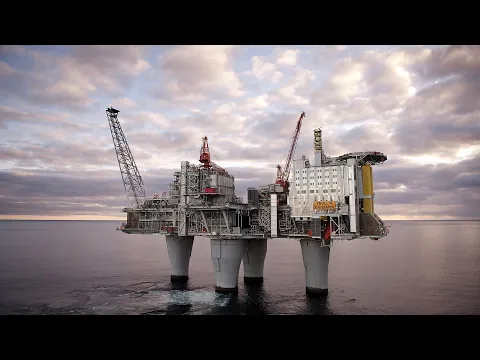

A structure with the weight of an industrial mountain was floated, towed, and installed in the North Sea, in an operation that required extreme stability control.
The Troll A shows that the challenge was not just to build something gigantic. The real achievement was to build a structure of this size, make it float safely, and position it on the seabed with precision.
245 thousand m³ of concrete transformed the platform into an offshore wall
Concrete is the structural heart of the Troll A. The Guinness World Records reports that the platform was made with 245 thousand m³ of concrete, a volume compared by the entity itself to about 215 thousand foundations of common houses.
This concrete was not used as a simple coating or complement. It forms the gravitational base that supports the platform, distributes loads, and allows the structure to remain firm on the seabed.
Aker Solutions also records approximately the same volume of concrete in the project. The company describes the Troll A as the original structure of the Condeep type, a model of gravitational base concrete founded directly on the seabed.
100 thousand tons of steel reinforced a structure equivalent to 15 Eiffel Towers
In addition to concrete, the Troll A used a gigantic amount of steel. The Guinness World Records reports that there were 100 thousand tons of steel, a volume equivalent to approximately 15 Eiffel Towers.
Aker Solutions also points to about 100 thousand tons of reinforcing steel in the project. This steel was essential to provide internal strength to the mass of concrete subjected to extreme loads, hydrostatic pressure, and operational efforts.
The comparison with the Eiffel Tower helps translate the scale for the public. Instead of an urban tower exposed to the wind, the Troll A uses this mass of steel within an oceanic foundation made to survive for decades.
Condeep technology allowed the platform to rest directly on the seabed
The Troll A was built with Condeep technology, a type of gravity-based concrete structure. According to Aker Solutions, this model rests directly on the seabed by its own weight and reduces the need for complex anchorages.

The company states that the concrete “skirts” penetrate the seabed to help secure the foundation. This system allows for stability in deep waters and severe conditions, especially in the harsh environment of the North Sea.
In practice, the platform functions like an industrial city supported by a concrete base. It does not rely solely on cables, piles, or permanent flotation, but on a colossal mass resting on the ocean floor itself.
472-meter structure surpasses many famous skyscrapers
Aker Solutions reports that the structure is about 472 meters in total height, considering the complete platform assembly.
This dimension surpasses the height of many well-known buildings worldwide. The difference is that a large part of the structure is submerged, crossing hundreds of meters of water until it rests on the North Sea bed.
The contrast is visually powerful. A structure taller than many skyscrapers was built to remain almost entirely hidden in the ocean, supporting gas production in a region of high strategic value.
Troll A towing became one of the boldest operations in offshore engineering
The transportation of Troll A was one of the most critical stages of the project. The structure needed to maintain stability during the movement, even being a gigantic mass of concrete and steel carried by the sea.

Equinor reports that Troll A is the tallest structure ever moved by people on the surface of the Earth. The company also notes that the gravity-based substructure was designed for a productive life of 70 years.
This operation required control of ballast, flotation, navigation, and positioning. It was not enough to tow the platform; it was necessary to guide the giant to the exact point and settle it on the seabed.
Troll Field concentrates about 40% of Norway’s gas reserves
The importance of Troll A is not just in structural records. The platform operates in a field that Equinor describes as responsible for about 40% of the total gas reserves of the Norwegian continental shelf.
The field is located in the northern part of the North Sea, about 65 km west of Kollsnes, near Bergen. This location connects offshore production to essential onshore infrastructure for processing and export.
Equinor operates the Troll A, Troll B, and Troll C platforms, as well as the pipelines that reach the coast. The gas processing plant in Kollsnes is operated by Gassco on behalf of Gassled.
Production began in the 1990s and remains central to European energy
Equinor reports that it took over the operation of Troll Gas on June 19, 1996, with gas entering production in the first half of that year. Commercial deliveries under the Troll contracts began on October 1, 1996.
Since then, Troll A has become one of the main contributors to the natural gas production of the Norwegian continental shelf. Equinor itself states that the platform has been the main responsible for the field’s gas production since the start of operation.
The longevity of the project reinforces the importance of the work. The platform was not just a construction feat of the 1990s, but an infrastructure that remains relevant for European energy security.
Troll Field set a historic production record in 2024
In 2024, the Troll field reached a new production record. According to Equinor, 42.5 billion standard cubic meters of natural gas were produced that year, the highest annual volume ever recorded by the field.
The company reported that this result was almost 10% above the previous record, set in 2022. The performance was attributed to high operational regularity, efficiency improvements, and system expansions.
Recent expansions show that the colossus has not yet become a museum piece
Troll A remains connected to new phases of field development. In 2021, according to Equinor, production was expanded to also include the gas cap of the western part of the reservoir, through a major subsea development.
In 2026, Equinor announced a new expansion of the Troll field to deliver more gas to Europe. The company reported an investment of over NOK 4 billion in subsea development to increase production linked to the field.
Troll A Engineering combines civil construction, deep sea, and gas production
Building a platform like Troll A requires a different logic than that used in buildings, bridges, or dams. The structure needs to withstand its own weight, the marine environment, water pressure, corrosion, and industrial loads.
The concrete needed to act as both foundation and structural body at the same time. The reinforcement steel needed to ensure internal resistance for a structure subjected to continuous stresses in an offshore environment.
The difficulty increases because the platform went through completely different phases. It needed to be built on land, floated, towed, sunk with control, and operated for decades in the North Sea.
Norwegian platform became a symbol of concrete, steel, and energy in the ocean
Troll A remains one of the strongest images of Norwegian engineering. Its gravity base shows how concrete and steel can be used on an extreme scale to create a stable structure on the seabed.
The Guinness World Records recognizes the platform for its weight, materials, and record as the heaviest movable object ever made by humans.
Aker Solutions emphasizes the importance of the project as a reference in gravity-based Condeep structures.
Equinor, in turn, shows that the Troll field remains essential for Norway’s gas production. This combination of structural record and energy relevance keeps the platform as one of the largest offshore works on the planet.


