Portuguese
  Spanish


In March 2011, operator Shawn Funk accidentally struck the fossil at the Millennium Mine in Alberta. What seemed like rock was a 110-million-year-old nodosaur, an armored herbivorous dinosaur so well preserved that it still has skin, scales, and armor, today the most complete of its kind.
It seemed like just another workday until the excavator hit something too hard. On the afternoon of March 21, 2011, machine operator Shawn Funk was digging at the Millennium Mine, a massive oil sands crater about 30 km north of Fort McMurray, in Alberta, Canada, when his bucket hit blocks of strange colors. Unknowingly, he had just unearthed a 110-million-year-old dinosaur.
It wasn’t just any skeleton. Later named Borealopelta markmitchelli, the dinosaur is a nodosaur, an armored herbivore, and has reached the present day with its skin, scales, and armor preserved, frozen in stone as it was in life. Weighing almost 1,360 kilograms and measuring 5.5 meters in length, it is considered the best-preserved fossil of its kind ever found in the world.
An ordinary Monday until the bucket found “a dragon”
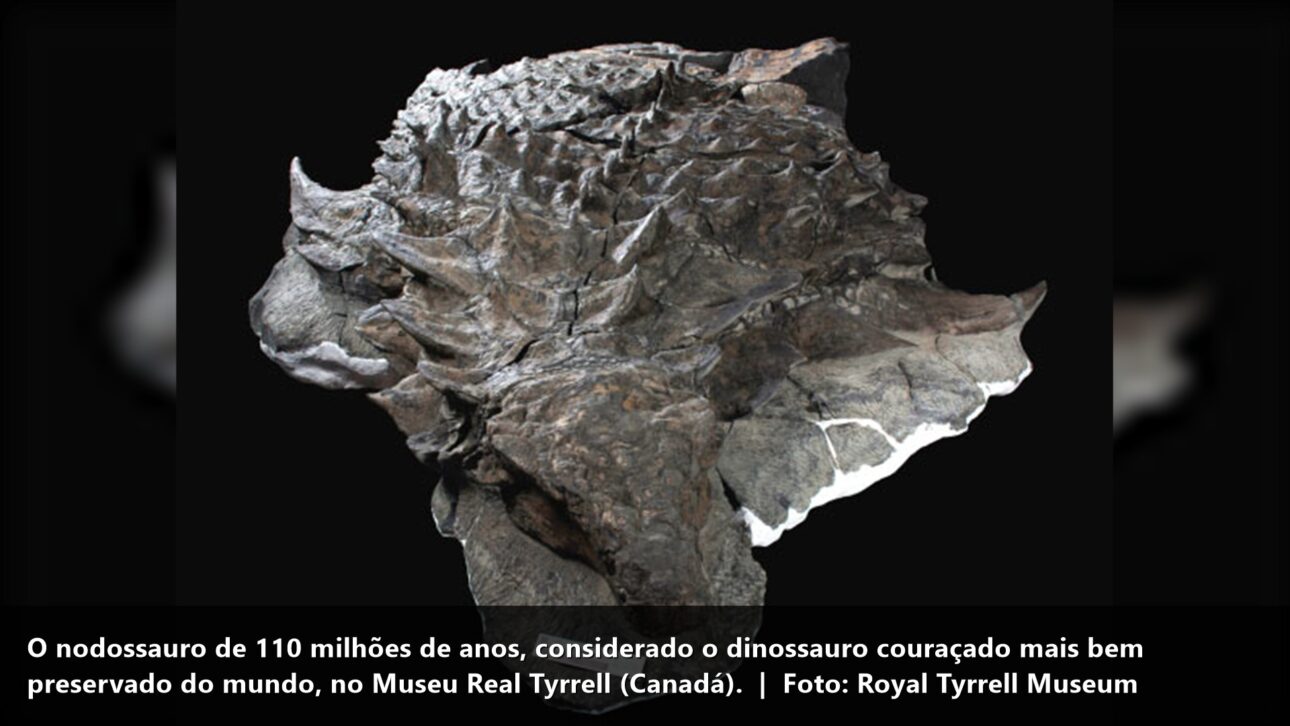
Nodosaur (most preserved fossil in the world)According to information released by the portal National Geographic, Funk’s bucket hit something much harder than the surrounding rock, and pieces of unusual colors tumbled down the slope.
-
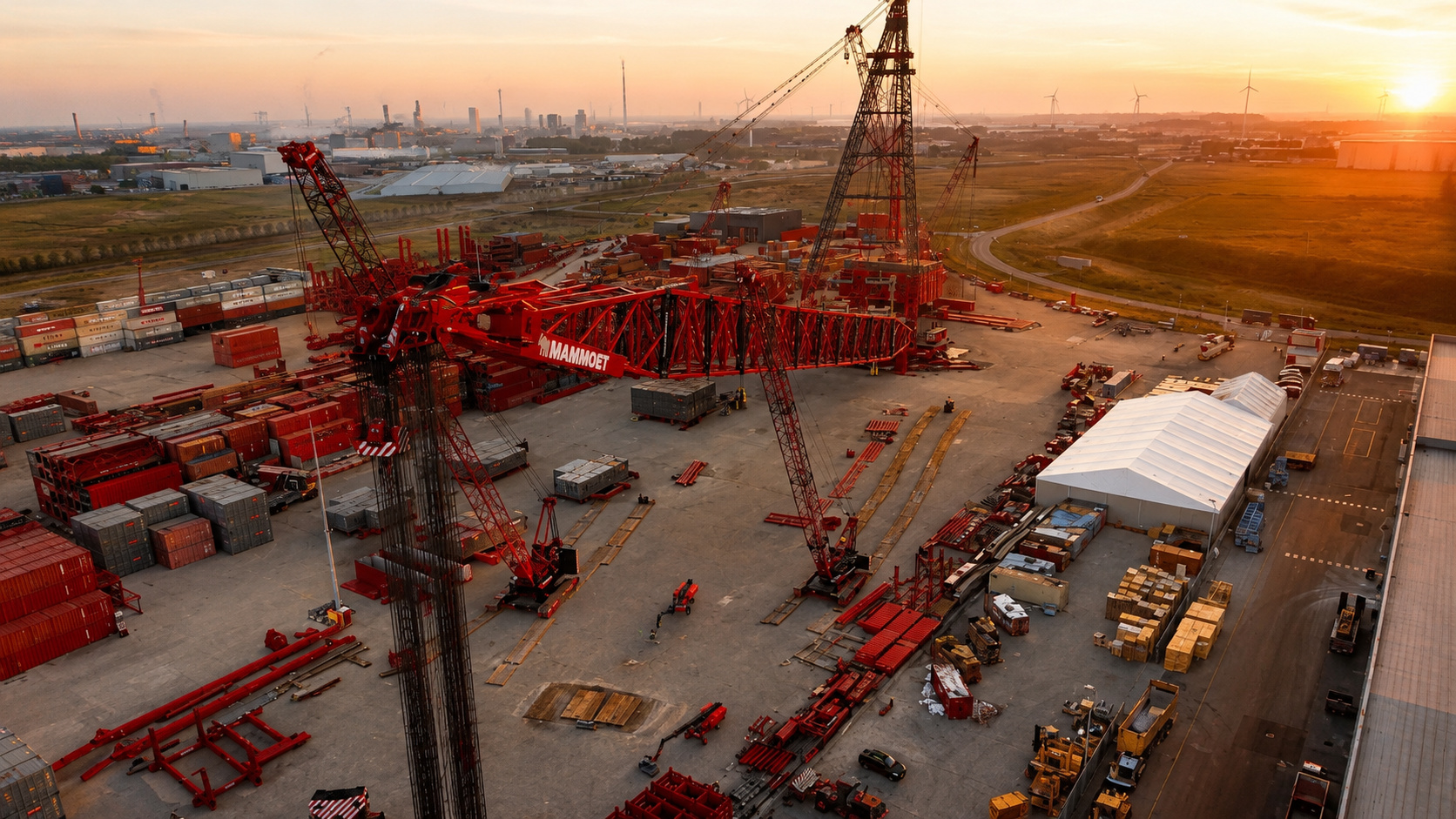
Most powerful land crane on the planet: Mammoet SK6000 lifts 6,000 tons, raises 3,000-ton parts to 220 meters, and carries 4,200 tons of counterweight to unlock mega projects in the offshore wind, nuclear, and oil and gas industries.

-
Two students from SENAI-RS developed AI to help identify rare ocular cancer in children. They were the only Brazilian project in the world finals of Infomatrix in Romania and secured 2nd place with neural networks that promise more accuracy in early diagnosis.

-
Couple replaces the kitchen floor in a Yorkshire village, finds under the 18th-century boards an earthenware mug stuffed with 266 gold coins from 1610 to 1727 and takes the “buried retirement” to auction: final hammer of £754,000, triple the estimate.

-
Archaeologists lift a giant stone in 3,500-year-old ruins in a country neighboring Brazil and discover a ritual treasure buried 3,800 years ago, with human figures, shells, beads, and symbols of a city that connected the Pacific, Andes, and Amazon.



Upon turning one of the blocks, he and the supervisor, Mike Gratton, saw a bizarre pattern: rows and rows of brown discs, each surrounded by gray stone. Alerted, the mining company Suncor contacted the Royal Tyrrell Museum of Palaeontology, which sent a team in haste.
“Right away, Mike said: we need to check this out. It was definitely nothing we had seen before,” Funk recounted. In 12 years operating excavators on that ancient soil, he had only found petrified wood and stumps, never the remains of an animal, much less a dinosaur. What he had hit, however, was a rarity of incalculable value.
Nodosaur: the armored “rhinoceros” of the Cretaceous
The animal belongs to a little-known group. The nodosaur is a type of ankylosaur, but unlike the cousins that adorn cereal boxes, it did not have a club at the end of its tail.
Its defense was different: a spiny armor covering the body and two half-meter spikes projecting from the shoulders, like displaced bull horns.
Between 110 and 112 million years ago, in the middle of the Cretaceous period, this 5.5-meter giant weighing almost 1,360 kilograms was “the rhinoceros of its time,” a solitary and grumpy herbivore.
If a predator like the fearsome Acrocanthosaurus approached, the armor would come into play. At the time, by the way, Alberta was not the cold plain it is today: it resembled southern Florida, hot and humid, on the edge of an inland sea.
Why it became the best-preserved dinosaur in the world
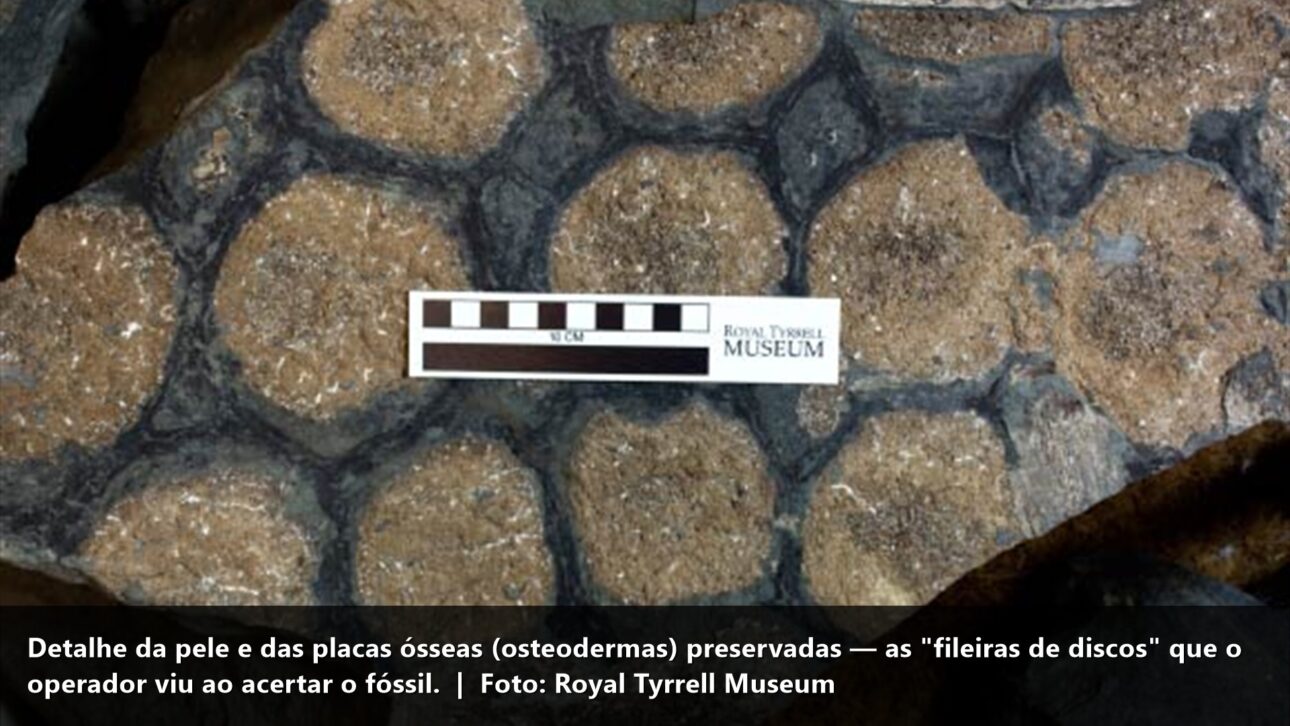
Detail of skin and osteoderms The impressive preservation was the work of chance and the sea. Scientists speculate that the animal died on land, was swept away by a flood into a river, and, bloated by gases, floated belly up for about a week before sinking back-first to the ocean floor.
The mud and minerals quickly enveloped it, shielding the skin and armor before they decomposed.
This rapid burial is what makes the fossil almost unique. Normally, only bones and teeth endure, and it is rare for minerals to replace soft tissues in time.
For paleobiologist Jakob Vinther, from the University of Bristol, the specimen is exceptional: “It is so well preserved that it could have been walking around a few weeks ago. I’ve never seen anything like it.”
7,000 hours to free the “Rosetta Stone” of armors
Removing the dinosaur from the mine was an epic task. The rock was reduced to a 6,800-kilogram block, but when hoisted, it shattered and broke the fossil into pieces—the interior, with a cake-like consistency, couldn’t support its own weight.
It was up to technician Darren Tanke to come up with an improvised plan, MacGyver style, with plaster-soaked burlap, to cover the approximately 676 kilometers to the museum.
In the laboratory, the fine work was done by preparator Mark Mitchell. It took more than 7,000 hours over five years scraping the rock, millimeter by millimeter, until the skin and bones were exposed — “you have to fight for every millimeter,” he summarizes.
The care was such that the species ended up being named in his honor. For curator Donald Henderson, the fossil is the “Rosetta Stone” of nodosaur armor, for preserving the bony plates and the scales between them.
The color of a Cretaceous monster
The fossil still holds a delicate secret: its color. Chemical tests on the skin revealed reddish pigments, and the study that described the species, published in 2017 by Caleb Brown and colleagues, identified a pattern of counter-shading darker back and lighter belly, a common camouflage in animals that need to hide from predators.
The detail changes the perception of the creature. Even armored and the size of a rhinoceros, the nodosaur probably lived under the constant threat of large carnivores otherwise, it wouldn’t need to camouflage itself. Since May 2017, the public can face this ambassador from Canada’s distant past up close, now the centerpiece of an exhibition at the Royal Tyrrell Museum dedicated to fossils found in industrial sites in Alberta.
And you, what would you feel in front of a dinosaur “frozen” for 110 million years?
An excavator strike, an unlikely chain of events, and thousands of hours of artisanal work transformed a “strange rock” into the best-preserved dinosaur on the planet with skin, scales, and armor from 110 million years ago. It is the distant past looking back at us.
Have you ever come face to face with a fossil that left you speechless or what would you most like to know about this mummy dinosaur? Tell us here in the comments.