





 Portuguese
  English
  Spanish
  4 min of reading
  0 comments



Proposal Approved by the Chamber in 2025 May Extend the Requirement for Toxicology Tests for Those Seeking Their First License in Categories A and B, but the Rule Was Vetoed and Still Depends on a Decision from the National Congress.
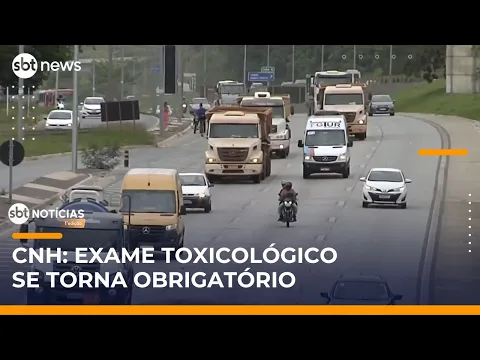
The Chamber of Deputies approved this year a text that included the mandatory requirement for a negative toxicology test for those seeking their first license in categories A and B.
The provision was inserted in the Bill 3965/2021, which gathers amendments to the Brazilian Traffic Code (CTB).
This text approved by the deputies stipulated that the toxicology test would be mandatory for those requesting the first license in categories A and B, applying the same requirement already adopted for professional drivers in categories C, D, and E.
-
The noise law will no longer be in effect at 10 PM starting in June with a new rule valid during the 2026 World Cup.

-
The Chamber opens a debate on driver’s licenses at 16 years old as part of a reform that includes around 270 proposals to change the Brazilian Traffic Code and may redesign rules for licensing, enforcement, and circulation in the country.

-
The new Civil Code could revolutionize marriages in Brazil with “express divorce” and changes that could exclude spouses from inheritance.

-
Banco do Brasil sues famous influencer for million-dollar debt and intensifies debate on delinquency, risks of seizure, and direct impact on Gkay’s credibility.


According to the justification presented during the processing, the measure aimed to enhance road safety and increase control over the use of psychoactive substances among candidates for motorcycle and car drivers.
The provision, however, received a presidential veto and still depends on deliberation by the National Congress. Until now, the requirement is not in effect.
How It Works Today in the Brazilian Traffic Code
The current legislation requires the toxicology test only for drivers in categories C, D, and E, aimed at drivers of cargo and passenger transport vehicles.
In categories A and B, the test is not part of the process for obtaining the first CNH.
This configuration remains in force, as the presidential veto suspended the extension of the requirement until a new deliberation by Congress.
Processing and Status of the Veto
The vetoed provision was sent to Congress as Veto No. 17/2025 and has been “ready for Plenary deliberation” since July 2025.
The federal government justified the veto by arguing that the measure could impose disproportionate burdens on candidates and that the oversight of substances should be directed to professional drivers.
In October 2025, the Minister of Transportation advocated, in a meeting with legislators, for the maintenance of the veto, emphasizing the need for technical analysis regarding administrative and financial impacts before any extension of the test.
As of the last check, the veto remained pending for voting in a joint session of the National Congress.

What Would Change for Categories A and B
If the veto is overturned, the issuance of the Permit to Drive would depend on the presentation of a negative toxicology report.
The test would be conducted at posts and clinics accredited by Senatran, with the results electronically recorded in the candidate’s file and available for verification by the traffic executive bodies.
The obligation would add a step to the licensing process, to be fulfilled before completing the practical test.
Traffic management specialists state that the measure would require administrative adjustments in the Detrans and Driver Training Centers, especially in system integration and in controlling deadlines for issuing reports.
What Would Remain the Same
Even with the inclusion of the toxicology test, the traditional steps for the first license — medical and psychological evaluation, theoretical course, practical lessons, and tests — would still be valid.
The new requirement would only add to the process if the veto is overturned and the Executive Power publishes the regulatory norms.
Rules That Depend on Regulation
The eventual implementation of the measure would depend on regulation by the National Traffic Council (Contran) and the National Traffic Secretary (Senatran).
This step would define the collection procedures, validity periods of the test, data integration formats and protocols for inconsistencies.
Sources linked to Senatran state that, even with the legal provision, execution would only be possible after national standardization to ensure uniformity of oversight and electronic registration across all states.
Expected Impacts on Detrans and CFCs
If the test comes into effect, the Detrans would need to adjust their internal systems to integrate information from laboratory reports.
The change would also require updates to schedules at the Driver Training Centers (CFCs), to include the material collection step before issuing the Permit to Drive.
Technicians linked to the National Traffic System evaluate that the adaptation would be feasible but would require investments in technological infrastructure and staff training to ensure automatic data crossover between laboratories and traffic authorities.
Debate Between Entities and Specialists
The approval of the project and the presidential veto reignited discussions among traffic entities, medical organizations, and road safety specialists.
Representatives from public health emphasize that the toxicology test can help identify the use of substances that affect driving ability.
Traffic sector analysts argue that the expansion of the requirement must consider additional costs for candidates and the operational capacity of the executive bodies.
According to the Ministry of Transport, maintaining the veto aims to avoid administrative overload and ensure that any changes are preceded by technical studies.
Guidance for Those Seeking Their First CNH
Anyone looking to start the process for their first license in categories A or B should follow the steps currently in effect: medical and psychological exams, theoretical course, practical lessons, and assessments.
The toxicology test is not required at this time.
Any changes will depend on the outcome of the vote on Veto No. 17/2025 and, if overturned, the publication of regulatory norms by the federal government.
Candidates should follow the communications from the state Detrans and the official updates on the topic.
Would the toxicology test for new drivers be an advancement for safety on the roads or merely an additional cost for those seeking their first CNH?









-

Uma pessoa reagiu a isso.