





 Portuguese
  English
  Spanish
  4 min of reading
  0 comments


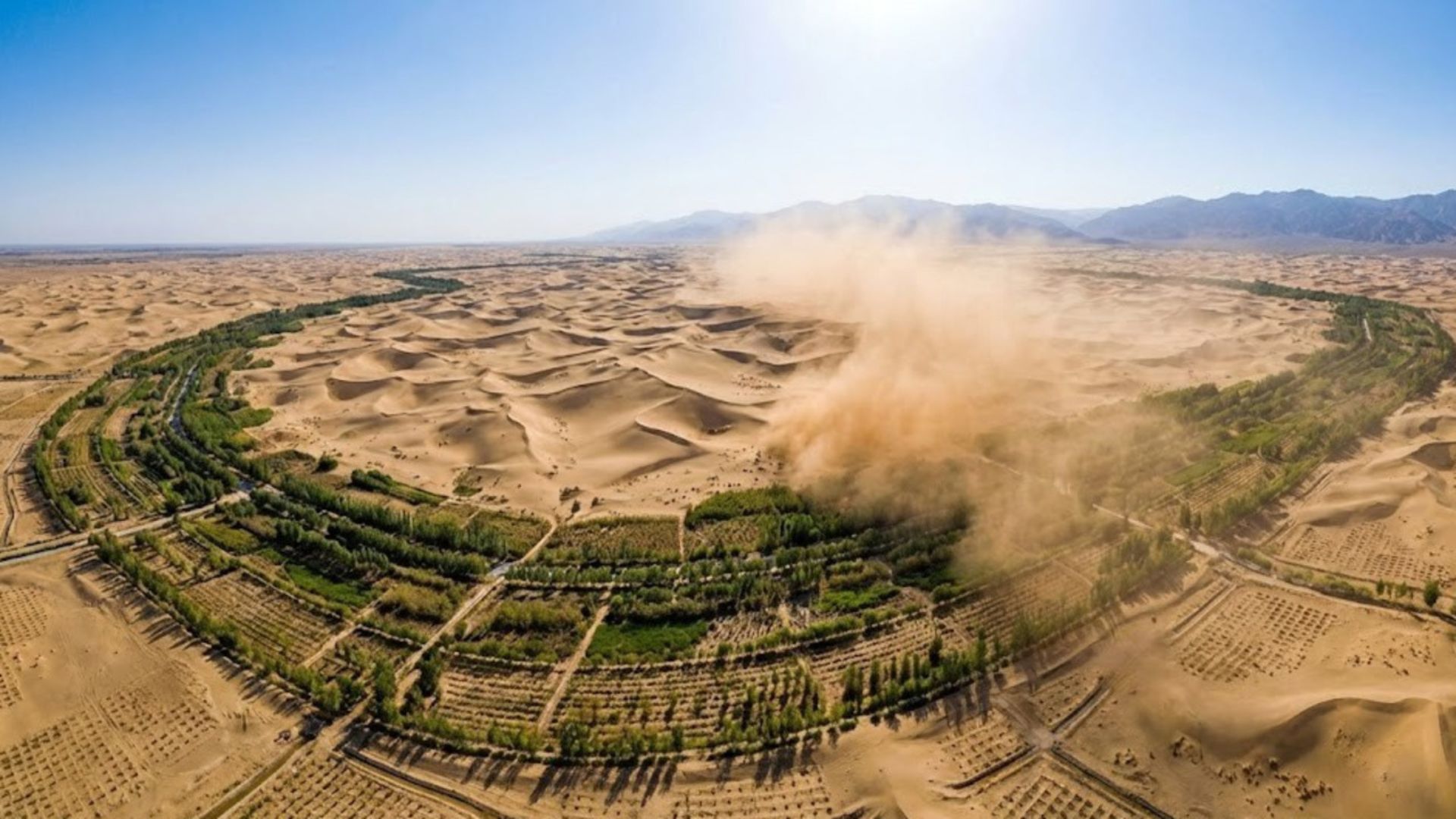
Green Belt of Continental Scale Combines Ancestral Techniques and Solar Technology to Contain Sand Dunes, Reduce Sandstorms and Protect Chinese Cities by the Middle of the Century, in a Project Launched in the 1970s That Advances Over Strategic Desert Areas and Redefines the Fight Against Desertification in the Country.
China completed, at the end of November 2024, a green belt of 3,046 kilometers that surrounds the Taklamakan Desert in the Xinjiang region.
The closing of the loop was announced by local authorities and the state press as a milestone in a campaign launched in 1978 to contain the advance of dunes and reduce sandstorms that hit populous areas.
The enterprise is part of the Three-North Shelter Forest Program, considered the largest effort to combat desertification in the country.
-
Unknown Brazilian rewrites one of the pillars of physics and gains global prominence: discovery made in Rio becomes central theme of the 2027 Nobel Prize.

-
Brazilian city neighboring Paraguay becomes a ‘magnet’ for people seeking quality of life and high standards with exceptional growth and commutes of up to 15 minutes.
-
A rare storm transformed part of the Gulf into an unlikely scene of hail, extreme rain, and tornado risk in the middle of the desert, with volumes that exceeded the annual average in a single day.

-
Brazil catches the world’s attention with ships powered by ethanol and biodiesel that have lower emissions, an unprecedented certification with advantages in chartering, and a revolution in cabotage.


The strategy combines traditional sand stabilization techniques, large-scale planting, and solar energy solutions for irrigation and vegetation maintenance.
Reports released by international media associate the effort with more than 30 million hectares reforested over the decades.
The horizon of the project remains set on 2050.
Taklamakan at the Center of the Strategy Against Desertification
The Taklamakan is the largest desert in China and one of the largest areas of mobile dunes in the world.
The completion of the 3,046 km belt, announced as having occurred on November 28, 2024, marks the end of a stage built gradually over decades.
The interventions focused on points considered more vulnerable to wind action and sand transport.
Despite the image of a “green fence,” the project is not limited to a continuous strip of trees.
It consists of a set of containment measures, featuring vegetation mosaics, soil stabilization structures, and protection corridors around roads, settlements, and agricultural areas.

In parallel, the Chinese government associates this type of work with national goals for expanding forest coverage and reducing areas affected by desertification.
Independent analyses, however, report concerns about the survival of seedlings in arid regions.
There is also debate about the weight of natural climatic factors in the variation of sandstorms.
The “Yellow Dragon” and the Impact of Sandstorms
Sandstorms known locally as the “Yellow Dragon” are considered one of the main environmental threats in northern China.
These events are associated with strong winds that lift dust and sand grains.
The effects include drastic reductions in visibility, transport disruptions, and increased concentrations of harmful particles in the air.
Dust clouds can reach cities far from the desert areas.
This expanded reach reinforces the logic of creating physical and biological barriers to limit the mobility of the dunes.
Experts emphasize that the dynamics of the storms also depend on seasonal atmospheric patterns and land use.
For this reason, attributing changes solely to containment works remains a technical challenge.
Straw as an Engineering Base to Stabilize Mobile Dunes
One of the central techniques adopted in the project is known as straw checkerboard.
Instead of planting directly in loose sand, teams install bundles of straw partially buried.
These bundles form squares on the ground, usually measuring about one meter by one meter.
The straw creates roughness on the surface and reduces wind speed close to the ground.
With less energy, the wind loses its capacity to carry sand grains.
The sand begins to accumulate within the squares, stabilizing the ground.
This initial stage allows for planting seedlings in a less unstable environment.
Over time, the roots of the plants take on the role of permanent soil stabilization.
Solar Energy and Irrigation in Areas Without Electricity
Another front of the project involves the installation of large areas of solar panels in sandy regions.

Initiatives of this type have expanded in areas such as the Kubuqi Desert and regions near the Taklamakan.
In addition to generating electricity, the panels act as artificial barriers against the wind.
They create shade, reduce soil evaporation, and alter the local microenvironment.
The energy produced on-site replaces diesel engines in irrigation systems.
This electricity powers pumps used to extract groundwater and maintain strips of vegetation.
The use of irrigation is considered one of the most sensitive points of the model.
Crops in arid regions rely on water, a limited resource in desert areas.
For this reason, authorities emphasize the selection of species more resistant to drought and saline soil.
Goals Until 2050 and the Debate on Reforestation Efficiency
Launched in 1978, the Three-North Shelter Forest Program has an official execution deadline until 2050.
Information released by official channels indicates that the program covers about 42% of Chinese territory.
Data presented by the government indicates increased forest coverage in the serviced areas.
The rate would have increased from 5.05% in 1978 to 13.84% in 2023.
These figures are used as evidence of progress in controlling desertification.
Researchers, however, warn of recurring challenges, such as seedling mortality and the risk of monocultures.
There are also concerns about the compatibility between vegetation expansion and water availability.
With the 3,046 km belt announced as closed, China signals that it will continue to expand the ecological barrier.
The central question now is how to measure, over time, the real impact of these interventions on sandstorms and on local ecosystems.







-

-

-

-

-

27 pessoas reagiram a isso.