





 Portuguese
  English
  Spanish
  5 min of reading
  2 comments


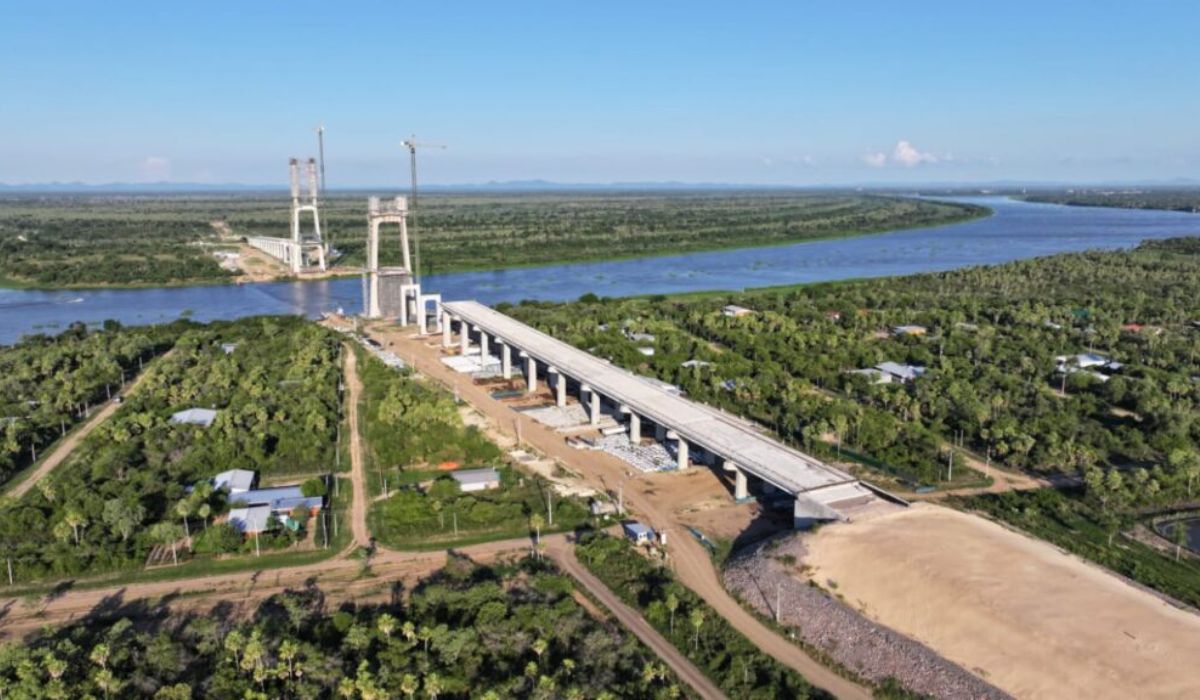


International Bridge in the Midwest Integrates Bioceanic Corridor and Repositions Commercial Routes Between South America and Asia, with Direct Impact on Logistical Deadlines, Border Infrastructure, and International Freight Transport Strategies.
The international bridge under construction between Porto Murtinho in Mato Grosso do Sul and Carmelo Peralta in Paraguay is seen by the governments and experts involved in the project as one of the main links to reduce transport times for cargo between Mercosur and Asian markets.
The structure integrates the Bioceanic Route and, according to official estimates, can shorten the journey of goods by up to 15 days compared to routes currently used.
The project aims to provide a logistical alternative to the traditional outflow via the Atlantic Ocean.
-
Middle East War Hits Fertilizers and Transportation and May Strain Brazilian Wallets

-
Russia Considers Suspending Gas to Europe After Surge in Energy Prices

-
How A War Thousands of Miles From Brazil Started Disrupting Global Shipping Routes, Raising Container Costs, and Putting Up to 40% of Brazilian Beef Exports at Risk

-
Iran-U.S. War Drives Up Oil Prices and Pressures Global Financial Markets


The proposal is to allow Brazilian cargo to travel by land to ports in northern Chile on the Pacific Ocean, from where vessels head to Asia.
Authorities involved state that the redesign of the route could reduce operational costs and timelines, depending on the type of cargo and the port of departure.
With approximately 1.3 kilometers in length, the bridge spans the Paraguay River and was designed to support heavy vehicle traffic.
Projections released by the government of Mato Grosso do Sul indicate that, upon completion, approximately 250 trucks are expected to cross daily over the structure, a number that may vary according to the consolidation of the logistical corridor.

Bioceanic Route and Change in Cargo Flow
Currently, most Brazilian exports and imports utilize ports on the Atlantic coast, with long maritime journeys to the Asian market.
The Bioceanic Route proposes a change to this framework by creating an international roadway corridor connecting Brazil’s Midwest to Paraguay, Argentina, and later Chile.
According to logistics sector experts, the possibility of accessing the Pacific by land could represent a strategic alternative for certain commercial flows.
However, specialists emphasize that the effective adoption of the route will depend on factors such as costs, trade agreements, available infrastructure in the countries involved, and the efficiency of destination ports.
The debate also involves international e-commerce.
Asian online sales companies, such as Shein and Temu, are frequently mentioned in discussions about delivery timelines for Brazilian consumers.
Nonetheless, there is no public confirmation that these platforms will specifically use the bioceanic corridor, as decisions of this nature depend on private contracts and each company’s logistical strategy.
Public Investment and Access Construction in Brazil
The total investment associated with the project is usually presented in parts.
According to official information, the binational bridge has an estimated cost of R$ 575.5 million, funded by a consortium involving Brazil and Paraguay.
In parallel, the National Department of Transport Infrastructure is responsible for access construction on the Brazilian side.
These accesses comprise around 13 kilometers on the BR-267, including the implementation of bridges, overpasses, and roadway adjustments.
The amount reported by the federal agency for this phase is approximately R$ 472 million, within the New PAC program.
Considering both fronts, the total amount approaches R$ 1 billion.
In addition to the direct connection to the bridge, other roads in the region are undergoing interventions to ensure capacity and safety for truck traffic.
DNTI technicians highlight that the functionality of the corridor depends on the integration between the new structure and the existing network, avoiding bottlenecks outside the bridge area.
Border, Customs, and Operational Bottlenecks
The anticipated increase in heavy vehicle traffic brings additional challenges for border control systems.
Authorities involved in the project assess that to ensure real time gains, it will be necessary to expand and modernize inspection areas, customs, and screening yards in the region.
According to international logistics experts, projects of this scale typically require not only physical infrastructure but also adjustments to administrative procedures.
Otherwise, part of the savings obtained in transport could be neutralized by queues and delays at control points.
In the case of Porto Murtinho, the federal government classifies the accesses as part of a new international logistics corridor.
The official expectation is that the city will come to play a significant role as a transit point and support for foreign trade, expanding its function beyond local production.
Reduction of Deadlines and Effects on International Logistics
In institutional communications, the government of Mato Grosso do Sul states that the Bioceanic Route, with an approximate length of 2,400 kilometers, has the potential to reduce time and costs in transport between Mercosur and Asia.
The estimate of up to 15 days less in the journey considers comparisons with traditional maritime routes but may vary according to the adopted itinerary.
Experts emphasize that the logistical gain is not uniform for all cargo.
The time saved depends on the destination port, the type of goods, the need for cargo consolidation, and integration with international carriers.
Nevertheless, shorter deadlines tend to facilitate logistical planning and inventory management.
In foreign trade, the reduction of days in transport is seen as a relevant factor, especially in long supply chains, where delays can generate additional costs.
Sector analysts emphasize that these effects can only be measured more accurately after the corridor begins operations effectively.
Schedule of the Bridge and Expected Deliveries
The schedule released by state authorities indicates that the bridge is expected to be completed in the second half of 2026.
Meanwhile, the construction of road access on the Brazilian side is expected to be completed by the end of the same year, according to DNIT.
However, the full operational delivery of the corridor depends on the completion of road sections in neighboring countries and the adaptation of border structures.
Even so, the physical connection over the Paraguay River is treated by public managers as a central step to enable the route.







Muito interessante. Uma verdadeira revolução comercial. Tudo que se fizer pela evolução da independência de certas rotas é um progresso imenso.
Precisamos nos livrar do canal do Panamá. Passagem sob controle dos EUA, sem confiabilidade.