





 Portuguese
  English
  Spanish
  4 min of reading
  0 comments



European Project Develops New Technology With Carbon Fiber Capable of Detecting Damage and Allowing Future Spacecraft to Repair Themselves, Increasing Safety and Reusability in Space.
A new technology based on carbon fiber is being developed in Europe with the aim of allowing future spacecraft to repair themselves during space missions.
The system uses sensors and smart materials capable of identifying structural damage and automatically initiating a repair process.
The initiative involves the Swiss companies CompPair and CSEM, as well as the Belgian Com&Sens, with support from the European Space Agency (ESA).
-
China is testing a train that will operate at 400 km/h in daily service, which is 80 km/h faster than the French TGV, and uses carbon fiber, magnesium alloys, and more than 4,000 sensors to become the fastest commercial train on the planet.

-
Forget about having an air fryer, electric oven, and steam pot taking up space in your kitchen because a 30-liter smart oven combines all these functions, automatically selects the ideal temperature, and even turns off by itself when cooking is done.

-
Engineers rewrote all the apps from scratch and bet everything on a buttonless screen: now the creator of the iPhone says that Apple needs to make the same revolution again because of AI.

-
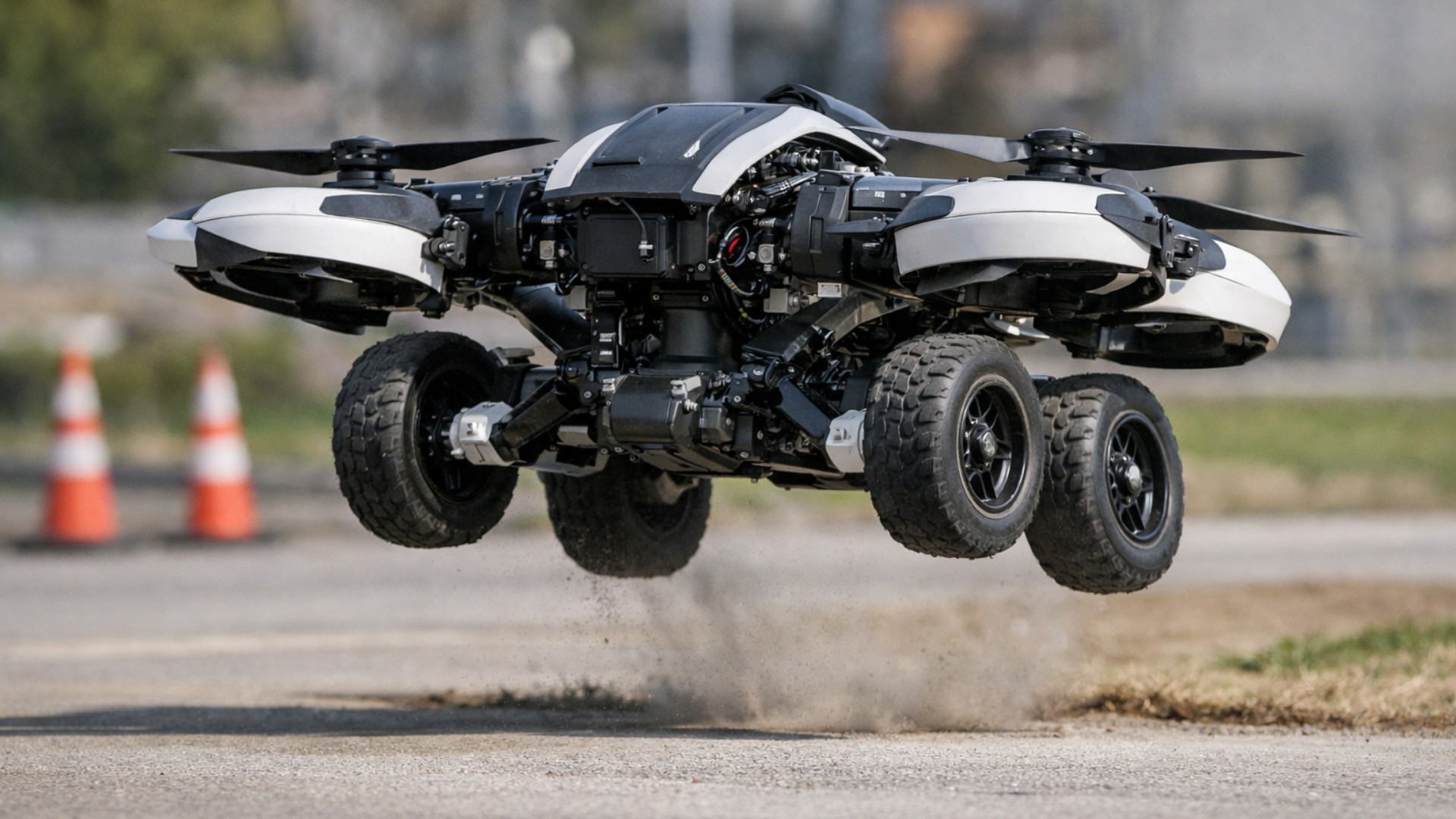
Researchers in the U.S. have created a flying robot that transforms into a land vehicle while still in the air. The technology, based on aerodynamic transition, converts landing into a scene worthy of Transformers and redefines mobility between sky and ground.

The project is part of a research program that seeks to make space missions safer, reduce maintenance costs, and increase the durability of rockets and other orbital structures.
If the technology progresses to real applications, it could help create more resilient spacecraft ready to face the extreme conditions of space.
Sensors Monitor Damage and Activate Auto Repair
One of the main innovations of the new technology is the use of fiber optic sensors embedded directly into the structural material.
These sensors function as a continuous monitoring system. They track the condition of the structure and can identify small cracks or deformations at an early stage.
As soon as they detect damage, the system activates a mechanism that initiates the recovery process of the material.
This combination of sensors and automatic repair is considered essential for the development of future spacecraft that repair themselves, reducing the need for manual maintenance.
Cassandra Project Invests in Smart Materials
The development of this technology is part of the Cassandra Project, whose name comes from the expression in English Composite Autonomous SenSing AnD RepAir.
The program focuses on creating composite materials capable of detecting structural flaws and initiating repairs autonomously.
In practice, the goal is to transform structural components into intelligent systems that monitor and preserve their own integrity.
This type of approach can be especially important in long-duration space missions, where external repairs are extremely complex.
Carbon Fiber Allows Light and Strong Structures
The structural basis of this new technology is formed by composite materials reinforced with carbon fiber, widely used in the aerospace industry.
These materials combine polymers with extremely strong fibers, creating lightweight structures with a high load-bearing capacity.
Because of these properties, carbon fiber is already used in components of rockets, satellites, and fuel tanks.
However, even advanced structures can suffer damage over time due to impacts, intense vibrations, or sudden temperature changes.
To address this issue, researchers have developed a system capable of detecting these flaws and correcting them automatically.
HealTech Activates Internal Agent to Repair Cracks
The solution created by the company CompPair is named HealTech.
This composite material has a healing agent incorporated into its structure. When heated, this agent reacts and helps to close cracks present in the material.
The process occurs when the system heats the structure between 100 °C and 140 °C, allowing the material to recover part of its original strength.
To generate this heat, aluminum grids produced by 3D printing have been integrated into the material, functioning as small heaters distributed throughout the structure.
Thus, cracks can be sealed before they become larger structural damages.
Tests Simulate Impacts and Extreme Temperature Variations
Researchers have already conducted several tests to evaluate the performance of the technology.
During the experiments, samples of different sizes were subjected to mechanical impacts and thermal shocks that simulate conditions faced in space.
Among the tested scenarios are situations similar to those experienced by cryogenic tanks, used to store extremely cold fuels.
The results showed that the system was able to quickly identify damage, activate heating uniformly, and restore part of the structural strength of the material.
Future Spacecraft Could Become More Durable
The next phase of the project foresees the application of the technology in larger components, including complete fuel tanks.
If the results continue to be positive, the innovation could contribute to creating future spacecraft that repair themselves, making rockets and space structures more durable.
Moreover, the technology could help reduce waste and facilitate the development of reusable spacecraft.
For industry experts, the combination of new technology, carbon fiber, and self-repair systems could represent an important advancement for the future of space exploration, allowing for longer, safer, and more efficient missions.
Source: Olhar Digital







-

-

-

7 pessoas reagiram a isso.