





 Portuguese
  English
  Spanish
  7 min of reading
  0 comments


New Images Indicate That 3I/ATLAS Remains Whole After Perihelion, Reinforcing the Status of Anomalous Interstellar Comet, With Giant Jets and Unusual Behavior That Intrigues Experts and Divides the Scientific Community, Including Avi Loeb
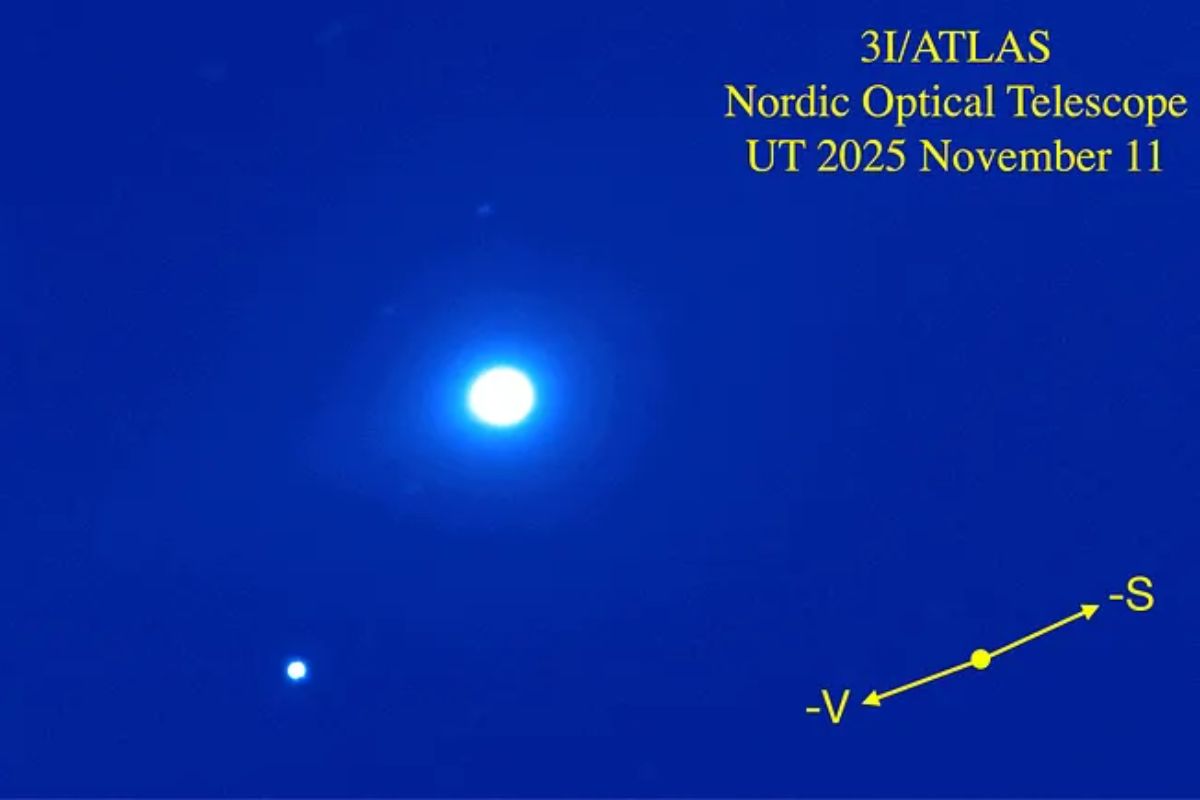
The 3I/ATLAS has returned to the center of scientific debate after new observations confirmed that the interstellar comet remains whole after perihelion. The latest images, taken on November 11, 2025, with the Nordic Optical Telescope, show a single body, with no signs of fragmentation, but displaying complex structures such as a sunward anti-tail and asymmetries in the opposite direction. For many researchers, this would be just another chapter in the physics of comets. For others, like Avi Loeb, the data suggest that there is something unexpected about the behavior of this interstellar visitor.
What makes 3I/ATLAS so unique is the combination of structural integrity after perihelion, giant jets extending millions of kilometers, and an energy budget that is difficult to reconcile within the traditional parameters of a natural comet. Loeb, a Harvard scientist and head of the Galileo Project, argues that the intensity and scale of these jets, combined with the maintenance of a single nucleus, create a physical anomaly that has not been satisfactorily explained. According to him, when calculating the energy needed to sustain such jets, the result does not match the estimated size of the nucleus of 3I/ATLAS.
New Images Confirm 3I/ATLAS Intact After Perihelion

The new images of 3I/ATLAS, obtained by the Nordic Optical Telescope in La Palma, clearly show that the object remains a single body after passing through the perihelion two weeks earlier.
-
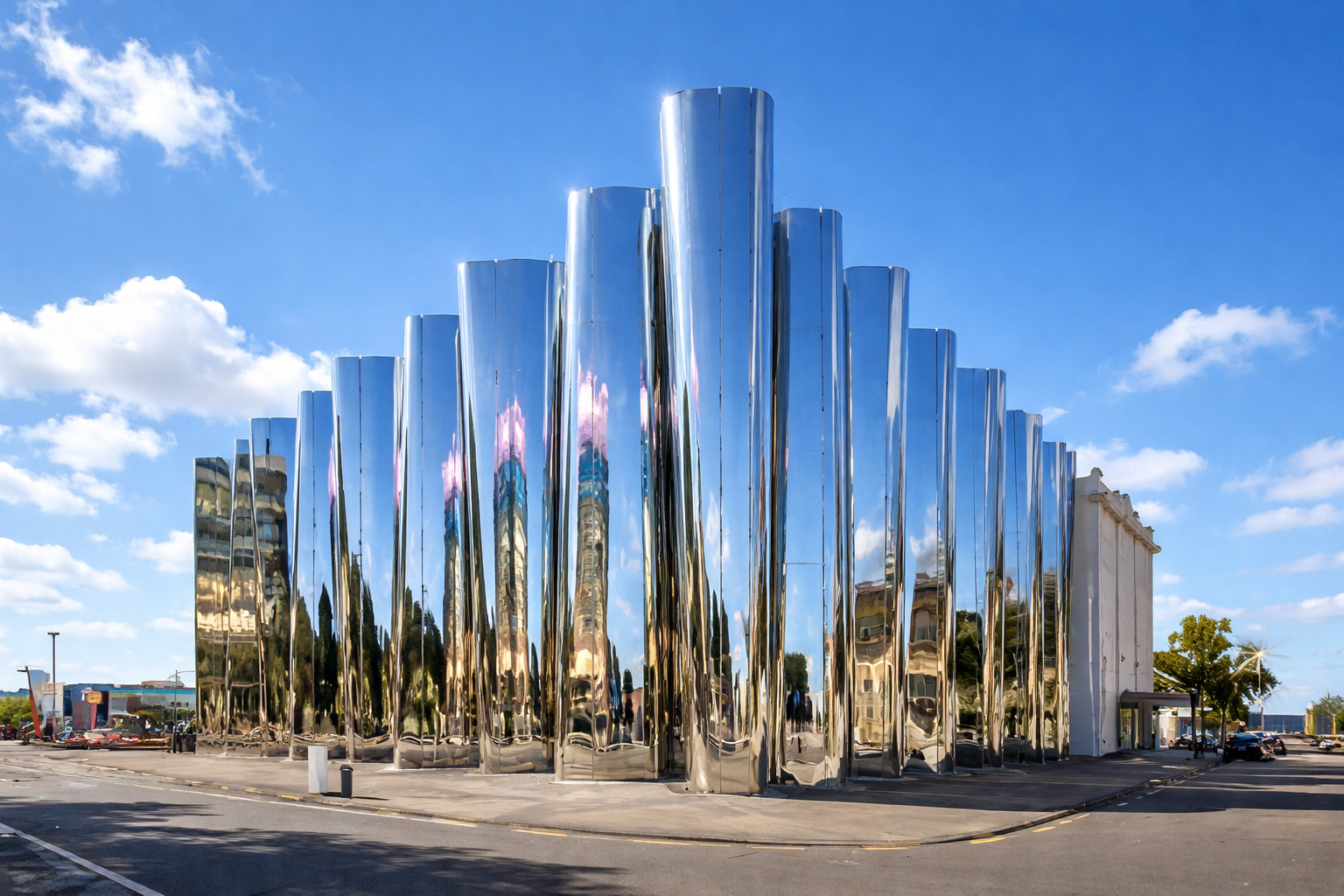
New Zealand builds a shimmering building that vibrates, featuring a 62-seat cinema, moving sculptures, and an environment where sound, light, and energy are felt in the body.
-
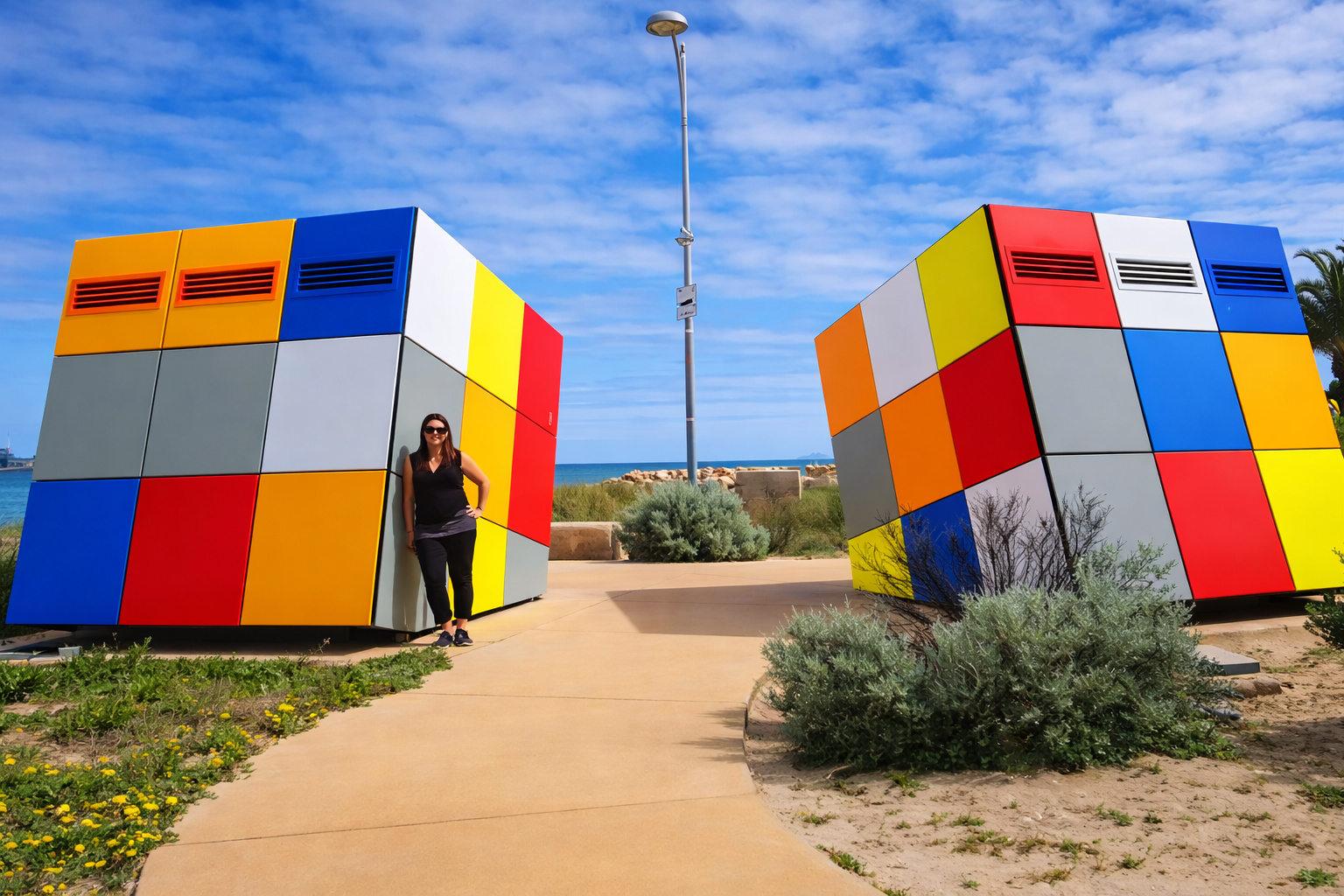
Two colored cubes of 2.5 m transform a public bathroom into a selfie spot in Western Australia, costing up to 75% less than traditional construction and helping to reduce vandalism in public spaces.
-
Santa Catarina produces up to 7 times more than it consumes in some sectors, and its century-old industries founded by grandparents and great-grandparents now compete on equal footing with Germany and the United States in the international market.

-
U.S. war giant weighing 9,600 tons and equipped with long-range missiles is sent to the Atlantic to protect global internet and hunt submarines.


There is no evidence of significant fragmentation, although the structure around the nucleus is highly complex.
The elongation of the brightness projects at a very close angle to the direction of the Sun, setting up a sunward anti-tail, something already seen in previous observations, including with the Hubble Space Telescope.
At the same time, a weaker asymmetry appears in the anti-solar direction, typical of an interstellar comet interacting with the solar wind.
On a physical scale, the imaged field covers about half a million kilometers, a dimension that in itself already evidences the size of the giant jets associated with 3I/ATLAS.
For Avi Loeb, the fact that 3I/ATLAS remains intact after such activity near the perihelion reinforces the perception that this is not a trivial case.
The natural expectation for a comet subjected to intense thermal and tidal forces would be some degree of fragmentation, especially given such extensive and persistent jets.
Giant Jets and Anomalous Behavior of the Interstellar Comet

here )
One of the central points of discussion is the scale of the giant jets observed in 3I/ATLAS. Previous wide-field images show structures extending about 1 million kilometers toward the Sun and up to 3 million kilometers in the opposite direction.
For a natural interstellar comet, an exit speed of around 0.4 km/s is assumed, related to the physics of the gas that sublimates at the distance where the object is from the Sun.
From this speed, Avi Loeb estimates that these giant jets should persist for a period of one to three months, implying a mass flow of around 5 billion tons per month for each area of one million square kilometers.
This rate of mass loss is compatible with an extremely active comet, but raises doubts when confronting the volume of material and energy required with the inferred size of the nucleus of 3I/ATLAS in previous observations.
In terms of energy, just the sublimation of carbon dioxide (CO₂) would require something like 3 x 10¹⁸ joules during the perihelion passage, considering an interval of about a month.
At the distance in question, the solar flux would be around 700 joules per square meter per second. To meet this energy balance, an absorption area greater than 1,600 square kilometers would be needed, equivalent to the surface of a sphere approximately 23 kilometers in diameter.
The problem, highlighted by Avi Loeb, is that the maximum estimated diameter for 3I/ATLAS from Hubble data is around 5.6 kilometers.
For water ice, the calculation becomes even less favorable, requiring a body about 51 kilometers in diameter.
In natural comets, moreover, the active areas usually occupy only a fraction of the total surface. This accentuates the discrepancy between what is observed and what standard models of interstellar comets suggest.
The Physical Anomaly According to Avi Loeb
In Avi Loeb‘s view, the picture painted by the data from 3I/ATLAS configures a concrete anomaly.
On one side, there are giant jets of great reach, with high mass flow and energy.
On the other, the nucleus remains a single compact body after the perihelion, with a maximum estimated diameter that does not alone support the calculated energy balance.
This combination leads Loeb to assert that 3I/ATLAS represents a direct challenge to traditional knowledge about comets in the Solar System.
He emphasizes that it is not just a statistical detail or a small model correction, but a structural inconsistency between size, absorbed energy, and intensity of the giant jets.
Within this logic, insisting on treating 3I/ATLAS as a conventional comet, without addressing the anomalies, would mean ignoring relevant signals that something different may be happening.
In quoting Albert Einstein — “knowledge is perceiving that the street is one-way; wisdom is looking both ways anyway” — Avi Loeb argues that the scientific community should keep an open mind for alternatives, without confusing critical spirit with automatic resistance to unconventional interpretations.
For him, 3I/ATLAS is precisely the type of case in which the discomfort with the data requires more investigation, not less.
Possible Explanations and the Technological Hypothesis
Among the alternatives raised by Avi Loeb, is the possibility that part of the behavior of 3I/ATLAS may be compatible with a directed propulsion system, rather than pure natural sublimation.
He suggests that technological thrusters, expelling gases in the direction of the Sun, could accelerate the object in the opposite direction after perihelion, also taking advantage of the gravitational assistance of the star to gain speed.
This idea is not presented as a conclusion, but as an exploratory hypothesis in light of an interstellar comet that does not comfortably fit traditional equations.
Loeb argues that if humanity accepts studying artificial signals in other domains — such as radio, laser, or hypothetical megastructures — it wouldn’t make sense to dismiss, by principle, the possibility of artificial behavior in objects like 3I/ATLAS, especially when the energy and active area numbers seem incompatible with a simple natural body.
At the same time, Loeb himself acknowledges that it is necessary to continue refining measurements, testing alternative models, and comparing 3I/ATLAS with other interstellar visitors.
The anomaly, according to him, should not be seen as proof of technology, but as motivation for future observations to be more comprehensive, precise, and transparent.
The Role of 3I/ATLAS in the Science of Interstellar Objects
Regardless of the interpretive outcome, 3I/ATLAS has already established itself as a landmark in the study of objects coming from outside the Solar System.
The fact that it is an interstellar comet with giant jets, sunward anti-tail, and preserved integrity after the perihelion makes this case a natural laboratory for testing theories of formation, orbital dynamics, and interaction with solar wind.
For Avi Loeb and other researchers, the main immediate legacy of 3I/ATLAS is to push the boundary of discussion: to what extent are our comet models robust when confronted with data from interstellar objects?
And at what point does an anomaly cease to be just “noise” and begin to require a revision of concepts or consideration of bolder scenarios?
As new images and analyses are produced, one thing seems clear: 3I/ATLAS will not be remembered merely as “another comet.”
It has become a practical test of science’s willingness to seriously evaluate its own limits, something that Avi Loeb, from Harvard, has been insisting on placing at the center of public debate.
Do you think the case of 3I/ATLAS will still be explained by a more refined natural model, or do you consider it legitimate for science to keep open, at least as a working hypothesis, the possibility of a technological origin for part of this behavior?







-

-

-

-

-

9 pessoas reagiram a isso.