





 Portuguese
  English
  Spanish
 3 min of reading
  0 comments


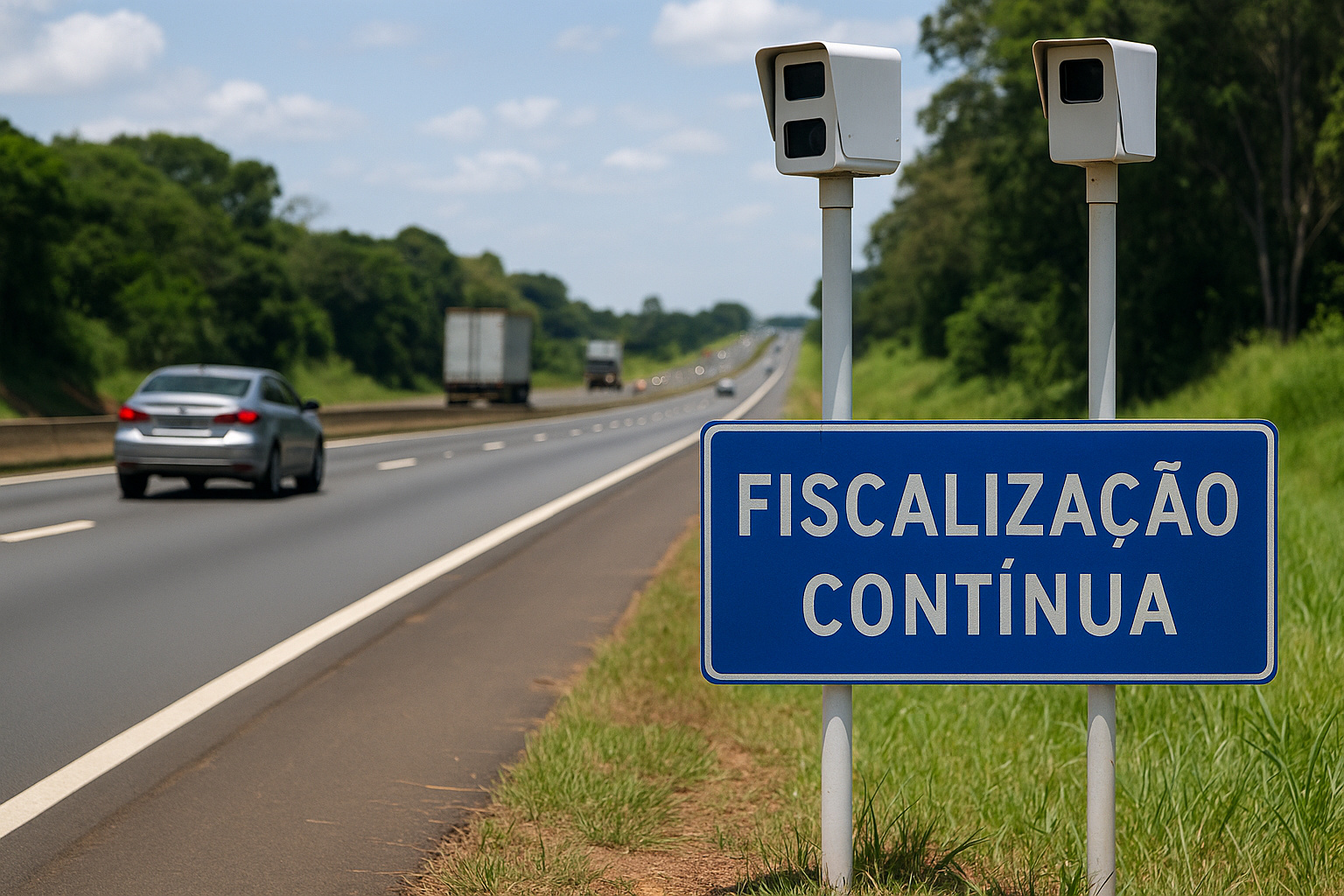
A New System Promises to Transform Speed Control and Reinforce Road Safety with Constant Monitoring in Strategic Sections
Since the beginning of 2024, as reported nominally by the National Institute of Metrology, Quality and Technology (Inmetro) to g1, Brazil has begun the experimental phase of a regulatory model that could significantly change the routine of drivers on federal highways. While drivers usually reduce speed only when seeing a traditional radar, this new method prevents that behavior because it uses continuous measurement along the monitored stretch. Although it is still only operating in an educational manner, the system has already been installed at kilometers 171 and 182 of BR-050, in Uberlândia (MG), to guide drivers on the need to maintain a constant speed throughout the route.
Technical Enforcement Reveals Important Change in Speed Measurement
Firstly, common radars only register the speed at the exact point where the vehicle passes. The new segment radar, on the other hand, identifies the vehicle at the entry and exit of the monitored segment.
Thus, the system calculates the average speed based on the time taken by the vehicle between the two points. The driver must respect the speed throughout the entire stretch, avoiding only reducing it when they see the equipment.
In this way, enforcement becomes more efficient in preventing risky behaviors on the roads.
According to Inmetro, which confirmed the start of testing to g1 in 2024, the technology is still being improved and remains restricted to educational functions. The agency emphasizes that the goal is to guide drivers and enhance road safety, ensuring greater consistency in driving and reducing sudden speed variations.
Therefore, the educational nature of this phase contributes to accustoming the public to the new enforcement standard.
-
American Airlines starts selling trips as if they were flights, with check-in and baggage check at the airport, but on short routes, passengers board luxury buses connecting cities to major hubs in the U.S.

-
São Paulo surprises the world with a colossal railway network project that promises over 1,000 km of tracks, R$ 194 billion in investments, and 40 projects connecting the capital to the interior with fast and sustainable trains.

-
The world’s largest escalator, measuring 905 meters in China, reduces urban travel time from 1 hour to about 20 minutes and transforms mobility in mountainous regions with an engineering solution adapted to the terrain.
-
A R$ 300 million logistics giant is taking shape in Serra with over 100,000 m² and raises a question: how can this transform e-commerce and distribution in the state?

Impacts Observed During the Experimental Phase
Although the system does not yet issue fines, its presence has prompted changes in the behavior of drivers traveling on the BR-050 stretch. No penalties are applied because the initial phase prioritizes adaptation and technical assessment of the equipment’s operation.
Additionally, this phase allows for the identification of any necessary adjustments before future definitive implementation.
Thus, the continuous operation reinforces the importance of maintaining a constant speed, avoiding excessive accelerations after passing the radar.
According to information from Inmetro, segment enforcement emerges as a more precise alternative that is consistent with the real dynamics of highways. In this way, the system prevents strategies used by drivers who only reduce speed at the monitored point.
Project Timeline in Brazil
- Beginning of 2024: Inmetro confirms to g1 that the initial phase of implementation of the new radars has begun in the country.
- First half of 2024: Two devices are installed at kilometers 171 and 182 of BR-050, in Uberlândia (MG).
- 2024: Enforcement remains exclusively educational, with no fines issued throughout the experimental period.
What Could the Future Hold for the New Enforcement System?
Inmetro experts indicate that the segment radar could become a reference in road safety if it is officially adopted after the testing phase. Drivers continue to observe the system with curiosity, as it requires discipline throughout the monitored route.
Meanwhile, the solely educational phase helps shape driver behavior without immediate penalties.
Thus, the country is evaluating whether the model should be expanded to other highways following a technical analysis of the results.
What do you believe will have a greater impact on the safety of Brazilian highways: the definitive adoption of the segment radar or the improvement of traditional equipment already in operation in the country?









Seja o primeiro a reagir!