






 Portuguese


The first sea outing of the Khabarovsk highlights a Russian program shrouded in secrecy, propaganda, and technical doubts, as the Poseidon platform enters a critical testing phase.
The Russian Poseidon program entered a new phase in August 2026, when the special purpose nuclear submarine Khabarovsk of Project 09851 was first seen navigating outside the Sevmash facilities in Severodvinsk, heading towards the White Sea.
The vessel is specifically designed to operate special underwater systems and is seen as the first platform built from the ground up around the Poseidon mission.
Records from open sources indicate that the outing took place on August 16, 2026.
-
Rock in Rio Becomes a Telecommunications Laboratory with Over 120 TIM Antennas, 45% Increase in 5G Infrastructure, and 5G Advanced Debut at Major Event as Over 100 Professionals and AI Systems Monitor a Network for 130,000 Daily Attendees

-
Elon Musk and SpaceX Bet $100 Billion on a Mega-Base Eight Times Larger than Manhattan to Launch Starships and Fuel Space AI Projects

-
Florida Deploys 120 Robotic Bunnies in Everglades to Combat 16-Foot Pythons
-
Puerto Rico Imported Mongooses from India to Eliminate Rats in Sugarcane Fields but Overlooked a Detail: The Pests Were Nocturnal While the Predators Hunt During the Day; 150 Years Later, the Invasive Species Has Become the Island’s Main Reservoir for Rabies


The Barents Observer reported that the submarine began sea trials in the White Sea, although, until the release of images, Sevmash, the Russian Ministry of Defense, and Russian state media had not yet officially announced the start of this campaign.
This development is significant as it transforms the Khabarovsk from a submarine primarily known for ceremonies, shipyard images, and technical estimates into a vessel actively navigating during the testing phase.
At the same time, there remains a substantial difference between going to sea and entering operational service with the Poseidon.
Khabarovsk was developed for a special underwater mission
The Khabarovsk is not a conventional strategic submarine equipped with ballistic missiles and does not neatly fit into the traditional category of attack submarines.
Designed by the Rubin Central Design Bureau and built by Sevmash in Severodvinsk, Project 09851 has been officially identified by Russia as a submarine intended for the deployment of modern underwater armaments and robotic systems.
The direct association with the Poseidon appears repeatedly in specialized analyses and has also been publicly recognized by Russian sources following the vessel’s release from the construction bay.
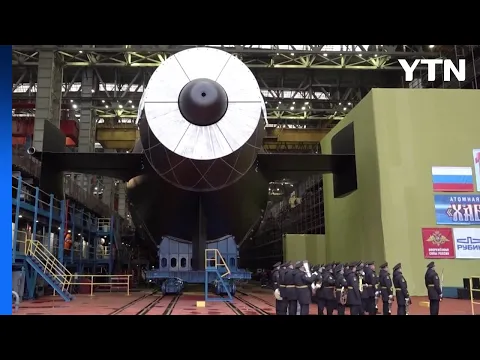
On November 1, 2025, Sevmash officially confirmed the ceremony for the Khabarovsk’s unveiling from the construction shed.
The event was attended by Defense Minister Andrei Belousov, Commander of the Russian Navy Alexander Moiseev, and leaders from the shipbuilding industry.
This was another milestone in a program initiated many years prior.
Construction of the Khabarovsk began on July 27, 2014, in Severodvinsk.
Since then, much of its characteristics have remained protected by the level of secrecy applied to Russia’s strategic submarine projects.

Poseidon combines nuclear propulsion and nuclear capabilities
Poseidon is officially described by Russia as an unmanned underwater vehicle powered by nuclear energy, designed to operate at great depths and travel extremely long distances.
When Vladimir Putin publicly introduced the program in March 2018, he claimed that the system could carry conventional or nuclear payloads and target various types of objectives, including coastal infrastructure.
The Russian president also attributed intercontinental range and speeds exceeding those of conventional submarines and torpedoes to the equipment.
These features have made Poseidon one of the most controversial pieces of Russia’s strategic arsenal.
However, much of the data released regarding speed, range, depth, and survivability comes from statements by the Russian government and cannot be independently verified in its entirety.
In November 2025, Putin again addressed the system and stated that tests had been successfully conducted.
During a ceremony at the Kremlin dedicated to the developers of Poseidon and the Burevestnik missile, he declared that the vehicle was designed to operate at depths of up to 1,000 meters.
The Russian government portrays Poseidon as part of its nuclear deterrence strategy.
In practice, this concept seeks to add an underwater route to a strategic arsenal historically based primarily on land-based missiles, bombers, and ballistic missile submarines.

Belgorod Connected to the Poseidon Program
There is an important distinction between Khabarovsk and another Russian vessel frequently associated with the weapon.
The Belgorod, Project 09852, has already been used in the development of the Poseidon program and became the first major submarine publicly linked to the system.
However, its origin is different.
Belgorod is derived from a hull originally intended for a Project 949A submarine, known in the West as the Oscar II class, which was later significantly modified for special missions.
Khabarovsk, on the other hand, was conceived from the outset as a special-purpose platform, which explains the weight given to its first sea trial.
Specialized analysts believe that its architecture utilizes solutions related to the Borei family but with significant changes, especially since it lacks the section designated for large ballistic missiles found in Russian strategic submarines.
Khabarovsk’s Capacity to Carry Poseidon Remains Estimated
One of the most frequently repeated pieces of information about Khabarovsk is the possibility of carrying up to six Poseidon units.
This configuration appears in analyses from Naval News, the U.S. Naval Institute, and other publications specializing in naval warfare.
However, Moscow has not published a complete technical data sheet for the submarine confirming this number.
Exact dimensions, displacement, launch compartment configuration, and various aspects of the combat system remain subject to estimates based on images, open-source information, and comparisons with other Russian projects.
This requires caution.
The existence of a vessel designed for this mission is documented.
However, the complete internal configuration of the Khabarovsk remains partially publicly unknown.
First Sea Voyage Initiates Testing Phase for Khabarovsk
The submarine’s appearance in the White Sea in August 2026 does not mean it is ready for operational patrols.
Before such a nuclear vessel is incorporated into the Navy, its systems must undergo various evaluation stages.
It is during this phase that aspects related to navigation, propulsion, hull behavior, onboard systems, and the overall functioning of the submarine are observed.
The Barents Observer reported that the Khabarovsk was conducting tests in the White Sea after departing Severodvinsk.
The publication also noted that there was no official Russian confirmation regarding that specific departure when the initial information was released.
Industry sources expect that, following the testing process and the Navy’s eventual acceptance, the Khabarovsk will be assigned to the Pacific Fleet.
There is still no publicly confirmed date for its definitive entry into service.

Poseidon Program Moves from Propaganda to Concrete Infrastructure
For years, much of the attention surrounding Poseidon was focused on animations released by the Kremlin, statements from officials, occasional images, and analyses of its potential attributes.
This began to change as the physical elements of the program became more visible.
Belgorod entered service, the Russian government announced Poseidon tests, and in November 2025, the Khabarovsk finally left the construction shed.
Now, in August 2026, the submarine especially associated with this mission was seen navigating during what is identified as its first sea testing campaign.
This does not yet prove that the Khabarovsk-Poseidon system is operational.
It also does not confirm all the capabilities attributed to the nuclear torpedo by Russia.
But it shows that the program already possesses much more than just designs and political statements: there are submarines, support facilities, reported tests, and a dedicated platform undergoing one of the necessary steps before eventual incorporation into the fleet.
In a system developed specifically to be difficult to locate and predict, the main question now is when the Khabarovsk will transition from a testing submarine to an effectively operational platform for Poseidon.


