





 Portuguese
  English
  Spanish
  3 min of reading
  1 comment


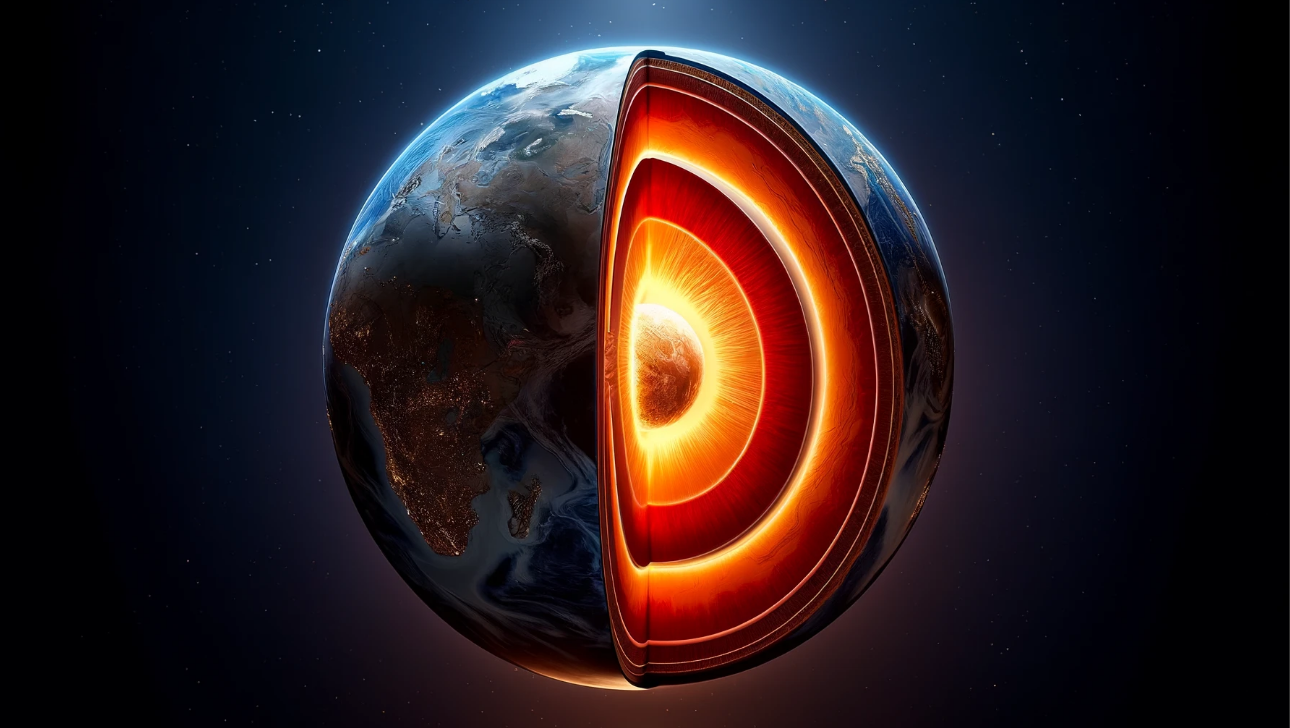


Researchers Discovered That The Earth’s Inner Core Wobbles Mysteriously Every 8.5 Years, And May Be Close To Unraveling The Reasons Behind This Intriguing Phenomenon.
The Earth’s core, a dense mixture of iron and nickel, plays a fundamental role in sustaining life by generating the magnetic field of the planet. This field acts as a protective shield against harmful solar radiation. Despite its importance, the behavior of the core has puzzled scientists for decades, especially the slight, yet rhythmic, movements of the inner core.
One of the most fascinating phenomena is the “Inner Core Wobble” (ICW), an oscillation of the inner core that occurs approximately every 8.5 years. A recent study from Wuhan University, published in the Nature Communications journal, provided new insights into this mystery.
The Oscillation Of The Earth’s Inner Core
According to the study, the axis of the inner core tilts 0.17 degrees relative to the rotational axis of the Earth’s mantle. This small misalignment has significant implications for understanding how the core moves and interacts with the planet’s other layers.
-
Surrounded by the sea, the airport will have a system to prevent airplanes from falling into the water; technology will be installed in Ilhéus (BA), with an investment of R$ 70 million.

-
With a cost per shot close to zero, the DragonFire laser could change naval warfare in 2027 and provide British ships with nearly unlimited defense against drones.

-
A British startup creates tires that generate electricity in electric vehicles when passing over potholes, speed bumps, and cracks.

-
Scientists have created robots made with living cells that have their own nervous system, swim on their own, explore the environment, and self-organize without any genetic engineering, and now they want to do the same with human cells.


The researchers analyzed polar motion (PM) and variations in the length of day (ΔLOD). These data indicated that the inner core spins slightly to the east, at a differential angle of less than 1 degree. This oscillation, though small, may help explain some variations in the Earth’s magnetic field.
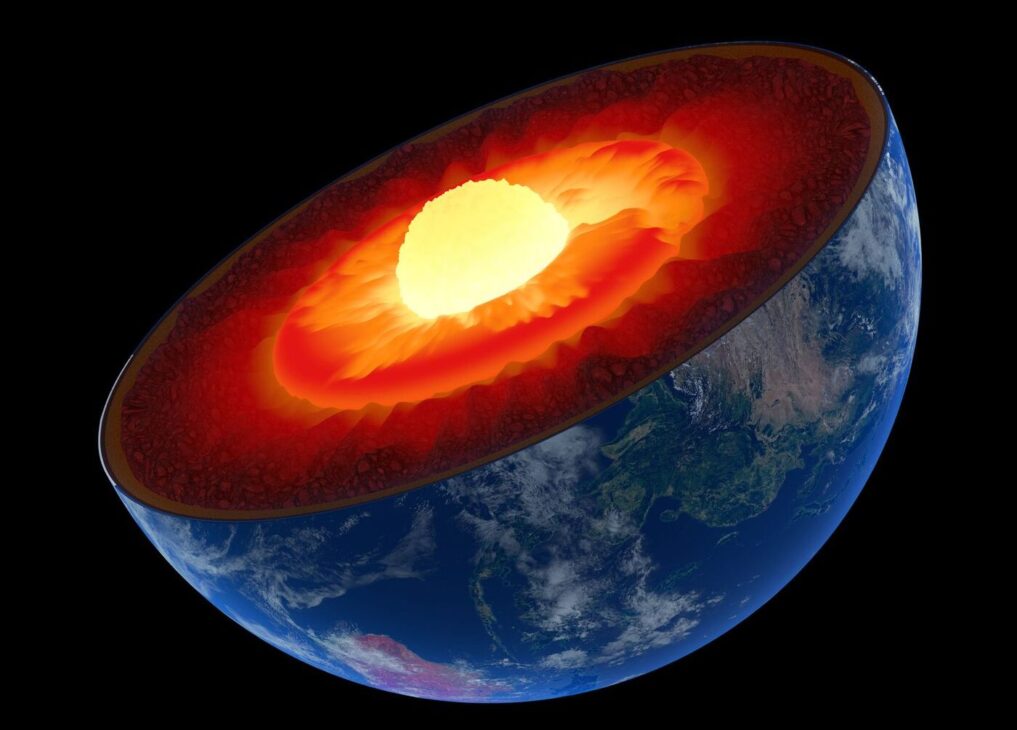
Understanding The Mechanics
Hao Ding, co-author of the study, explained that the findings suggest that the inner core may not be as perfectly spherical as previously thought. The misalignment of its tilt and rotation may indicate density differences both in the mantle and at the boundary between the core and the mantle.
Ding began to detect signs of this wobble in 2018 while studying the Earth’s polar motion. Now, the research suggests that the tilt of the inner core also influences the shape and behavior of the outer liquid core, which directly affects the Earth’s magnetic field.
Fluctuations in the geomagnetic field are crucial for modern technology, which relies on magnetic orientations for navigation and communications. Therefore, a better understanding of these internal movements is essential for developing more precise and reliable systems.
Alternative Theories And New Perspectives
While the Wuhan University study is a milestone, it does not fully resolve the enigma of the inner core’s movement. Competing theories suggest that gravitational and magnetic forces of the Earth may be in a constant tug of war, contributing to the complex movements of the core.
Another hypothesis raises the possibility that the very irregular shape of the inner core plays a crucial role in the observed wobble. Still, without physical access to the core, scientists rely on indirect methods, such as the analysis of seismic waves and changes in the magnetic field, to build more accurate models.
Importance Of Ongoing Research
With so many variables involved, the core remains one of science’s greatest mysteries. Research like this is essential for refining our understanding of the Earth’s internal workings and how these processes affect the planet’s surface.
The wobble of the inner core, though subtle, is just one piece of a much larger puzzle. Future studies, combining interdisciplinary approaches and advanced technologies, promise to unveil more secrets about the Earth’s internal structure.
By better understanding these phenomena, science can not only resolve fundamental questions about planetary dynamics but also predict and mitigate the impacts that these wobbles may have on life on the surface. The work continues, and with it, the hope of deciphering the deepest mysteries of our planet.









Tem alguma coisa a ver com a nutação da terra? Os desvios-padrão são bem próximos.