





 Portuguese
  English
  Spanish
  4 min of reading
  4 comments


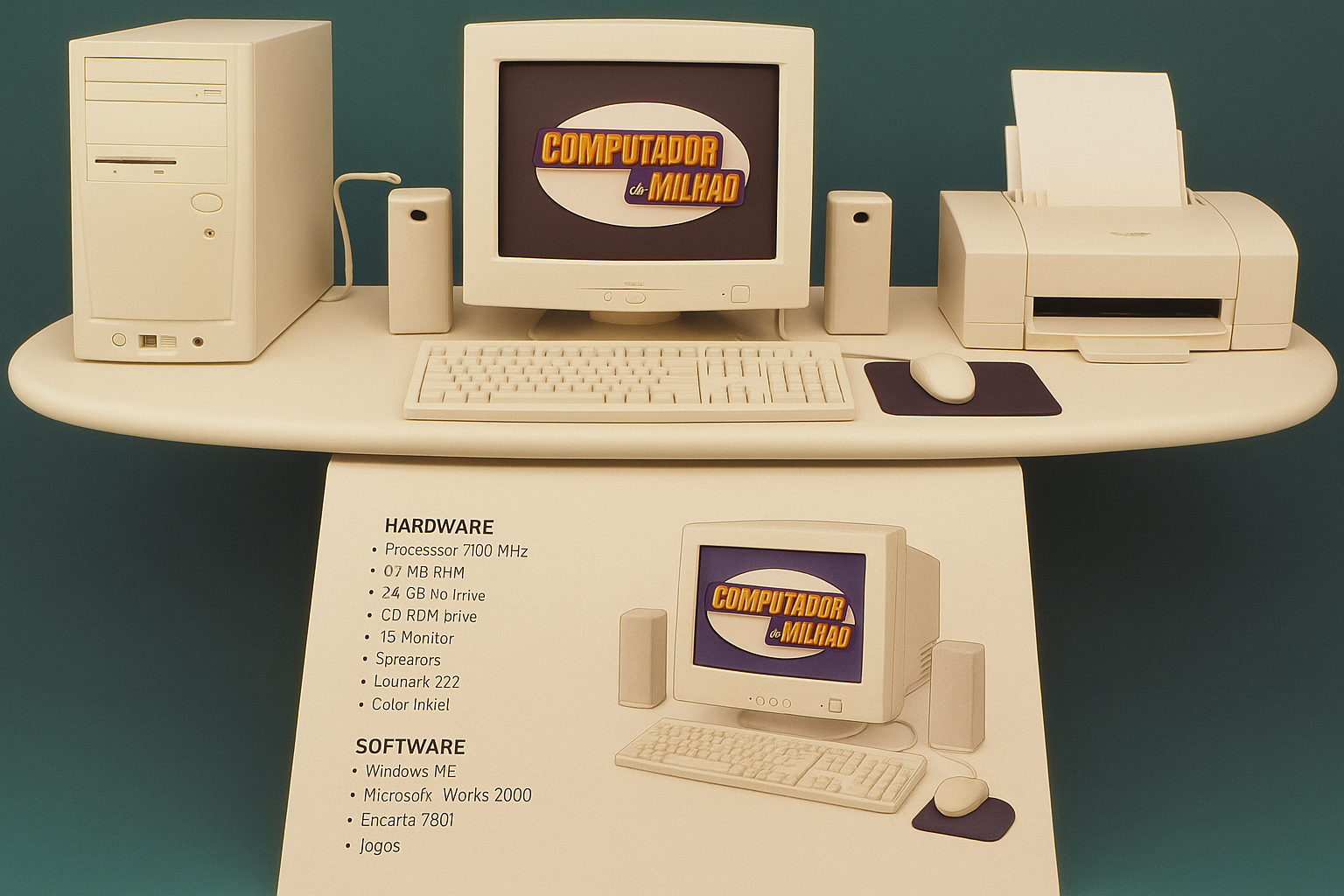


Inspired by Show do Milhão, the project aimed to bring computers to families, but high prices and financing hindered the dreams of many Brazilians
In the early 2000s, having a computer at home was a distant reality for many Brazilians. The high price of equipment and limited income made it difficult for the population to access technology. It was in this context that the Computador do Milhão emerged, inspired by the success of the Show do Milhão program, aired by SBT since November 1999.
The project was born from a partnership between SBT and Microsoft. The goal was to offer a computer at a more affordable price, allowing families from lower social classes to have their first PC. Launched in 2001, the Computador do Milhão was initially sold for R$ 1,928 upfront.
Prices and Payment Options
Although the upfront price was lower than other computers of the time, many consumers opted for installment payments. The Computador do Milhão could be purchased in up to 36 installments of R$ 88, which totaled R$ 3,168 by the end of the payment.
-
With around 6,000 residents on a single 9 km street, a village in Poland maintains a strong sense of community, cultivates strawberries and potatoes, and becomes the target of a false image created by artificial intelligence.

-
Sleeping at different times each day can be a bomb for your heart and even double your risk of having a heart attack.

-
Without help and without heavy machinery, a woman builds a house from scratch with stone, wood, and cement, erects a chimney, creates a complete leisure area, and transforms an empty lot into her dream home.

-
Couple transforms abandoned house after years of being closed; residence was overgrown with weeds, had a green pool, and a deteriorated structure in the interior of Rio de Janeiro.


In practice, financing made the equipment even more expensive, but it offered a purchase opportunity for those who could not afford to pay upfront. Installments have always been, and continue to be, a common alternative among Brazilians for higher value purchases.
The Specifications of the Computador do Milhão
The specifications of the Computador do Milhão were basic, even by the standards of the time. While other computers were already equipped with Pentium 4 processors with frequencies over 2 or 3 GHz, SBT’s equipment had more modest components.
In the first version, the computer came with a 700 MHz Intel Celeron processor, 64 MB of RAM, 10 GB of storage, and Windows ME as the operating system. The package also included a 52X CD-ROM drive, a 15-inch LG monitor, and a Lexmark Z22 color inkjet printer.
Shortly after, a second configuration was released. The processor was upgraded to a 1 GHz Intel Celeron, the RAM doubled to 128 MB, and the storage increased to 20 GB.
The operating system was also updated to Windows XP. The multimedia kit included a sound card, speakers, the same 15-inch monitor, and the Lexmark Z22 printer.
Computador do Milhão: The Weight of the Investment at the Time
To give you an idea of the financial weight, the minimum wage in 2001 was R$ 180. This meant that the average Brazilian would need approximately 10 minimum wages to pay for the computer upfront.
Updating the value to today, based on the IPCA of IBGE, the upfront price of R$ 1,928 would be equivalent today to R$ 8,117. Meanwhile, the total installment cost of R$ 3,168 would currently correspond to R$ 13,337.48. This amount would be equivalent to about 74 minimum wages back then.
What Could Be Purchased Today with This Amount
With the corrected value of R$ 8,117, it would be possible to assemble a very powerful current computer. This machine would include an AMD Ryzen 5 9600X processor, an AMD Radeon RX 7800 XT graphics card, 32 GB of DDR5 RAM, a 500 GB SSD, and a robust power supply. The total cost of this setup would be R$ 7,708.76.
Considering the amount equivalent to the installment plan, R$ 13,337.48, it would be feasible to build an even more advanced PC, featuring an AMD Ryzen 7 9800X3D processor, an AMD Radeon RX 9070 XT graphics card, a high-performance motherboard, along with RAM, SSD, and a high-capacity power supply. The sum of the components would amount to R$ 12,466.81, leaving almost R$ 1,000 remaining.
The High Demand and Sales Issues
Even with the simple specifications, the Computador do Milhão sparked enormous interest. In its first month, there were over 700,000 calls from interested buyers.
Since sales could only be made over the phone, SBT’s call center became overwhelmed. In the end, just over 15% of those interested were able to finalize their purchase, according to Folha de São Paulo.
A Significant Initiative for Digital Inclusion
The Computador do Milhão was an important attempt to expand access to computers in Brazil in the 2000s. Today, with technological advancements, the same investment amount would allow for the purchase of machines that are far superior in performance and capability.
With information from Canal Tech.







Tá. Gostei dos comparativos, mas agora faz um comparativo do nível de performance do computador do milhão x seu valor de mercado convertido pro dia de hoje. Ou seja. O que um Pentium 4 com 1 ghz com 128 Mbps e 20 GB representava para a época de 2000 em questão de desempenho e aí fazer o mesmo comparativo hoje. O valor convertido (que TB não seria apenas converter diretamente prós dias atuais considerando o salário mínimo) pq a inflação lá de trás é diferente da inflação atual. Eu era adolescente em 2000 e me lembro pouco do mercado, mas lembro que um Pentium 4 era um topo de linha, mas não com 1ghz. Se vc tivesse uma placa de vídeo VGA que fosse, de 64 Mbps vc passava a ter uma máquina bem potente pra jogos. Mas lembrando ainda, que um Athlon XP tinha desempenhos melhores que um Pentium 4 (embora tenha sido lançado apenas em 2001) acredito que seria algo entre um um i7 13ª vs Ryzen 7 7800 hj em dia (mas sem uma RTX)
Que imagem de IA horrorosa.
Kkkkk
“07 MB RHM
24 GB no irrive
CD RDM Orive
15 monitor
Sprearos
Lounark 222
Color Inkiel
Microsofx Works 2000”
Meudeeeus, é msm todo bugado, nem revisão fizeram, pensaram que nem iriam ver a imagem fake e ainda toda estourada kkkk
Então, mesmo parcelado com juros, ainda não chegaria no valor do iPhone top de linha de hoje. Kkkkk