





 Portuguese
  English
  Spanish
  4 min of reading
  0 comments


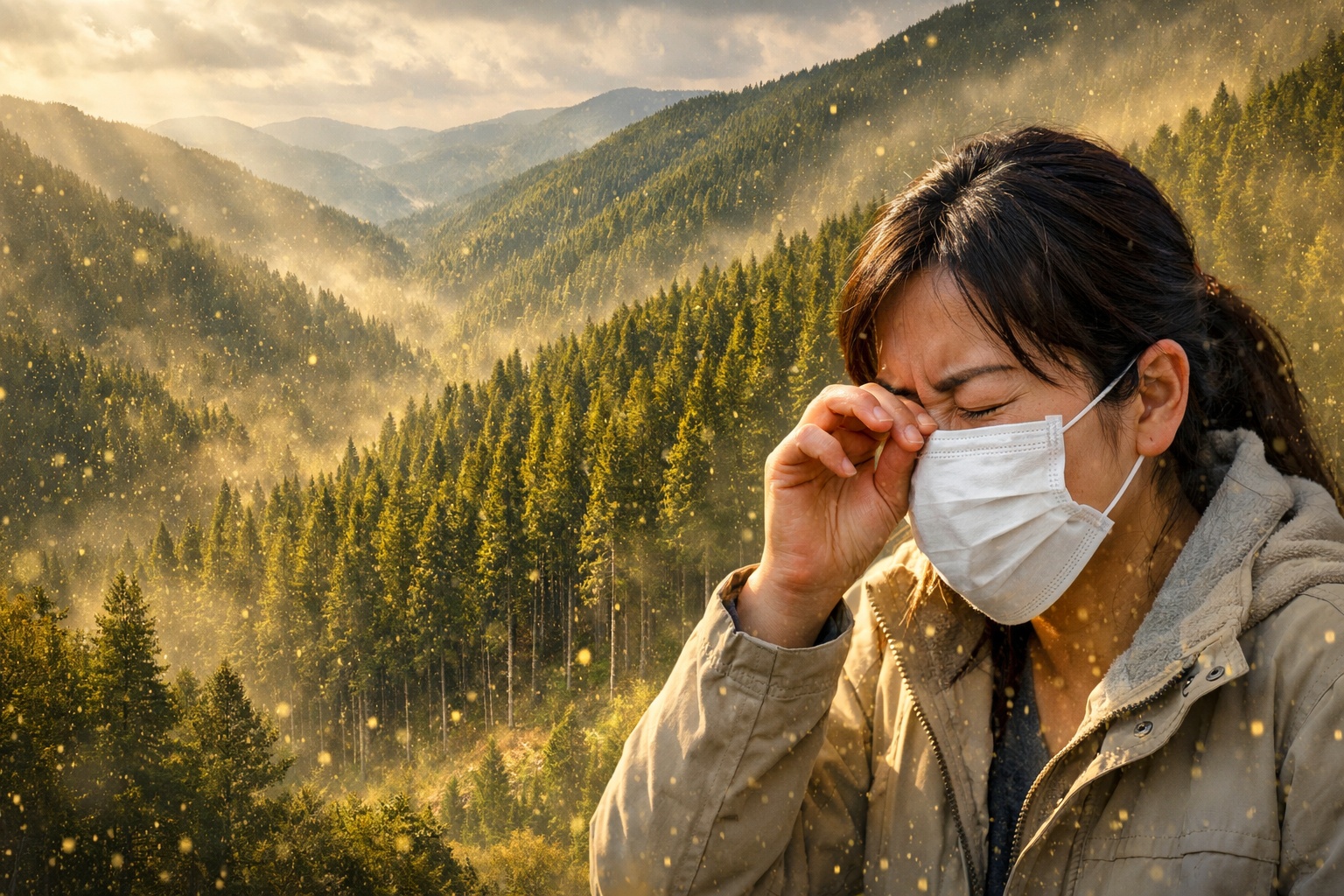
After World War II, Japan Planted Millions of Hectares of Japanese Cedar to Rebuild Its Timber Industry. Decades Later, the Pollen from These Trees Triggered One of the Country’s Largest Allergy Crises.
In the period following the end of World War II, Japan faced a huge challenge: rebuilding destroyed cities, reviving the economy, and ensuring raw materials to sustain the country’s growth. Among the most necessary resources at that moment was wood, essential for reconstructing houses, buildings, and infrastructure. To solve this problem, the Japanese government launched one of the largest reforestation programs in modern history. Between the 1950s and 1970s, millions of hectares of forests were planted mainly with sugi, Japanese cedar (Cryptomeria japonica), a relatively fast-growing species highly valued by the timber industry.
What seemed to be a strategic solution for economic development ended up generating, decades later, an unexpected public health problem. Today, the pollen from these trees is responsible for one of the largest seasonal allergy epidemics ever recorded.
The Massive Post-War Reforestation Program
After the war, much of Japan’s forests had been devastated by intensive wood extraction during the conflict and by bombings that struck urban and industrial areas. In light of this reality, the Japanese government decided to invest heavily in forest recovery.
-
In Sweden, Embraer subjects the KC-390 to rigorous testing in extreme cold, conducts operations in the snow with 100% success, and expands its presence among NATO countries.

-
An 8-kilometer submerged city discovered 36 meters deep in the Arabian Sea may be 9,500 years old and, if confirmed, would be older than any known civilization and coincide with the legendary Dwarka described in Hindu texts.

-
Roman game becomes an enigma for 40 years in the Netherlands, until AI and 3D scanning test 100 rules, run 1,000 simulations, and identify a “blocking game” that no one has been able to decipher since 1984.

-
A scientist proved with a thermal camera that the fan does not cool the environment but reduces the temperature of your skin by up to 6 degrees thanks to a natural mechanism of the human body that almost no one understands how it really works.


Between approximately 1950 and 1970, about 4.4 million hectares of trees were planted across the country. Much of these plantations consisted of two main species:
- sugi (Japanese cedar)
- hinoki (Japanese cypress)
These trees were chosen because they grow relatively quickly, have valued wood, and are suitable for the mountainous climate of the Japanese archipelago. The result was a vast belt of artificial forests scattered across the country’s mountainous regions.


Today, it is estimated that about 40% of Japan’s forests are artificial plantations created during this period.
The Change in the Wood Economy in the 1980s
During the first decades after planting, these trees were expected to be harvested to supply the domestic wood market. However, the situation changed drastically starting in the 1970s and 1980s.
With the globalization of trade and the rise of imports, foreign wood became much cheaper than wood produced domestically in Japan. Countries in Southeast Asia, North America, and Oceania began exporting large volumes of wood at more competitive prices. This shift profoundly affected the Japanese forestry industry.
Many cedar plantations ceased to be economically viable for harvesting. As a result, much of these forests ended up being abandoned without proper management.
Aging Forests and the Pollen Explosion
The abandonment of these plantations had unexpected environmental consequences. As the trees aged, they began to produce increasingly larger amounts of pollen during spring.
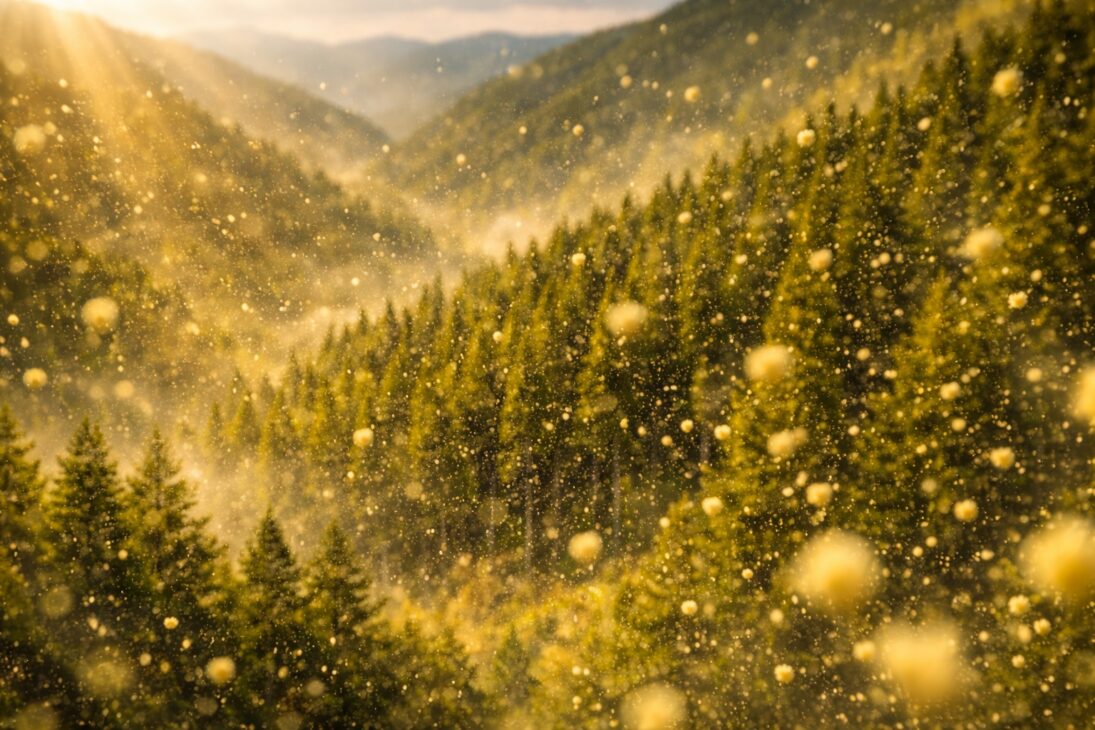
Japanese cedar is known for releasing huge clouds of pollen into the air during the breeding season, typically between February and April. In regions where vast areas were planted with the same species, the effect became particularly intense.
When the wind carries this pollen to densely populated urban areas, millions of people end up being exposed simultaneously.
This phenomenon gave rise to the so-called Japanese cedar pollinosis, known in the country as “kafunshō.”
An Allergy Epidemic Affecting Millions of People
The pollinosis caused by the pollen of Japanese cedar has become a national problem. Public health studies indicate that approximately 30% of the Japanese population suffers from pollen-related allergies from these trees.
The most common symptoms include:
- constant sneezing
- irritated and watery eyes
- nasal congestion
- fatigue and difficulty concentrating
During pollen season, it is common to see people on the streets wearing masks, protective glasses, or allergy medications. In some cities, the intensity of pollinosis is so great that it affects the daily routine of millions of people.
Economic Impacts of Pollen Allergy
In addition to being a public health problem, pollinosis also has a significant economic impact.
The costs include:
- medical treatments
- allergy medications
- consultations and exams
- reduced productivity at work

Japanese studies estimate that the total economic impacts could reach billions of dollars per year, considering both medical expenses and productivity loss. This phenomenon makes pollen allergy one of the largest seasonal health challenges in the country.
The Government Plan to Reduce the Problem
Given the scale of the problem, the Japanese government initiated programs to gradually reduce pollen production. Among the strategies adopted are:
- replacement of old trees with low-pollen varieties
- more active forest management
- encouragement of sustainable wood harvesting
- development of technologies to monitor pollen dispersion
However, the solution is not simple. Cedar trees take decades to grow, which means that complete replacement of these forests may take a long time.
Even with ongoing government programs, experts estimate that it will take years or even decades to significantly reduce the impact of pollinosis.
An Example of How Environmental Decisions Can Have Unexpected Effects
The Japanese reforestation was initially regarded as a major environmental and economic success. It helped to recover devastated areas and created a foundation for the country’s timber industry.
However, the combination of economic factors, abandonment of plantations, and excessive tree growth ultimately generated an unexpected side effect.
The Japanese case has become a frequently cited example by experts in environmental management and forestry planning. It illustrates how decisions made on a large scale can produce complex consequences decades later.
Today, the country continues to try to balance environmental conservation, public health, and forest management in one of the most well-known examples of the interaction between environmental policy and human health.








-

Uma pessoa reagiu a isso.