





 Portuguese
  English
  Spanish
  4 min of reading
  0 comments


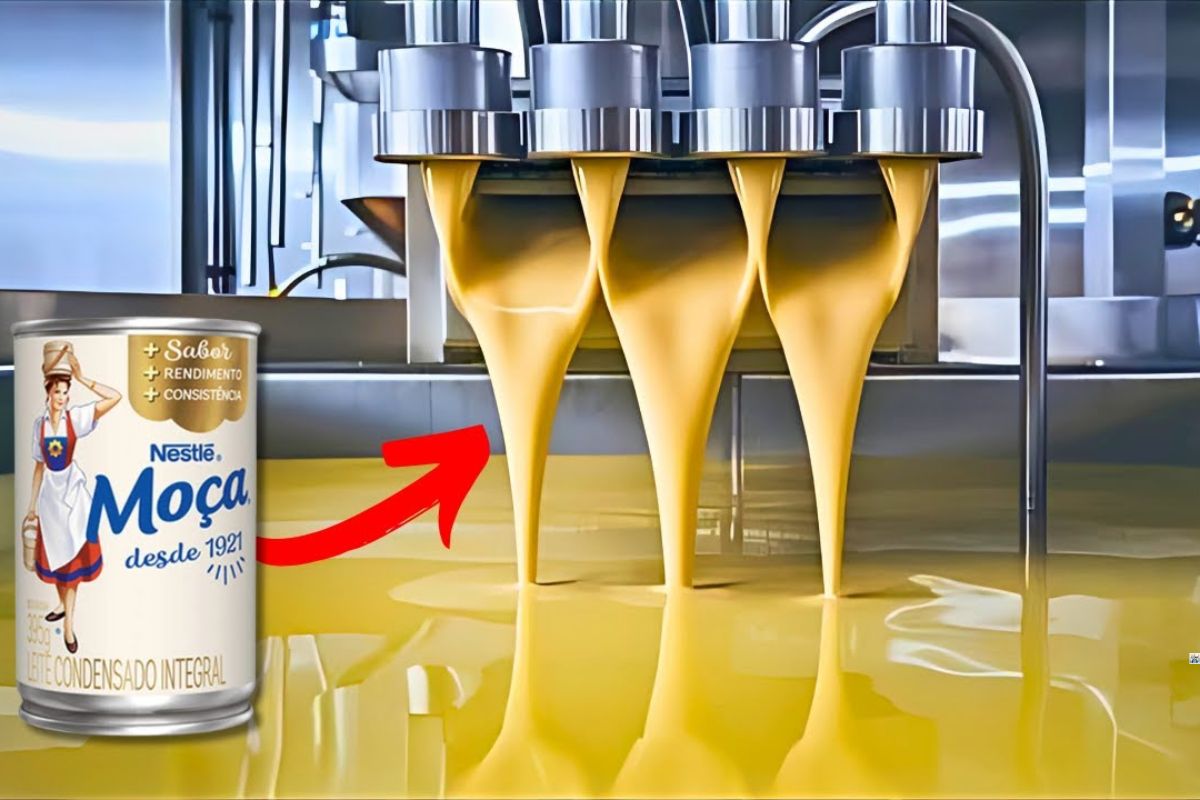
Condensed milk, a result of a rigorous industrial process that combines milk production, pasteurization, evaporation, and sugar addition, is one of the most consumed products in Brazil, symbolizing the union of food technology and culinary tradition.
Behind the creaminess and unmistakable flavor of condensed milk, there is a sophisticated industrial process that combines chemical precision, thermal control, and strict standardization. The journey begins on dairy farms, with milk production on a large scale, and ends on automated filling lines, where the product takes its final form and long shelf life.
The secret to success lies in the sequence of technical steps: pasteurization, evaporation, and sugar addition. Each phase is designed to ensure uniform texture, food safety, and the balance between sweetness and density. Condensed milk is, at the same time, a feat of food engineering and an icon of the Brazilian table.
From Farm to Factory: The Base of Condensed Milk Production
Condensed milk production begins on dairy farms, where cows are milked with automated systems that maintain hygiene and productivity.
-
Attracting around 250,000 people a year, a lighthouse 200 meters from the sea, on a 60-meter high cliff, on the North Sea coast in Denmark, becomes one of the most impressive examples of how nature can threaten historical buildings.

-
The narrowest house in the world is only 63 centimeters wide, but inside it can accommodate a bathroom, kitchen, bedroom, office, and even two staircases.

-
In the middle of the sea, these enormous concrete and steel structures, built by the British Navy to protect strategic maritime routes, look like they came straight out of a Star Wars movie.

-
For years, no one could cross a neighborhood in Tokyo because of the tracks, but an impressive solution changed mobility and completely transformed the local routine.


Raw milk is stored in refrigerated tanks at 2°C, ensuring freshness and nutrient preservation.
It is then transported to the industries in stainless steel tankers, an essential part of the industrial process.
Upon arrival at the factory, the milk undergoes laboratory analyses to check fat content, acidity, and absence of antibiotics.
Only after this screening is the product released into large storage silos.
This phase is crucial for the quality milk production, the basis of the entire industrial process that will lead to condensed milk.
Pasteurization: The Beginning of Transformation
Pasteurization is the first major technical step of the industrial process.
The milk is heated for a few seconds at high temperatures, eliminating microorganisms without altering its composition. Soon after, it is quickly cooled to prevent the loss of flavor and nutrients.
This step ensures safety and stability, creating the perfect base for condensed milk production.
Standardization follows shortly after: fat content is adjusted to maintain the ideal consistency.
Pasteurization is the starting point for the balance between purity, flavor, and durability.
Evaporation: The Heart of the Industrial Process
In the evaporation stage, the industrial process transforms liquid milk into a dense and creamy mixture.
In vacuum evaporators, about 60% of the water is removed, allowing the liquid to concentrate solids, proteins, and natural sugars.
This technique preserves nutrients, reduces the risk of oxidation, and guarantees the characteristic flavor of condensed milk.
Condensed milk production depends on the precision of this stage: small variations in temperature or pressure can alter the ideal viscosity point.
It is at this stage that milk stops being just a liquid and begins to acquire the distinctive texture that makes it recognizable in any recipe.
Sugar Addition: The Balance Between Flavor and Preservation
After evaporation, the most decisive moment of the industrial process arrives: sugar addition.
The ingredient is incorporated into the concentrated milk in calculated proportions to balance sweetness, thickness, and shelf life.
Sugar also acts as a natural preservative, inhibiting the growth of microorganisms and prolonging the product’s durability.
The mixture is homogenized so that the sugar dissolves completely, avoiding grains and ensuring a smooth texture.
Without this step, condensed milk would not have the shine, stability, and characteristic flavor that have made it indispensable in cooking.
Homogenization and Filling: The Final Touch in Condensed Milk Production


Before being packaged, condensed milk undergoes homogenization, a process that breaks down fat molecules and stabilizes the product.
This prevents separation and ensures a uniform appearance.
Then, the liquid is rapidly cooled and directed to filling machines, where it is placed in sterilized cans and hermetically sealed.
Quality control continues until the end: samples are tested to check texture, sugar content, and purity.
Each can represents the conclusion of a complex industrial process, where milk production, pasteurization, and sugar addition come together to generate a product with high nutritional and sensory value.
More than an ingredient, condensed milk is a national symbol.
Its origin dates back to the 19th century, but its popularity in Brazil was born with industrialization and the spread of preservation technologies.
Today, the country ranks among the largest producers and consumers in the world, a direct result of the efficiency of the industrial process and the versatility of the product.
From pasteurization to filling, from milk production to sugar addition, each step is a testament to the harmony between science and tradition.
Condensed milk is, at the same time, engineering and affective memory, a technical product that sweetens stories.
Did you already know all the stages of the condensed milk industrial process? Tell us in the comments what your favorite dessert made with it is.







-

-

-

6 pessoas reagiram a isso.