





 Portuguese
  English
  Spanish
  8 min of reading
  0 comments


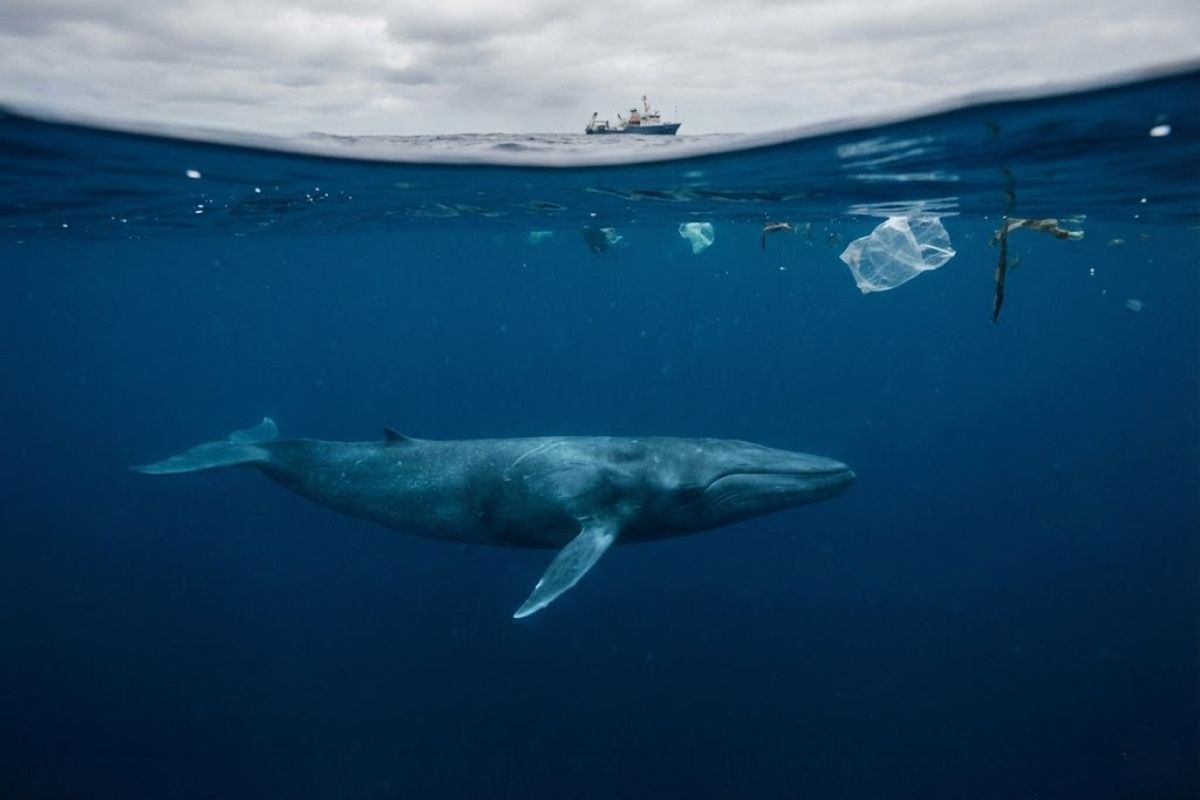
From Antarctic Ice to the Caribbean and the Coast of Brazil, the Largest Animal That Ever Existed Depends on Krill to Survive, But Record Fishing in 2025 and Sea Warming Weaken the Ecosystem Base, Expanding Coral Bleaching, Pressure on Sharks, and Invasion of Global Microplastics.
In the planet’s oceans, the blue whale has become a dual symbol: biological grandeur and political fragility. The largest animal that ever existed depends on seas with abundant food and food chains functioning like gears. When this mechanism fails, the impact isn’t limited to the high seas: it affects fishing, climate, and coastal life.
From the Antarctic ice to the warm waters of the Caribbean, passing through the North Tropical Atlantic, the Brazilian coast, and areas of the Pacific, signs of pressure accumulate. The main dish for the giant filter feeders, krill, faces warm years with less sea ice and fishing that has taken on industrial scale. At the same time, corals suffer from marine heatwaves, and microplastics enter the food web, from plankton to human plates.
The Filtering Giant and the Domino Effect in the Ocean

The presence of the largest animal that ever existed and other giant filter feeders, such as the whale shark, depends on something small enough to fit on the tip of a finger: krill.
-
Goodbye common refrigerator: essential appliance starts to gain competition with technology that preserves food for longer and reduces waste.

-
Germany discovers how to reuse old window glass without melting anything and can transform 220,000 tons per year into new high-performance panels, using material from nearly 150 million old windows that would be discarded.
-
China creates hypersonic engine that can make planes and missiles fly more than 6 times the speed of sound with less weight, more range, and without system change.

-
Mysterious object on Mars divides NASA and Harvard after Curiosity image reignites suspicions about what was really found on the planet.

These shrimp-like crustaceans concentrate energy from phytoplankton and pass that energy on to whales, penguins, seals, and fish.
Without krill, the giants simply cannot sustain themselves, and the base of many food chains collapses.
The role of krill goes beyond nourishment. It participates in a two-step climate mechanism.
First, krill feeds on phytoplankton, which sequesters carbon from the atmosphere by photosynthesis.
Then, krill’s feces sink rapidly, carrying carbon to the ocean floor and locking up that CO₂ for centuries.
When this mechanism works, part of the carbon is stored in the giant filter feeders, and part sinks in the ocean, removing CO₂ from the air through two different routes.
When the link with krill weakens, the loss is twofold: food is scarce and climate services are lacking.
The expected result is an ocean with less capacity to buffer warming and a world more exposed to extremes.
The threat to the largest animal that ever existed, in this scenario, becomes a marker of the overall state of the sea.
Antarctic Krill Under Heat and Less Sea Ice

The Antarctic krill depends on sea ice because the algae it consumes grow under the ice.
In warm years, when ice diminishes, krill reduces, and the entire chain feels the impact. Whales, penguins, seals, and fish that follow krill start to compete for a smaller resource in an already temperature-stressed environment.
This chain reaction helps explain why saving the largest animal that ever existed is not an isolated action focused on a single species.
The survival of the giant is tied to the stability of the ecological base.
When the ice fails, food diminishes; when food diminishes, the giant retreats; when the giant retreats, the dynamics of carbon and energy in the ocean change.
Krill Fishing Becomes a Business and Hits Records in 2025

The pressure on krill doesn’t come only from climate change.
Krill has turned into a billion-dollar business, valued for being rich in omega-3 and for supplying feed in aquaculture.
In 2025, krill fishing in Antarctica hit a record, raising alarms that exploitation is growing precisely where whales and other filter feeders depend on it.
The combination of warming and fishing amplifies the risk of a bottleneck.
Even when the ecological chain still exists, a cut in the volume of krill works like a supply lock: predators and filter feeders remain alive, but their diet loses support.
For the largest animal that ever existed, this means less margin for migrations, reproduction, and recovery in bad years.
Top Predators in Decline: Sharks and Dolphins
When the main dish for filter feeders diminishes, instability reaches top predators, such as sharks and dolphins.
These animals help keep populations balanced, control prey explosions, and stabilize entire trophic networks.
When top predators disappear, habitats degrade, and this effect returns to fisheries and coastal communities.
Global assessments indicate that over one-third of shark and ray species are threatened with extinction, with overfishing as the main factor.
The abundance of these animals has dropped by about 71% since 1970.
This data is relevant because sharks grow slowly and have low fecundity, so replenishment takes time, and recovery is difficult when pressure continues.
Predatory fishing and international trade drive catches, and shark finning, the removal of fins, persists in some areas.
A major driver of this demand is a billion-dollar market associated with fins, valued in the Asian market for supposed aphrodisiac properties, without scientific basis.
The result is a sea with less biological control and more instability.
Corals Under Stress: Marine Heatwaves in 2023 and 2024
Ocean warming affects not only the ice. Between 2023 and 2024, marine heatwaves broke records, with stretches of the North Tropical Atlantic and the Caribbean exceeding normal temperatures for hundreds of days.
When the sea warms, corals become stressed and expel the algae that provide food and color.
This phenomenon, bleaching, can lead to the death of corals.
Without corals, the sea loses structures comparable to pastures and nurseries. Fish and other organisms move away, including commercially important species.
Previously productive areas shrink or change location, crippling fisheries and the livelihoods of coastal communities.
In Brazil, between 2023 and 2024, the sea became warmer than usual along much of the coast, and the country experienced one of the worst coral bleaching events in its reefs, including in the Costa dos Corais in the Northeast.
Sea warming intensifies evaporation, fueling more intense storms.
Simultaneously, rising sea levels accelerate beach erosion and engulf homes in certain coastal areas.
The risk appears as loss of infrastructure, displacement of residents, and economic damage.
Ice and Penguins: Cascade Impacts in Antarctica
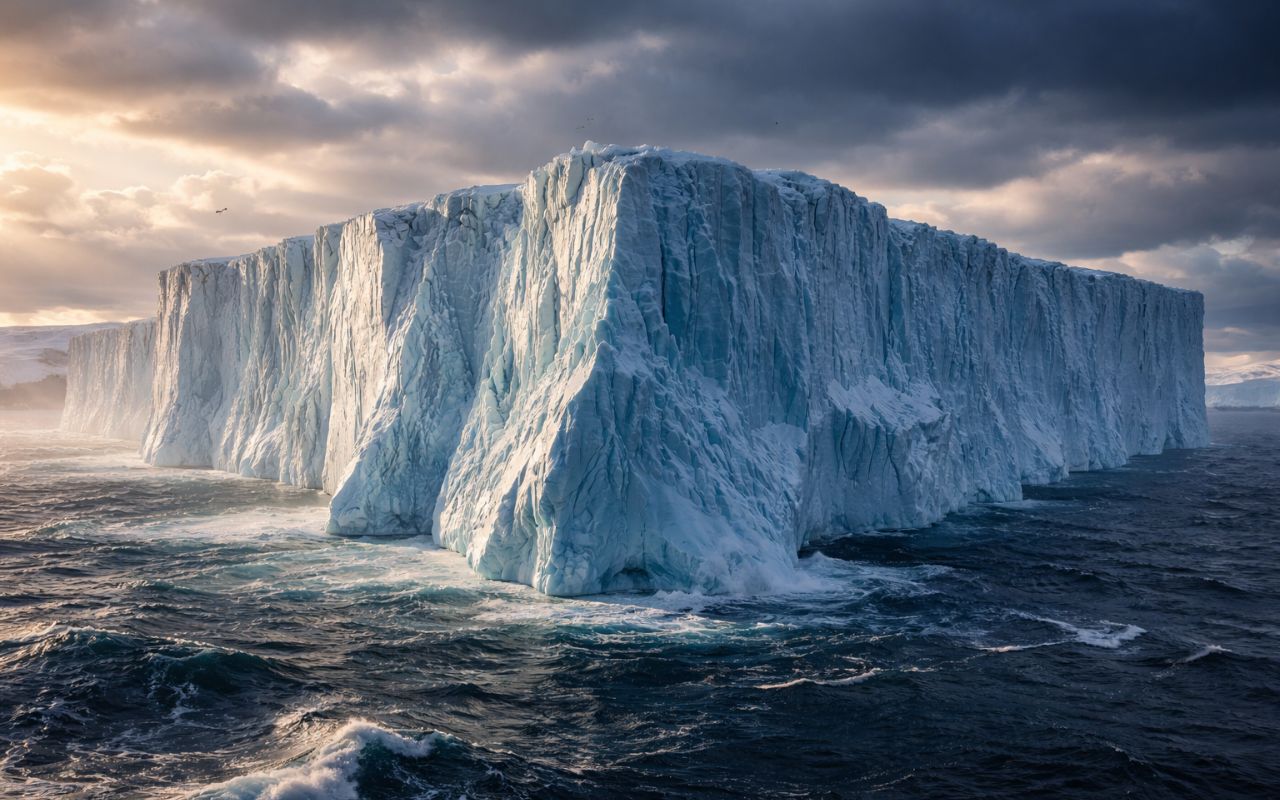
Climate change accelerates the melting of glaciers and alters the functioning of polar regions.
In Antarctica, record low ice extent in 2023 was linked to mass reproductive failures of emperor penguins, the largest penguins alive today.
In some colonies, the ice broke before chicks developed waterproof plumage, leading to the death of tens of thousands of individuals.
This loss doesn’t only affect penguins.
The same set of changes harms krill, which depends on sea ice to access the algae beneath the ice.
When the ice diminishes, krill decreases, and this reverberates up to the largest animal that ever existed.
It’s a feedback loop: less ice means less krill, which means fewer filter feeders and less efficiency in carbon capture via phytoplankton and sinking.
Plastic, Microplastics, and a Newly Named Disease
There is a villain that traverses levels of the food web and affects everything from seabirds to humans: plastic.
Improper disposal leads waste to rivers and seas, and the material accumulates in regions known as plastic islands.
The largest of these, the Great Pacific Garbage Patch, has an estimated area of 1.6 million km².
Along the way, turtles, fish, and seabirds confuse plastic with food and ingest it or get tangled.
A classic study estimated that about 90% of living seabirds have ingested plastic, and projections indicate that 99% of species will be affected by 2050.
The consequence is not just “filling stomachs with trash”: researchers have described plasticosis, an inflammatory fibrosis of the digestive tract associated with chronic plastic ingestion, which can lead to the death of thousands of seabirds every year.
With sun and waves, large pieces of plastic turn into smaller particles under 5 mm, called microplastics, and even smaller particles, known as nanoplastics.
These microplastics enter the food web, from zooplankton to fish, to birds and marine mammals, and eventually to human plates.
There have already been detections of microplastics in human tissues and organs, including blood, lungs, placenta, heart, and brain, while science attempts to understand the possible damages in a recent scenario.
Negotiations for an international treaty aimed at reducing, reusing, and managing the entire life cycle of plastic have faced deadlock, and a recent international meeting did not produce a final agreement.
In practice, this prolongs the window during which microplastics continue to spread.
Warmed Ocean and Amazon: When the Sea Pulls Drought Into the Continent
Ocean warming also connects to the wind and rain patterns in South America.
When the ocean heats up too much, as occurred in 2023 and 2024, the circulation pattern changes, and less water reaches the interior.
Droughts intensify in the Amazon, and heatwaves become more likely.
In 2023, the Amazon experienced historic drought and heat, with the Negro River in Manaus at its lowest level since 1902. Anomalies in the tropical Atlantic and El Niño emerge as explanatory pieces of the event.
The central point is that the ocean is not separate from the continent: the sea influences rain, river transport, and water security.
Practical Paths: Blue Carbon, Restoration, and High Seas Rules
Despite the heavy scenario, there are solutions described as ocean-based solutions.
One of them is the reforestation of mangroves, where many marine organisms spawn and develop.
Mangroves, salt marshes, and seagrasses accumulate the so-called blue carbon for centuries, buffer storms, reduce erosion, and sustain fisheries.
In coastal adaptation, planning appears as a tool: nature-based works, planned retreats, basic sanitation, and solid waste management are urgent measures to reduce damage and pollution that flows from rivers to the sea.
Globally, the implementation of the High Seas Treaty has entered its final stage and has been described as an agreement that will come into effect in January 2026, paving the way for Marine Protected Areas in international waters and scientific cooperation.
In Belém, COP30 is scheduled to take place between November 10 and 21, 2025, with themes related to the ocean, including responses to marine heatwaves, expansion and financing of Marine Protected Areas, blue carbon, and integration between the ocean and the Amazon in climate policies.
The message is straightforward: science, public policies, and the economy need to meet to keep the ocean as a climate buffer and food source.
Conclusion: Saving the Largest Animal That Ever Existed Is a Collective Choice
If blue whales, sharks, penguins, and corals disappear, it’s not just “marine life” that’s lost.
The package includes food, coastal protection, jobs, climate stability, and predictability of extremes.
The largest animal that ever existed serves as a thermometer: when the giant loses space, the question is not only about one species but about the entire system.
Realistic action starts where decisions are made and where habits weigh: reducing emissions, strengthening fishery management, restoring mangroves, and reducing the flow of plastic that turns into microplastics.
Demanding public policies, supporting protected areas, and treating sanitation as a priority are steps that fit into everyday life, from voting to consumption.
What do you think is the most urgent measure to prevent the largest animal that ever existed from becoming just a memory and to stop the avalanche of microplastics and the collapse of corals in the ocean?






-

-

-

-

-

-

27 pessoas reagiram a isso.