





 Portuguese
  English
  Spanish
  5 min of reading
  0 comments


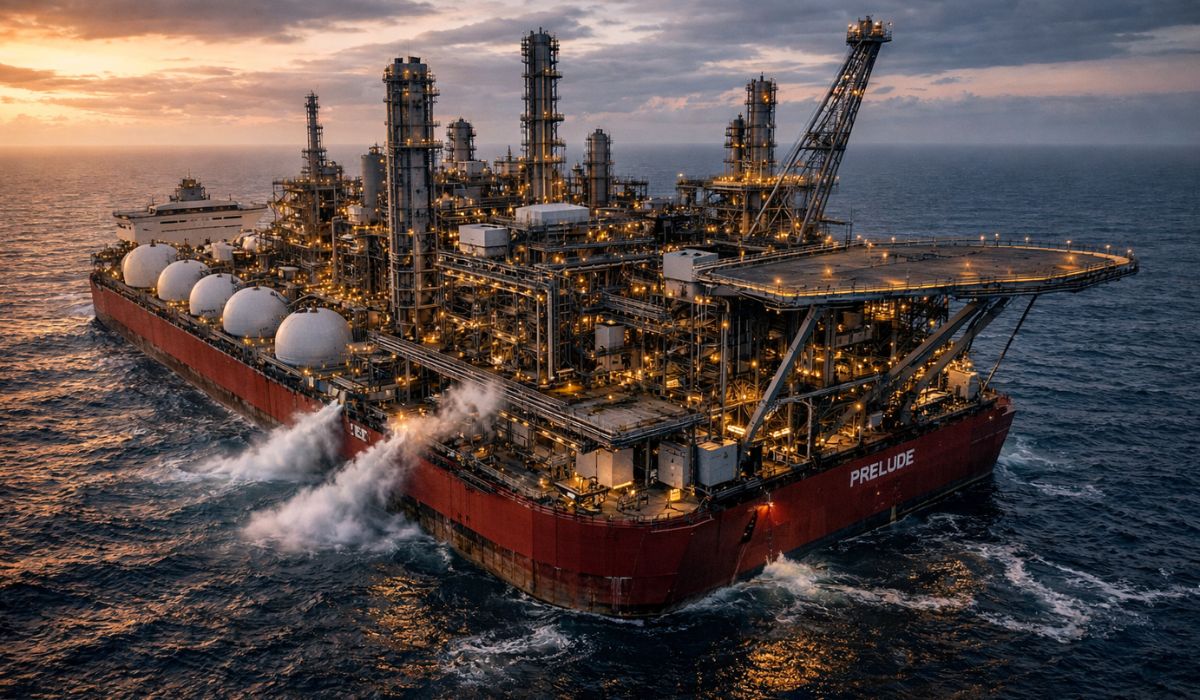
At Sea, A Giant Structure Brings Together Extraction, Processing, And Storage Of Natural Gas In One Location, With Cryogenic Cooling And Transfer To Methane Ships, Changing The Logistics Of LNG In Remote Fields.
With nearly 500 meters in length, the floating liquefied natural gas Prelude FLNG, operated by Shell, is cited by different technical records as one of the largest structures ever put into operation at sea.
The project was conceived to transform gas extracted at sea into liquefied natural gas (LNG) without relying on a land-based plant, with processing and storage on the unit itself.
In practice, the installation functions like a factory on the water.
-
Church from 1888 becomes a mansion of over 330 m² in Canada after a renovation of R$ 3.4 million and is eventually sold for nearly R$ 4.3 million.

-
How an innovative city combines high technology, well-being, and sustainability to become the largest reference in clean energy on the planet.
-
Couple buys 1846 church in ruins for R$ 660,000, invests R$ 3.2 million in renovations, transforms it into a millionaire mansion, and even preserved a historic cemetery with over 300 graves.

-
He started running at 66 years old, broke records at 82, and is now a subject of study for having a metabolic age comparable to that of a 20-year-old, in a case that is intriguing scientists and inspiring the world.


The production is received in the offshore field, goes through treatment stages, and at the end of the process, is cooled to the temperature range required for liquefaction.
The ready cargo is then transferred to methane ships, which transport it to terminals in other countries.
The logic of the system is to reduce steps between extraction and loading.
In conventional projects, some of these activities occur on the mainland and, therefore, often require extensive subsea pipelines, coastal works, and integration with port infrastructure.
What Is FLNG And How Does Offshore Liquefaction Work
The acronym FLNG stands for floating liquefied natural gas, a term used for floating facilities that produce and liquefy natural gas at sea.
This type of solution is discussed in the industry as an alternative for fields far from the coast, where building long pipelines and a land-based processing unit can increase costs and extend timelines.

In the operational arrangement, the gas produced in subsea wells is directed to the unit by typical offshore production systems.
From there, the material undergoes treatment and separation before the cryogenic cooling necessary for the gas to change state and become liquid.
The key point of the model is to concentrate, in the same location, stages that in many projects are divided between the sea and land.
This integration, on the other hand, increases the operational complexity on board, as production, processing, storage, and loading begin to occur within the same structure.
Why Is LNG Cooled To -162°C And Reduced In Volume
LNG is natural gas chilled to approximately -162°C, the temperature at which it liquefies.
According to energy agencies in the United States that explain the functioning of LNG in public materials, when liquefied, gas occupies a volume about 600 times smaller than in its gaseous form, making storage and maritime transport easier.
This volume reduction is one of the foundations of the international LNG trade.
With more energy concentrated in a smaller space, methane ships can carry large loads to markets not connected by pipelines.
Furthermore, the LNG chain allows the product to be discharged at regasification terminals and return to a gaseous state, to then flow through local networks.
This flow is utilized in countries that depend on gas imports for electricity generation, industry, and other uses.
Cryogenic Technology And Safety To Keep LNG At Sea
Liquefying the gas is just one step in the process.
Keeping LNG under safe conditions requires containment systems and thermal insulation compatible with cryogenic temperatures, along with monitoring routines to deal with variations in the marine environment and the movement of the structure.
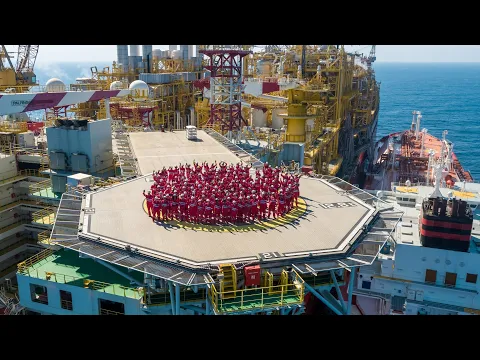

In institutional materials about LNG, Shell describes cooling and the consequent volume reduction as part of the principle that enables transportation over long distances.
Operationally, the stability of the product depends on appropriate tanks, pressure control, and procedures to handle gradual vaporization, a phenomenon anticipated in cryogenic storage systems.
At sea, loading also requires coordination with transport ships that approach to receive the cargo.
This type of operation is structured to reduce risks and maintain industrial safety standards, as it involves flammable products and extreme temperatures.
Differences Between Coastal Refineries And Gas Processing In Open Seas
In traditional projects, gas produced offshore typically travels through pipelines to the coast, where treatment units and, in some cases, liquefaction plants are located.
This route depends on licensing, civil works, and area availability, in addition to requiring integration with ports and transportation networks.
In the FLNG model, a significant part of these stages occurs in the ocean.
The proposal, according to industry analyses, is to reduce the need for permanent infrastructure on land and allow the development of more distant fields, with transfer of LNG directly to ships.
Nonetheless, industry experts often highlight that the change in location does not eliminate technical and safety requirements.
Rather than concentrating facilities on the mainland, the project now demands a large offshore structure, specialized maintenance, and continuous logistics of supplies and personnel.
Routine And Teams In A Large Offshore Unit
The routine in an FLNG unit generally follows offshore operation standards, with shifts and extended periods onboard.
Typically, structures of this kind include industrial areas and support spaces to accommodate teams from various specialties, such as operation, maintenance, safety, and services.

Training requirements and certifications vary according to legislation, company, and function, in addition to contractors’ demands and internal standards.
Since it involves an industrial environment at sea, training often includes safety, emergency response, and specific workplace procedures, without implying a one-size-fits-all package for all projects.
It is also important to differentiate the processing unit from the ships that transport the LNG.
The FLNG produces and stores.
The methane carriers receive the cargo and make trips to terminals, where the product can be regasified and distributed.
Prelude FLNG, Record Size And The Debate About “Largest Ship”
The Prelude FLNG is often described as one of the largest floating structures ever built, at about 488 meters in length, according to technical records and industry publications.
At the same time, the use of the term “largest ship” may vary depending on the criterion adopted, as there are historical records associated with large oil tankers and other types of vessels.
In widely cited lists and records, the supertanker Seawise Giant appears as the longest among self-propelled ships in its category, with a length shorter than that of the Prelude.
This difference helps explain why, in some contexts, the comparison is made between different categories: an industrial floating installation on one side and conventional cargo ships on the other.
The scale of the FLNG is linked to the need to integrate processing plant, cryogenic systems, storage tanks, and loading infrastructure into a single unit.





-

-

-

8 pessoas reagiram a isso.