





 Portuguese
  English
  Spanish
  5 min of reading
  1 comment


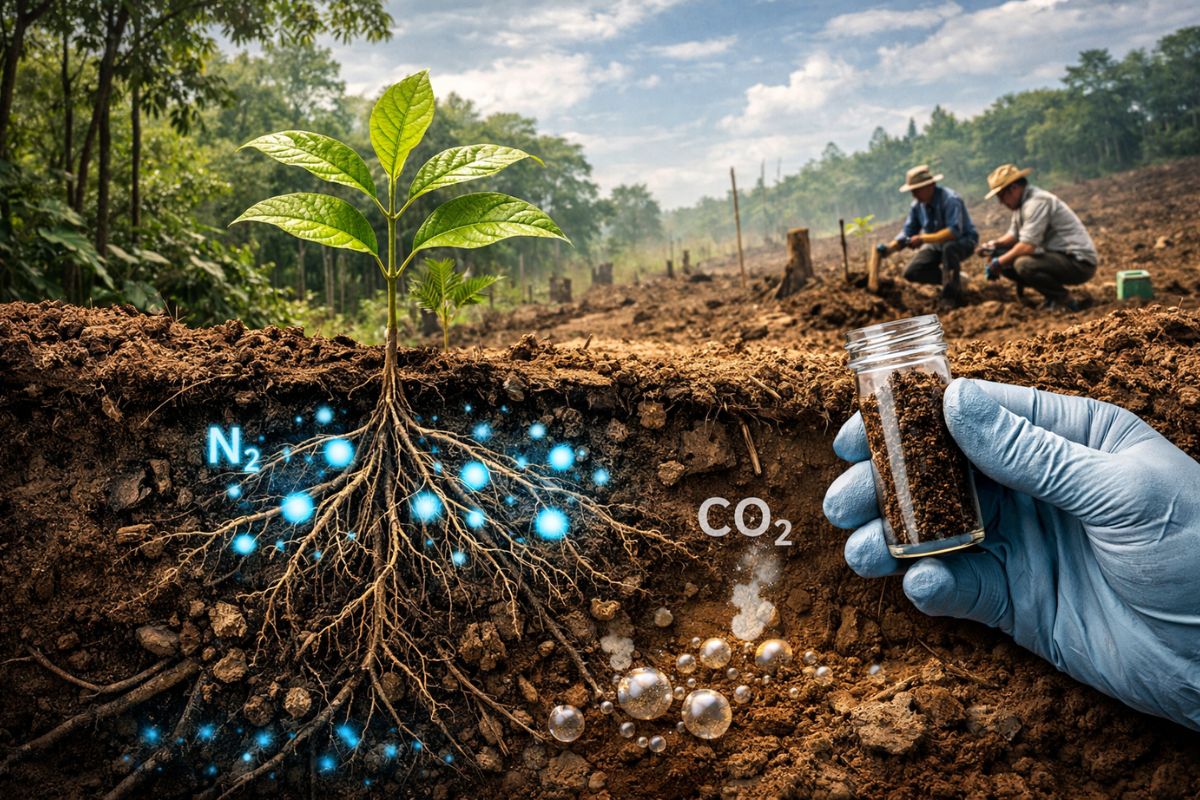


Decades-Long Experiment With 76 Plots In Central America Showed That In The First 10 Years, Young Forests With Sufficient Nitrogen Regenerate Nearly Twice The Rate. Isolated Phosphorus Did Not Replicate The Effect. Scientists Warn: Fertilizing Is Not The Solution; It’s Better To Prioritize Legumes And Areas Already Rich In Nitrogen In The Soil.
A new study has brought an alert that directly impacts the future of tropical forests: what is “hidden” in the soil can accelerate the return of trees after deforestation. In areas with sufficient nitrogen, recovery occurs up to twice as fast, especially in the first 10 years, precisely the phase in which growth determines whether the forest gains momentum or stagnates.
And this is not just good news for the landscape. Faster growth means more carbon capture from the atmosphere, directly impacting reforestation strategies. The study points to a path of smarter management, working with the logic of nature instead of relying on fertilizers, which can generate environmental side effects.
What Scientists Tracked For Up To 20 Years

The team, led by the University of Leeds, set up what they describe as the largest and longest experiment to understand how nutrients affect the growth of new tropical forests.
-
The oceans are darkening all over the planet – what is happening?

-
An engineer designs a solar plane to fly on Mars at an altitude of 1,000 meters and a speed of 300 km/h, covering 16,000 kilometers in a Martian year, 900 times the distance traveled by the Ingenuity helicopter in three years on the planet before experiencing a rotor failure, and NASA is already funding the feasibility study.

-
A new phenomenon of contactless magnetic friction intrigues scientists and questions a theory that has been valid since the 17th century.

-
An impressive phenomenon in Northern Brazil causes rivers of different colors to flow side by side, revealing secrets about sediments, currents, and biodiversity.


The focus was on tropical areas previously deforested by activities such as logging and agriculture, exactly the scenarios where natural recovery becomes a race against time.
A total of 76 forest plots in Central America were selected, monitored for periods of up to 20 years.
The sites varied in age and size, allowing observation of the recovery process over time, tracking tree growth and mortality as the forests rebuild.
How The Experiment Tested Nitrogen And Phosphorus In Practice
To isolate the effect of nutrients, the plots received different treatments: some received nitrogen fertilizer, others phosphorus, some both, and one group was left untreated. This design allowed for comparison of how the forests responded when the “fuel” of the soil changed.
The result was straightforward: nitrogen emerged as the deciding factor in accelerating regeneration, especially early on. Phosphorus, when applied alone, did not produce the same leap.
Nitrogen Became The “Engine” Of Young Forests

The strongest point of the study lies in the timing. During the first 10 years of recovery, forests with adequate nitrogen advanced at approximately twice the speed of those with a deficiency of the nutrient.
This matters because this first decade is the phase in which the forest defines its structure, gains volume, closes its canopy, and begins to function as a more stable system.
If the beginning is slow, the return of the entire ecosystem is delayed. If the beginning accelerates, the gain of biomass and carbon also accelerates.
Why “Growing Faster” Changes Carbon Capture
Tropical forests are among the largest carbon sinks on the planet. The more trees grow and accumulate biomass, the more carbon is stored in the plants, rather than circulating in the atmosphere.
The research estimated that if nitrogen scarcity is holding back young tropical forests worldwide, about 690 million tons of carbon dioxide may go unaccounted for per year.
The authors compare this amount to approximately two years of carbon dioxide and other greenhouse gas emissions from the United Kingdom. In other words: the “brake” of the soil could cost dearly for the climate.
Publication And Who Participated In The Work
The results were published on January 13 in the journal Nature Communications.
The study involved researchers from various institutions, including the University of Glasgow, the Smithsonian Tropical Research Institute, Yale University, Princeton University, Cornell University, the National University of Singapore, and the Cary Institute of Ecosystem Studies.
The lead author, Wenguang Tang, conducted the research during his PhD at the University of Leeds and emphasized that there is room to increase the capture and storage of greenhouse gases through reforestation, paying close attention to the nutrients available to the trees.
Why Scientists Do Not Recommend “Throwing Fertilizer” Into The Forest
Even having used nitrogen fertilizer in the experiment, the message is clear: they do not recommend fertilizing forests as a large-scale solution.
The reason is that widespread use can bring side effects, such as nitrous oxide emissions, a potent greenhouse gas.
Instead, the proposal is to work with practical alternatives aligned with nature, avoiding creating a remedy that generates another climate problem.
The “Smart” Alternatives Suggested By The Study
The line advocated by the researchers is strategic: restore better, not just restore more. Among the options pointed out, two stand out:
1) Plant Legumes to Naturally Introduce Nitrogen Into The System
The suggestion is to use trees from the legume family, which add nitrogen to the soil, helping to sustain growth without relying on fertilizers.
2) Prioritize Areas That Already Have Sufficient Nitrogen
Another possibility is to restore forests in locations where nitrogen is already more abundant, including due to effects related to atmospheric pollution, directing efforts to where recovery is likely to be faster.
The logic behind this is simple and strong: it’s not just about planting trees; it’s about choosing the ground where they will thrive.
The Political Timing: COP30 And The Tropical Forests Fund Forever
The study was released a few weeks after the conclusion of COP30 in Brazil, when the Tropical Forests Fund Forever (TFFF) was announced, aimed at supporting countries with tropical forests in protecting existing areas and restoring those that have been damaged.
The lead researcher, Sarah Batterman, associate professor at the School of Geography at Leeds, emphasizes a central point: avoiding the deforestation of mature tropical forests should remain a priority, but understanding how nutrients influence recovery helps policymakers to decide where and how to restore to maximize carbon sequestration.
What This Changes In Practice For Reforestation
The uncomfortable and powerful conclusion is: the subsoil can determine the success of reforestation. If the strategy ignores nutrients, it may end up investing heavily in areas where the forest will take much longer to “take off.” If nitrogen is considered, actions can be directed to accelerate the return of forests and increase carbon capture at the pace that the climate crisis demands.
In the end, the question that turns into debate is simple: do you think reforestation projects should prioritize areas where the soil already gives an advantage for forests to grow faster?








Fantástico o estudo!