





 Portuguese
  English
  Spanish
  6 min of reading
  5 comments


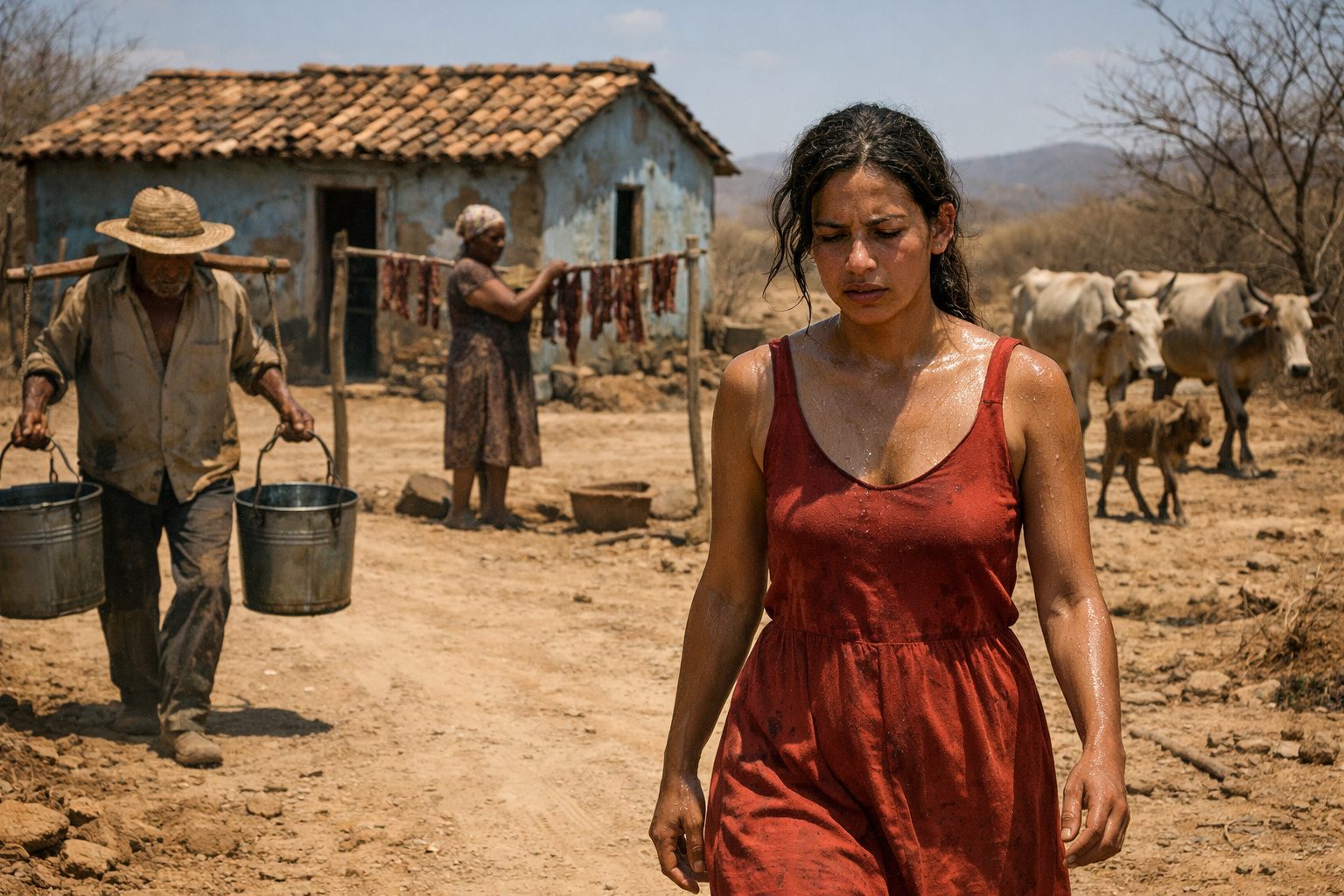


The Northeastern Hinterland Carries a History Marked by Recurring Droughts, Structural Absence of the State, and Cycles of Dependence That Span Generations, Revealing a Territory Where Poverty Is Not an Accident, but the Consequence of Prolonged Political Choices
There is a place in Brazil where absence has become routine. A territory where drought represents not just a natural phenomenon, but the starting point of a continuous chain of abandonment that spans generations. The Northeastern hinterland is often portrayed as a land of resistance, faith, and strength. However, behind this image constructed over time, there exists a much harsher reality, marked by a scarcity of opportunities, the fragility of public policies, and the transformation of survival into a daily challenge.
In this scenario, water ceases to be just a natural resource and begins to represent power. Poverty, in turn, becomes a political instrument. Violence fills the void left by the absence of the State, while the people are gradually pushed out of their own land. From historical cangaço to modern factions, from silent deforestation to the population exodus that empties entire cities, the hinterland reveals a Brazil that rarely confronts the consequences of what it has built.
This information has been disclosed by various reports, academic studies, and journalistic analyses over the past few decades, compiled in investigations on regional development, water resources, and public security in the Northeastern semi-arid region, according to surveys published by specialized media and social research institutes.
-
Tourists were poisoned on Everest in a million-dollar fraud scheme involving helicopters that diverted over $19 million and shocked international authorities.

-
Hidden beneath the dense forest of the Sierra Nevada, Betoma emerges in a neighbor of Brazil as the greatest archaeological discovery of the century, revealing a colossal ancestral city covering over 18 km², with 8,334 stone structures and the potential to rewrite the history of South American civilizations.

-
Goodbye iron: new technology from Xiaomi promises to revolutionize the way we iron clothes with 500 kPa steam, continuous flow of 120 g/min, heating in 65 seconds, and six smart modes for different fabrics.

-
Rio Pardo, the most mysterious city in Rio Grande do Sul: untouched Pampas castle, the missing treasure of the Devil Boy, bride’s saint, invisible tunnels, and a 200-year curse today.

Drought as a Starting Point, Not a Destination

When the hinterland is mentioned, drought almost automatically emerges as an explanation for all its woes. However, in the Northeastern semi-arid region, drought is not an exception, but a routine. Rainfall is scarce, poorly distributed, and concentrated in short periods of the year. The soil, shallow and stony, has a low capacity for water retention. The rivers are intermittent: they flow full for a few months and then disappear, leaving only dry beds and hardened traces of mud.
This scenario repeats itself in the hinterlands of Ceará, Pernambuco, Bahia, and Piauí. The landscape changes little, but the daily struggle renews with each season. Waking up before the sun is not a choice, but a necessity. In many communities, searching for water means traveling miles under a scorching sun. Women and children walk along dirt roads carrying heavy buckets, knowing that the water must last all day for drinking, cooking, and keeping the animals alive.
When the water runs out, there is no immediate alternative. There is only waiting. Waiting for the next rain, almost always uncertain, or for the arrival of the water truck, which does not always come on time. The animals feel it first. Goats, cattle, and horses wither to their limits. Many die on the way. Others survive just enough to be sold for pennies. Each lost animal represents food, income, and a future ripped from a family.
Throughout history, great droughts have caused mass exoduses. In the 19th century, entire families abandoned their lands, driven by hunger and thirst. In the 20th century, the scenario repeated under new names, but with the same pain: silent deaths, children who could not survive, and elderly people left behind. The hinterland has been emptied more than once, not by choice, but by lack of alternatives. Still, drought alone does not explain the social disaster. It is merely the starting point.
The Drought Industry and the Power Over Water

What turns the lack of rain into a permanent tragedy is the absence of structure. Water reservoirs that never reach where they should, promised and abandoned adductors, works initiated and interrupted. Emergency solutions become permanent. The water truck, the ultimate symbol of this model, appears as a momentary salvation but also as a mechanism of dependency.
In the hinterland, water ceases to be a right and becomes a bargaining chip. Whoever controls the water controls survival. It is at this point that the so-called drought industry emerges, a system that does not thrive on the absence of rain, but on the absence of solutions. It feeds on constant emergencies, eternal improvisation, and a population kept on the brink.
Whenever the drought intensifies, emergency speeches emerge, funds are released, and provisional actions take center stage. When the rains return, everything is forgotten. No structural transformation remains. This cycle repeats itself from generation to generation. Solving the problem would mean losing political control, influence, and financial resources.
This model is not inevitable. Regions of the world with even drier climates have managed to ensure continuous access to water through planning, reuse, and efficient management. The problem of the hinterland has never been just about rain, but the absence of political decision-making. Since the era of hereditary captaincies, large landholdings have shaped power relations based on dependence, favor, and fear.
While entire populations face water rationing, a significant portion of public water is directed toward large irrigation projects focused on agribusiness. In states like Ceará, the largest share of water serves fruit exporters, while neighboring communities live under permanent scarcity. Water exists, but it does not reach those who need it most.
Violence, Environmental Degradation, and Silent Exodus

The absence of the State does not only generate poverty. It opens space for violence. Long before modern factions, the hinterland was already lawless territory. It was in this void that cangaço emerged in the early 20th century as a direct response to abandonment. Violence was the consequence of a territory left to its own devices.
With the end of classic cangaço, abandonment remained. Violence merely changed its face. Today, factions occupy small towns, transforming the hinterland into a strategic route for drugs, arms, and illicit money. Bank heists, violent actions, and populations held hostage have become common in municipalities with little policing and weak oversight.
At the same time, violence extends to the land itself. The Caatinga, the only fully Brazilian biome, has already lost about 40% of its original cover. Deforestation, extensive livestock farming, illegal charcoal production, and unplanned expansion accelerate desertification. Each fallen tree reduces water infiltration, speeds up river desiccation, and compromises biodiversity.
When drought, violence, and environmental degradation converge, the result is predictable: exodus. The hinterland does not empty due to a lack of love from its people, but because staying becomes impossible. Young people leave early, cities age, schools lose students, and health posts primarily serve the elderly. The hinterland that remains is weary, dependent on aid, and increasingly vulnerable.
Meanwhile, the hinterland continues to be romanticized in the national imagination. Resistance is exalted, but the reason for it is rarely questioned. This narrative softens the pain and normalizes inequality. The real territory loses people, strength, and future.
In the face of this scenario, two paths remain: the continuation of abandonment or structural break. Investing in water, education, health, local production, and environmental protection requires political courage and long-term planning. Treating the hinterland not as a problem, but as an essential part of the country, is the only way to break a cycle that has lasted for centuries.





Essa mulher de vestido vermelho na foto da matéria não tem a mínima condição de ser uma sertaneja que sofre as agruras próprias do viver no cairiri. Está muito bem físicamente, sobrancelhas feitas, pele boa, embora com semblante de desalento. Parece mais uma atriz fazendo um personagem.
O Estado brasileiro não tem interesse em acabar com o sofrimento desse povo porque é interessante que permaneça assim pois esses vermes desses políticos querem que a miséria e o sofrimento desse povo continue o atraso a ignorância permaneça não querem um povo com saúde alimentado e com poder de pensamento pois é uma ameaça para essa **** de ****
Acertou na mosca.
Boas e oportunas falas.