





 Portuguese
  English
  Spanish
  6 min of reading
  10 comments


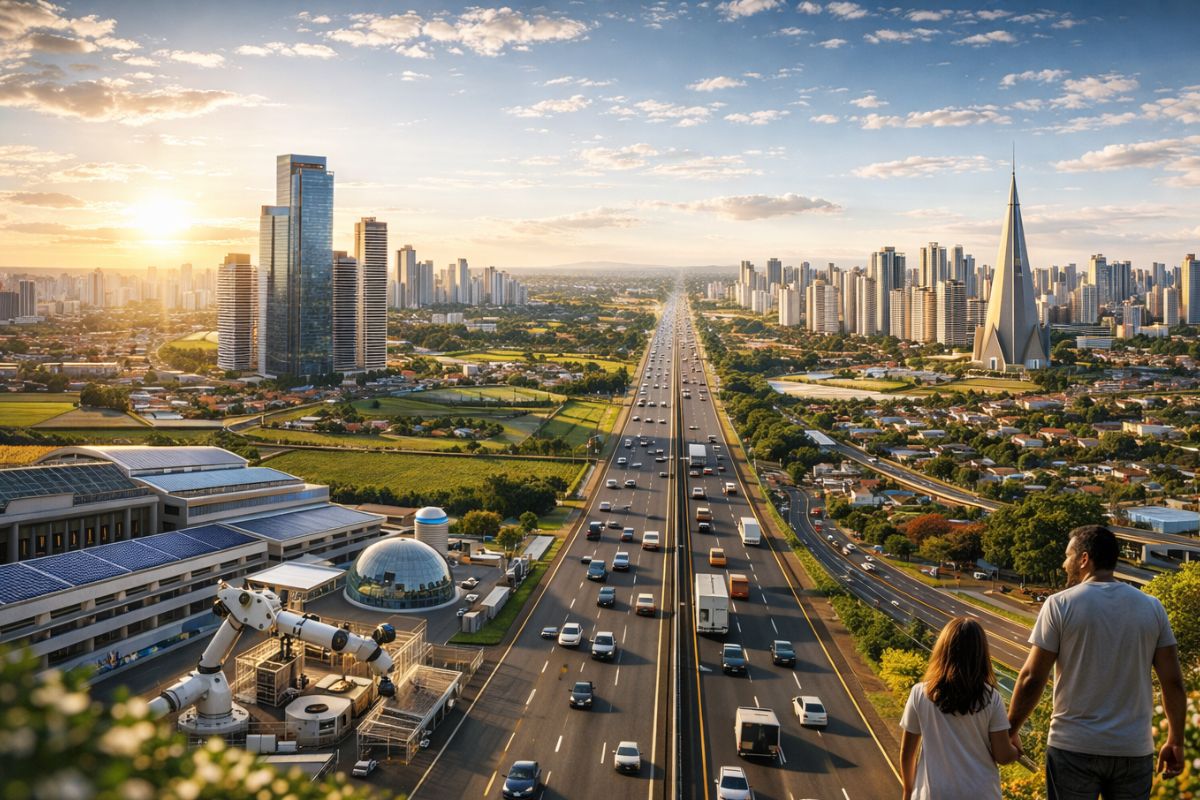


With Quality of Life, Urban Planning, High-Tech Agribusiness, and Strong Education, the Londrina-Maringá Axis Becomes the Economic Engine of the South and Challenges the Myth That Only Capitals Offer Opportunities
The south of Brazil is still viewed, by many, as synonymous with countryside, soybeans, tradition, and small towns at a slow pace. But the Londrina-Maringá axis proves that this picture is outdated. Between two highly planned, connected, and productive cities, an urban corridor has emerged that generates billions, attracts investments, draws companies and qualified professionals, and delivers a quality of life that many capitals have lost along the way.
More than just two successful neighbors, Londrina-Maringá now operates as a linear metropolis, with universities, hospitals, logistics centers, technology hubs, and high-level services distributed throughout the same region. Away from the spotlight of the mainstream media, this axis demonstrates another Brazil: modern, efficient, organized, and with a countryside that is already living the future.
The South That Remains in the Stereotype and the South That Really Exists
For decades, the idea of the countryside in the South has been reduced to farming, monoculture, and a placid routine, as if nothing had changed. However, in practice, the north of Paraná has become a laboratory for regional development.
-
“No one will make us change the Pix,” says Lula after the US report.

-
Lula responds directly to Trump and says that Pix is from Brazil and will not change under pressure from anyone, after a report from the United States pointed out the Brazilian payment system as an American trade barrier.

-
Amazon has just announced a new fee on all deliveries, and your online purchases will become more expensive starting April 17, including for those buying from the United States here in Brazil.

-
He sold his share for R$ 4 thousand, saw the company become a giant worth R$ 19 trillion, and missed the opportunity of a lifetime.


While the news insists on showing urban chaos, gridlock, and violence in large metropolises, Londrina-Maringá is moving in another direction.
Here, the countryside is not synonymous with delay. It is synonymous with planning, productivity, and quality of life. And this becomes clear when looking calmly at both ends of this corridor: Maringá and Londrina.
Maringá: Urban Planning, Green Tunnel, and High-Tech Agribusiness

Maringá, the well-known “city of songs,” has just over 400,000 inhabitants and is a rare case in Brazil: it did not grow haphazardly.
Since its founding, urban layout was carefully planned, with wide avenues, well-defined neighborhoods, and green areas spread throughout the city. Nothing seems to have been done in a rush.
The famous green tunnel, formed by the canopies of trees over the main roads, is not just a backdrop for pretty pictures.
It reflects a city that understood early the importance of thermal comfort, well-being, and urban quality, anticipating discussions that many metropolises only began to have recently.
No wonder Maringá frequently ranks among the best cities in Brazil to live in, with high HDI, good security indexes, relatively efficient public services, and urban organization that leaves several capitals behind.
But the tranquil appearance deceives those who think that “nothing happens” there. Maringá’s economy is strong and diverse. The city is one of the largest high-tech agribusiness hubs in the country, integrating technology in the field, logistics, industry, and services.
Companies that operate on a national and international scale use the region as their base, taking advantage of infrastructure and a qualified workforce.
The service sector is robust: modern shopping centers, active commerce, strong education, a heated real estate market, and constant verticalization demonstrate a city that thinks big.
The Cathedral Basilica itself, the tallest in Latin America, has become a symbol of this: it is not only a postcard but a kind of manifesto of ambition and growth. Maringá is no longer just the “city of the future” in discourse. Maringá is a consolidated present.
Londrina: Small London That Became a Hub of Technology, Health, and Education

Londrina was born linked to coffee and English colonization, which earned it the nickname “small London” and fueled rapid growth in the last century. But the city has not remained trapped in past memories.
About 100 kilometers ahead, the other end of Londrina-Maringá demonstrates how the countryside can also reinvent itself.
Today, with almost 600,000 inhabitants, Londrina is the second-largest city in Paraná and one of the most important in the interior of Brazil.
It has transformed into a hub of technology, innovation, and education, with notable universities, research centers, a startup ecosystem, and a constantly expanding entrepreneurial environment.
In healthcare, Londrina is a reference for dozens of municipalities surrounding it, receiving patients from all over the region.
The strategic geographical position also plays a role: the city connects the north of Paraná to São Paulo, Mato Grosso do Sul, and other major markets, reinforcing its logistical role and helping to explain the volume of business that passes through there.
Visually, Londrina surprises those who arrive for the first time. Lake Igapó surrounded by modern buildings, leisure areas, and well-structured roads gives it a metropolitan feel that many capitals would envy.
The city pulses: it has events, an active cultural life, bars, restaurants, full universities, and a market that moves billions of reais every year. Londrina practically demonstrates that it is possible to live in the countryside without giving up modernity, services, and opportunities.
Londrina-Maringá: When the Countryside Becomes a Linear Metropolis
When looking at Maringá and Londrina in isolation, the numbers are already impressive. But it is in combination that the strength of Londrina-Maringá appears more clearly.
Between the two ends, cities like Cambé, Ibiporã, Sarandi, Rolândia, Arapongas, and others grow and integrate, forming a continuous urban and economic axis.
This is not just a clustering of cities, but rather a linear metropolis in the countryside of Brazil.
This corridor concentrates universities that attract students from various states, reference hospitals, industries, logistics centers, strong trade, and a job market much more diverse than the countryside stereotype might suggest.
Londrina-Maringá serves not only northern Paraná but also parts of the interior of São Paulo and even Mato Grosso do Sul.
The key word to understand this model is simple: strategic location. Connected to important highways, close to major consumer centers, and well integrated into regional logistics, the Londrina-Maringá axis appears to companies as an ideal place to invest, produce, and distribute.
Therefore, construction is booming, new enterprises are emerging, jobs are being created, and the economy continues to move, even in times when the country faces crises.
In practice, the north of Paraná proves that the countryside is not a delay, but rather efficiency, productivity, and planning.
A Modern South That Rarely Appears in the Mainstream Media


Despite all this strength, Londrina-Maringá is still far from the big spotlight. National news tends to focus on the same capitals, the same crises, and the same problems.
Meanwhile, there is a modern, productive, and organized Brazil growing silently.
It is clear that challenges exist. No region is perfect. But just walking these cities reveals that something different is happening here.
While many capitals struggle with chaotic traffic, rising violence, overloaded services, and declining quality of life, the Londrina-Maringá axis displays consistent urban planning, applied technology, strong education, and a continuously advancing economy.
Perhaps it is not talked about much because it breaks the narrative that Brazil only happens in the capitals or because positive stories do not attract as much audience as bad news.
Speaking ill of the country has almost become standard, but the reality is that the north of Paraná has become a concrete example of a countryside that is already living the future.
What Londrina-Maringá Reveals About the Future of the Countryside in Brazil
In the end, Londrina-Maringá shows that the countryside can be the true engine of the country, combining high-tech agribusiness, sophisticated services, innovation, education, and quality of life.
This is not an isolated case of a “successful city,” but rather a planned, connected, and competitive regional system.
While many still associate the countryside with isolation and lack of opportunity, Londrina-Maringá offers precisely the opposite: connection, mobility, employment, education, relative security, and space to grow professionally without sacrificing time and well-being.
It sends a clear message to the rest of Brazil: it is not necessary to choose between development and quality of life.
And now I want to know from you: if you could choose, would you prefer to live in a traditional capital or in an axis like Londrina-Maringá, with a countryside feel but a future pace?






Moro em Arapongas e confirmo pq vejo isso de perto TDS os dias.
Quanto as mideas e noticiários nacionais, deixem que continuem focados nas capitais de sempre. Melhor não divulgar, ou isso aqui vai lotar de gnt e vai estragar como aconteceu com as grandes capitais que eles tanto mostram .
Já não chega o tempo da pandemia que acabou trazendo muitos pra cá por ter pouco caso da doença e emprego não ter parado. Povo veio conheceu tudo q foi citado nesse documentário e muito mais, gostou ,ficou e foi espalhando pra outros trazendo familiares e amigos tbm.
Arapongas já não é mais a cidade tranquila. Então deixe que crescemos em silêncio mesmo. Melhor assim p não estragar nossa qualidade de vida que ainda que temos por aqui.
Moro em Ibiporã, então concordo plenamente.
Realmente.. essas 2 cidades são diferentes.. mas Maringá um pouco a frente de Londrina.