





 Portuguese
  English
  Spanish
  2 min of reading
  0 comments


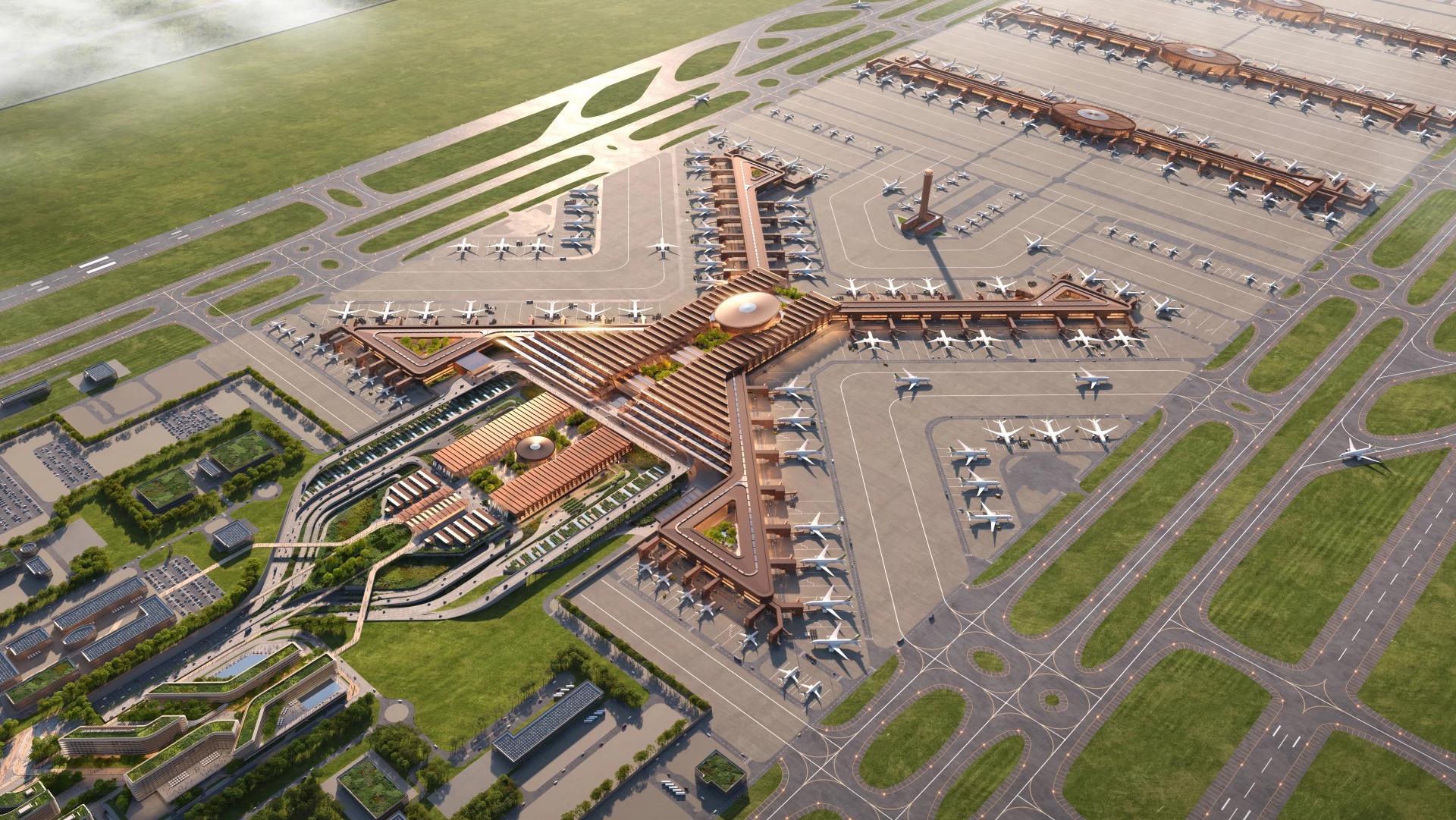
The Futuristic Airport Designed by Zaha Hadid Architects, Under Construction South of Addis Ababa, Ethiopia, Will Have 660 Thousand Square Meters, X-Shaped Inspired by the Rift Valley, Construction in Phases and Final Capacity Estimated at Up to 110 Million Passengers Per Year
The futuristic airport Bishoftu International Airport, designed by Zaha Hadid Architects and commissioned by the Ethiopian Airlines Group, is under construction south of Addis Ababa, Ethiopia, covering 660,000 m² with a goal of 110 million passengers per year, redefining African airport infrastructure.
Futuristic Airport in an X Shape Establishes a New Scale Benchmark
With approximately 7 million square feet, the terminal adopts an X-shaped design. The layout prioritizes efficient circulation, reducing internal distances and connecting piers through a central backbone inspired by the nearby Rift Valley in Bishoftu.
Each pier incorporates unique interior materiality and color palettes to reflect different regions of the country.
-
He started running at 66 years old, broke records at 82, and is now a subject of study for having a metabolic age comparable to that of a 20-year-old, in a case that is intriguing scientists and inspiring the world.

-
Oldest tree on the planet reappears after 130 years of searches: Wattieza, 385 million years old, was 10 meters tall and had no leaves or seeds; Gilboa fossils in New York solved the mystery in 2007.

-
A 48-square-meter house assembled in hours with 4,000 bricks made of recycled plastic that does not absorb moisture, has natural thermal insulation, and costs less than 90,000 reais in a complete kit.

-
Luciano Hang revealed that Havan’s air fleet has already accumulated more than 20,000 landings, 10,000 flight hours, and 6 million kilometers traveled, and he says that without the planes, the company would never have grown so quickly.


The spatial organization aims to minimize transfers and facilitate direct connections, allowing continuous movement to the next gate, according to the design team.
Sustainability Strategies and Local Materials Guide the Construction
The futuristic airport will use locally sourced materials and sustainability solutions. Natural ventilation, semi-open areas, and outdoor spaces aim for thermal comfort.
The goal is to achieve LEED Gold certification, with prefabricated modules and landscaping featuring drought-resistant native species.
Water Management, Solar Energy, and Phased Construction
Rainwater from runways, roads, and yards will be channeled to wetlands and basins for storage and reuse. Solar panels will generate on-site energy. Implementation will occur in phases, with inauguration scheduled for 2030.
When completed, Bishoftu International Airport will have a capacity of up to 110 million passengers per year and parking for 270 aircraft. The scale of the complex reinforces the strategy for regional air expansion and the country’s logistical integration, enhancing efficiency for transit passengers.









-

-

-

-

7 pessoas reagiram a isso.