





 Portuguese
  English
  Spanish
  7 min of reading
  0 comments


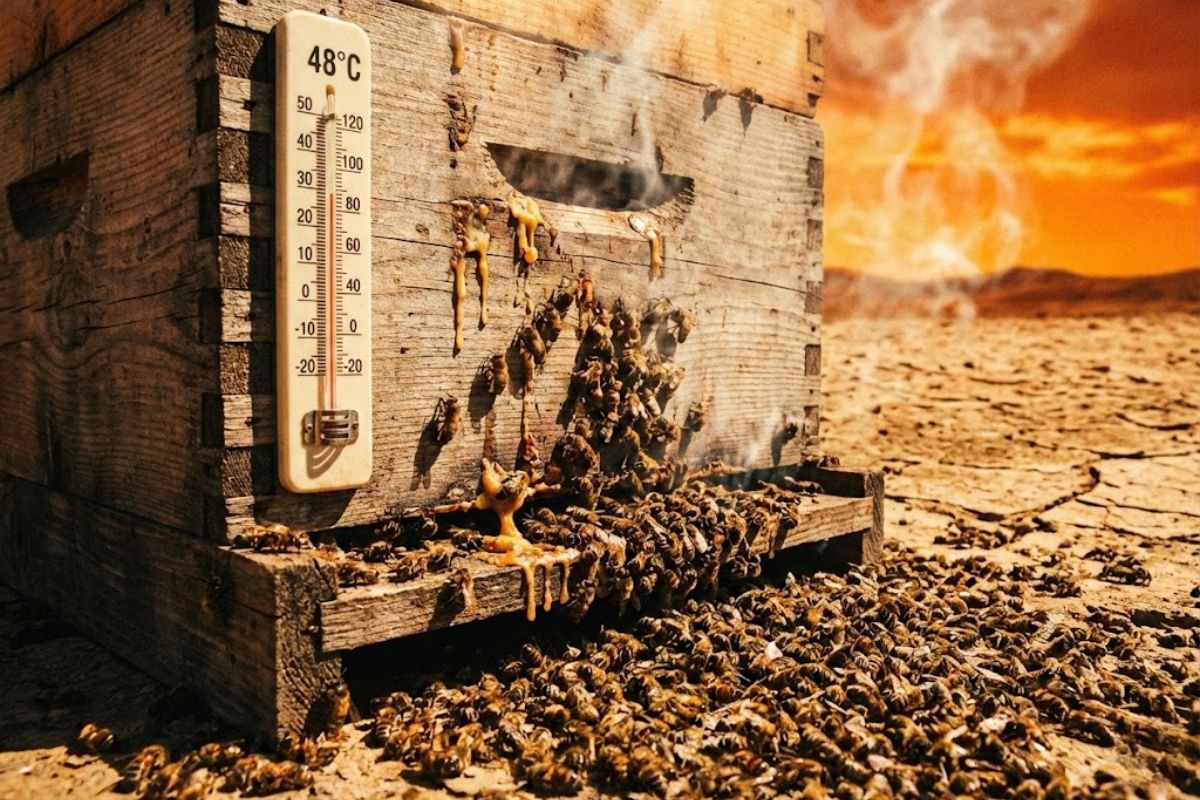
After Monitoring Nine Colonies In Arizona For Three Months With Temperatures Above 40°C, Research Shows That Bees Lose Thermal Stability, Brood Spend Hours Outside The Ideal Range, And Smaller Colonies Collapse Faster.
Bees, famous for keeping the internal temperature of hives under near-surgical control, are being pushed to a dangerous limit. Prolonged heat waves are overloading the natural cooling system, causing repeated internal fluctuations and making parts of the hive stay outside the safe range for hours.
The result is not just thermal discomfort. This continuous overheating shortens the lifespan of adult bees, interferes with brood development, reduces the total population of colonies, and threatens pollination, an invisible service that supports crops, natural ecosystems, and food chains worldwide.
Where It Happened And Why Arizona Became A Global Alert

The scenario observed was Arizona, in the United States, during a particularly hot summer.
-
Agricultural drone sprayed poison into the air and destroyed the neighbor’s crops, causing 1 million in damages; 48 cows died from nitrite poisoning in the pasture, and Russia is hiding a possible outbreak of foot-and-mouth disease: the week was brutal for the rural sector.
-
Russia cut fertilizers, China cut fertilizers, and oil prices soared with the war in the Middle East: sugarcane producers in the interior of São Paulo are seeing costs explode from all sides and warn that the effects will take months to be absorbed.

-
It does not come from flowers, is produced only every two years, and more than 90% goes straight to Europe: meet the bracatinga honeydew honey from Santa Catarina, considered one of the rarest in the world and overlooked by Brazil itself.
-
They said no to 26 million dollars and would do it all over again: mother and daughter from Kentucky reject a million-dollar offer from a mysterious company that wants to build the largest data center in the state on more than 2,000 acres of rural land.

Over three months, external temperatures repeatedly exceeded 40°C, creating a situation of prolonged thermal stress for the monitored colonies.
The researchers monitored nine bee colonies, specifically aiming to measure something that had not yet been directly assessed: what the real limits of the colonies’ thermoregulation are and how natural heat waves affect their ability to keep the hive stable and grow in population.
This focus is crucial because the issue is not an isolated peak. It is the repetition.
When extreme heat returns day after day for weeks, the bees’ cooling system ceases to be a shield and turns into a race of endurance that the colony might lose.
The Golden Rule Of The Hive: Brood Must Stay Between 34°C And 36°C

Life inside a hive depends on controlled temperature.
The brood, which are developing bees, needs to remain between 34°C and 36°C to develop healthily.
This range is not a detail. It is a biological limit.
Outside of it, the developing organism can suffer stress, have its development compromised, and, in more severe situations, be pushed into potentially harmful conditions.
Even under extreme heat, the colonies managed to keep the average brood within this range.
The problem is what happened throughout the day: the average concealed dangerous fluctuations that, when added together, became a continuous assault on the stability of the hive.
Fluctuations Inside The Hive: The Danger Is Not Just “Hot”, It’s Unstable

The data showed that internal temperatures varied widely throughout the day.
In the center of the brood area, where thermal control is normally most efficient, developing bees spent about 1.7 hours per day below the ideal temperature and approximately 1.6 hours above this range.
This means that, daily, even in the heart of the hive, brood faced repeated windows of thermal stress in both directions: relative cold and excessive heat.
This back and forth is exhausting because it forces the body to deal with constant changes instead of a stable environment.
In practical terms, this is not about continuous and predictable heating.
This is about an environment that oscillates and repeatedly exposes developing individuals to conditions outside the ideal.
On The Edges Of The Brood, The Hive Becomes A Thermal Risk Zone For Eight Hours

The most critical point appeared on the outer edges of the brood area. There, the conditions were described as much more severe.
Young bees in these areas spent about eight hours per day outside the safe temperature range. Eight hours is not a peak.
It is half a day in stressful conditions.
This detail changes the weight of the threat. The hive is not heating uniformly.
It is creating pockets where cooling fails for long periods, exposing parts of the new generation to a constant risk.
And the longer a brood spends outside the safe range, the greater the chance of biological consequences accumulating and reflecting on the colony’s population.
What This Heat Does To The Colony: Fewer Bees, Shorter Lifespan, Population Decline
The effects were clear on the population. Colonies exposed to higher maximum air temperatures and greater internal variations showed a decline in population size.
The proposed mechanism is dual and brutal.
First, excessive heat impairs the thermoregulation of the brood. This means that the colony produces fewer healthy individuals, reducing the natural “replenishment” of workers.
Second, adult bees are exposed to temperatures that shorten their lifespan.
When adults live less time and new bees do not fully develop, the result is a decline that can accelerate.
The study emphasizes that maximum temperatures above 40°C can reduce populations either by harming brood or by exposing adults to enough heat to shorten their lives.
The practical effect is a decline that doesn’t depend on a single tragedy.
It happens from wear and tear, day after day.
Why Large Colonies Resist Better And Small Colonies Collapse First
The size of the colony emerged as a decisive factor.
Larger colonies can maintain more stable internal temperatures.
The difference was recorded objectively: in smaller hives, temperatures at the brood edges fluctuated up to 11°C per day. In larger colonies, oscillations stayed around 6°C.
This reveals a structural advantage.
With more bees, there are more workers available to ventilate, redistribute tasks, forage, and sustain the collective cooling effort.
In smaller colonies, each heat wave weighs more because there is less workforce available to keep the system running.
And this creates a cascading risk: heat reduces the population, the colony becomes smaller, cooling worsens, and the colony enters a cycle of weakening.
The Central Piece Of Cooling: Evaporation, Water, And An Enemy Called Humidity
The primary cooling mechanism cited is evaporative cooling. To work, it relies on favorable environmental conditions and the colony’s ability to mobilize resources.
The problem is that humidity can exacerbate everything.
High humidity significantly reduces the effectiveness of evaporative cooling, making thermoregulation much harder.
This is particularly dangerous because heat waves can occur alongside atmospheric conditions that do not help natural “cooling”.
In other words, even if bees make every effort, the environment can prevent the hive from losing heat at the necessary rate.
What Could Happen In The World: More Frequent And Intense Heat Waves
The warning expands because described climate projections suggest significant warming by the end of the century.
The authors point out that global average temperatures could rise by approximately 2.7°C, with potential to reach 4°C in higher emissions scenarios.
This does not mean just a “slightly warmer” planet. It means more frequent and intense heat waves in many regions, increasing the chance that hives face long periods above the tolerance limit.
The more frequent the episodes, the smaller the recovery window for the colony.
The Invisible Risk That Becomes Real Risk: Pollination At Stake
The most serious point is the indirect effect. Bees provide essential pollination services. When colonies weaken and populations fall, the number of visits to flowers decreases, and the plant reproduction process is affected.
This threat spreads on two fronts. The first is agricultural: productive systems depend on pollination to maintain yield and quality. The second is ecological: natural ecosystems depend on pollinators to maintain diversity and regeneration.
When pollination declines, the impact does not happen in a single place. It can reverberate through crops, natural landscapes, and food chains.
What Changes For Beekeepers: Management Becomes A Line Of Defense
The results have direct implications for beekeepers. With more intense heat waves, management practices cease to be “optimization” and become survival.
Among the cited measures are:
- Provision of supplemental water to sustain evaporative cooling
- Placement of hives in shaded areas to reduce direct sunlight
- Improvement in the design and insulation of hives to reduce heat gain
- Ensuring access to high-quality forage to maintain energy and resilience
These actions do not eliminate the climate problem, but they can reduce thermal stress and help maintain colony stability on extreme days.
The Hive As A Biological Thermometer Of The Planet
What this scenario shows is that the thermoregulation of bees has limits. It functions as a collective engineering, but depends on external conditions that cannot be controlled.
When heat exceeds 40°C repeatedly for weeks, and also adds high humidity and internal fluctuations, the system begins to fail precisely on the edges, where the biological cost accumulates without pause.
And when brood spends hours outside the ideal range, the future of the colony is compromised even before the new generation is born ready.
What Might Come Next If The Heat Continues To Press
If heat waves intensify and become more frequent, smaller colonies will be the first to collapse because they have less capacity to maintain thermal stability.
This may reduce the overall resilience of populations over time.
With each extreme season, more colonies may weaken, and recovery may become more difficult, as stability depends precisely on population size.
The risk, therefore, is not a one-time crisis. It is a trend of continuous wear.
Do you think that agriculture and beekeepers are prepared for a world where heat waves knock down bee colonies before they can even recover?







-

-

-

-

-

-

84 pessoas reagiram a isso.