





 Portuguese
  English
  Spanish
  6 min of reading
  0 comments


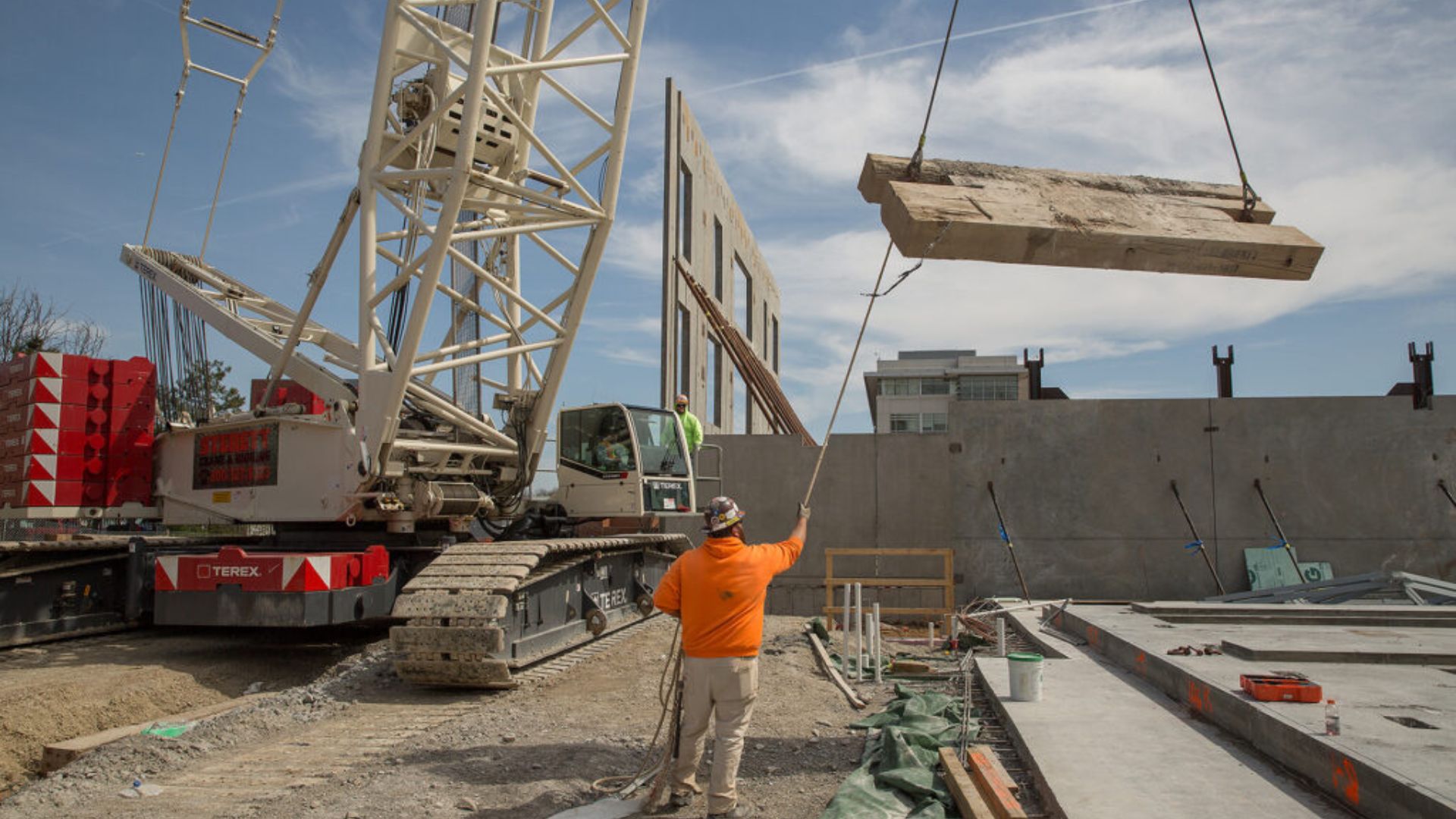
Construction Technique Changes Work Order by Molding Walls on the Ground and Raising Concrete Panels with a Crane, Reducing Heights, Reorganizing the Site, and Focusing Execution on Planned Operations, Mainly Used in Warehouses, Logistics Centers, and Large-Scale Commercial Buildings.
A scene draws attention at sites where the tilt-up method is adopted.
Instead of brick on brick, or vertical forms set high, large concrete walls appear ready on the ground and, after hardening, are lifted by a crane until they are in their final position.
The system, described by technical associations in the sector as a two-step process, combines horizontal molding on the site with lifting and securing the panels to form the building’s envelope, generally with panels acting as structural walls.
-
Sleeping at different times each day can be a bomb for your heart and even double your risk of having a heart attack.

-
Without help and without heavy machinery, a woman builds a house from scratch with stone, wood, and cement, erects a chimney, creates a complete leisure area, and transforms an empty lot into her dream home.

-
Couple transforms abandoned house after years of being closed; residence was overgrown with weeds, had a green pool, and a deteriorated structure in the interior of Rio de Janeiro.

-
Hidden marks on the walls of the site associated with the Last Supper of Jesus for centuries have been deciphered in Jerusalem, revealing medieval inscriptions left by pilgrims, European nobles, and travelers from the Middle East.


What Is the Tilt-Up Method in Civil Construction
The point that often causes strangeness is precisely what names the technique.
In tilt-up, the panel is poured lying down on a slab on the ground or on a temporary pouring bed, and only after is it “turned” to vertical.
This inversion of the traditional order changes the logistics of the work, as it moves part of the work to ground level, with more space to position reinforcements, openings, and inserts.
Additionally, it concentrates the most critical moment in a planned lifting operation, performed when the concrete reaches sufficient strength.

Molding on the Job Site Reduces Traditional Steps
The basis of the method is well-known and documented.
Large dimension panels are molded on-site, close to where they will be installed, as their weight and size make it unfeasible to treat the piece as a small, easy-to-transport and handle element.
Technical guides from the American Concrete Institute treat tilt-up as a consolidated technique, primarily used for exterior walls.
These materials provide specific recommendations for panel sizing, loading during lifting, and the temporary bracing system that keeps the piece stable until it integrates with the rest of the structure.
Work Sequence Begins on the Ground
In practice, the construction sequence typically begins with site preparation and the execution of the base where the panels will be poured.
In many projects, the floor slab itself serves as the molding surface, creating a leveled plan to set forms and position reinforcements.
This is the stage where openings for doors and windows may be planned.
It is also at this moment that connection details are installed on the panel while still on the ground, according to the structural project and the planned assembly method.

After pouring, the work enters a phase that is not instantaneous.
It is necessary to wait for the concrete to gain strength up to the level defined in the execution plan and the technical safety criteria.
Lifting Walls Concentrates a Critical Stage of the Technique
When the lifting day arrives, the panel undergoes a sudden change in condition.
It stops working as a plate horizontally supported and begins to receive typical lifting and rotation stresses.
The stresses concentrate on lifting points and in specific regions of the piece.
Therefore, the lifting is part of the structural sizing, not treated as an operational detail.
Technical literature emphasizes that the panels are raised in a continuous operation, moving from the pouring plane to the final position.
The control of this movement is crucial to avoid instability and damage to the element.
Lifting Speed Draws Attention on the Worksite
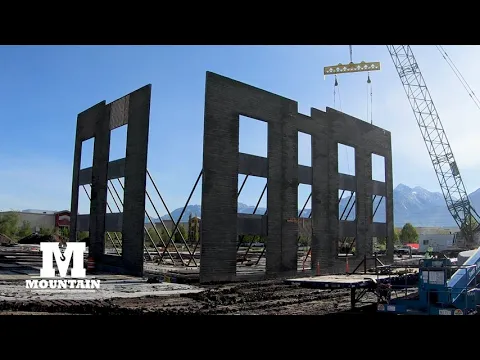

It is at this moment that the expression “in hours” often appears from the perspective of the worksite.
Companies specializing in tilt-up describe that the phase of raising and bracing panels can be concentrated in a relatively short window.
The procedure repeats several times throughout the day.
Sector reports indicate that the lifting of a single panel can take between 15 and 30 minutes, from the ground until it is upright and braced.
There are also descriptions of experienced teams capable of lifting dozens of panels in a single day.
This helps explain why many projects see the technique as a way to shorten the period between “open construction” and “closed envelope.”
Still, the speed of lifting does not eliminate the previous steps of planning, pouring, and curing the material.
Safety and Temporary Bracing Are Central Points
The discussion of safety is inseparable from the method.
The operation involves heavy pieces being moved by a crane, with the risk of toppling if the newly raised wall is not stabilized.
An official bulletin from the Occupational Safety and Health Administration specifically addresses risks with tilt-up panels.
The document reinforces the need for adequate braces and bracings to withstand lateral forces, such as wind, during the phase when the wall is not yet integrated into the final structural system.

Technical articles aimed at structural engineers highlight that wind is the main lateral load in the temporary phase.
Therefore, the bracing plan needs to be compatible with the project and site conditions.
Integration Transforms Panel into Permanent Structure
The integration of the panel with the structure is the step that transforms the standing wall into a part of the final system.
At this point, connections with roofing and floors come into play, along with ties and details provided in the project.
Guides from the American Concrete Institute address loadings, minimum reinforcements, deflections, connections, construction requirements, lifting stresses, and temporary bracing.
This highlights that tilt-up requires dedicated engineering, not merely the simple act of lifting panels.
Where the Tilt-Up Method Is Most Used
The adoption of tilt-up is more common in large-area buildings with few floors.
Examples include industrial warehouses, distribution centers, and commercial ventures.
In this type of construction, the repetition of panels and the need to quickly enclose the perimeter are often decisive.
Industry safety materials describe that the method can be adapted for multi-story buildings.

Even so, it is used more extensively in single-story or low-rise constructions.
Industry organizations reinforce that this is a system with over a century of use, with significant development over the 20th century.
Practical Limitations of the Method on Site
There are conditions that define whether tilt-up is viable on a given terrain.
The method depends on space to mold panels close to the installation location.
It also requires access for cranes with compatible capacity.
Another point is the logistical planning of the lifting sequence, as the order in which the panels are raised influences the operation.
As the pieces are large and heavy, technical associations emphasize that the proximity between the molding area and the final position is part of the concept.
Technique Gains Attention in Productivity Debates
The growing interest in techniques that reorganize steps, reduce work at heights, and transform manual activities into repeatable operations helps explain the return of tilt-up to discussions about productivity at the job site.
The visual narrative of walls appearing on the ground and being lifted sequentially generates strong appeal.
However, this visual impact does not replace the need for design, quality control of the concrete, verification of strength for lifting, and a rigorous temporary bracing plan.









Seja o primeiro a reagir!