





 Portuguese
  English
  Spanish
  5 min of reading
  2 comments


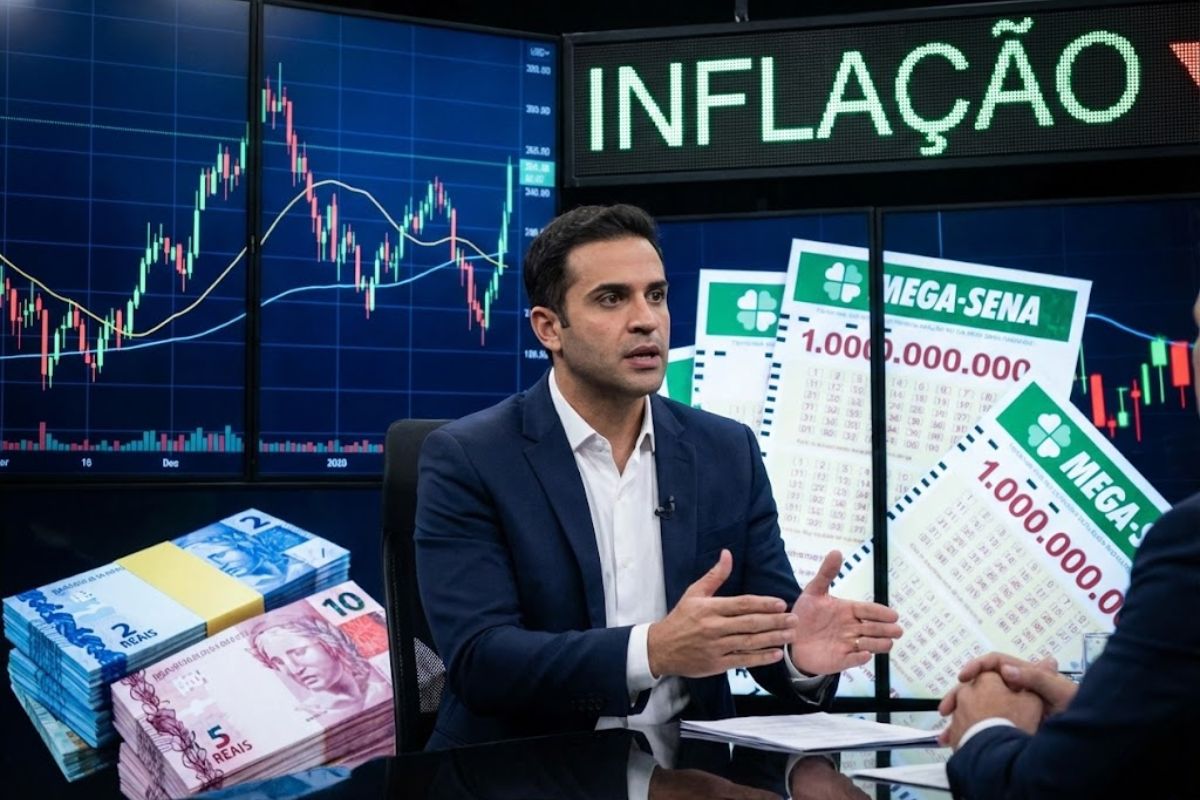


In Video, Pablo Marçal Claims That the Mega-Sena With a Prize of R$ 1 Billion Has Become Economic Alert, Not Celebration. He Attributes the Record Amount to Devalued Real, Excessive Printed Money, and the State Collecting from Bets, and Calls for Political Participation to Avoid Loss of Purchasing Power Next Year.
Commenting on the R$ 1 billion prize from Mega-Sena, Pablo Marçal said that the figure should not be treated as a celebration. In his view, the record is a sign of devalued real, as a consequence of money printed beyond reasonable limits, and also of a State collecting from bets, since the prize grows with the collection from bettors over time.
In the same statement, Pablo Marçal connected the debate to the political calendar and expressed concern about the financial system next year. He mentioned loss of purchasing power by comparing the present with 15 years ago and 20 years ago, and referred to October of the following year as an electoral milestone, advocating for political action before, in his words, the money melts away without most noticing.
What Pablo Marçal Means by Mentioning Mega-Sena and R$ 1 Billion
The starting point of the statement is the size of the prize.
-
Brazilian city bets on the business environment to generate jobs and attract investments in the energy sector — secretary reveals strategy at Macaé Energy 2026.

-
50 viaducts, 4 tunnels, 28 bridges, and 40 kilometers of bike paths: BR-262 in Espírito Santo will receive 8.6 billion reais for the largest engineering project in the state’s history, inspired by the Immigrant Highway in São Paulo.

-
Brazil produces too much clean energy and doesn’t know what to do with it: over 20% of solar and wind capacity was wasted in 2025 while investors flee and 509 renewable generation projects were abandoned in the last year.

-
Piauí will produce a new fuel that replaces diesel without needing to change anything in the truck’s engine and reduces pollutant gas emissions by half: truck drivers from all over the Northeast are already celebrating the news that will arrive later this decade.


Pablo Marçal insists that Mega-Sena and R$ 1 billion, when placed side by side, should sound like a siren, not like euphoria.
For him, the fact that Mega-Sena reaches R$ 1 billion for the first time is an indicator of monetary devaluation, not proof of collective prosperity.
In building his argument, he compares the record amount with prizes that, according to him, revolved around R$ 200 million in other periods.
The conclusion presented is that the R$ 1 billion level only becomes possible when there is a devalued real, because the nominal number grows while purchasing power declines.
Devalued Real as Diagnosis and Not as Opinion
Pablo Marçal repeats the idea of devalued real as a central axis.
He uses the term as a macroeconomic diagnosis to explain why R$ 1 billion may seem enormous and, at the same time, represent less purchasing power than smaller amounts represented in the past.
By stating that purchasing power would be “five times greater” 15 to 20 years ago, he tries to translate the loss into simple language.
Pablo Marçal’s message is that the devalued real appears in everyday life in higher prices and increasingly larger numbers to buy the same things, even when citizens do not follow statistics.
Printed Money, Fiat System, and Criticism of the Growth of the Monetary Base


Another axis is printed money. Pablo Marçal says that there is too much printed money and that “someone is printing more than they should,” associating this with what he calls the fiat system and the loss of trust, which in his view relies only on law and political decisions.
He presents printed money as a direct cause of devalued real.
In his speech, he also states that most of the money would be digital and that there would be a significant annual increase in the printing of paper currency.
Regardless of agreement, the objective of the speech is to link printed money to devalued real, suggesting that monetary expansion would accelerate the erosion of purchasing power.
State Collecting from Bets and the Growth of the Prize
Pablo Marçal places the State collecting from bets as part of the machinery.
He acknowledges that the prize is largely funded by bettors, but uses the collected volume as evidence that the State collecting from bets has found a way to increase revenue while citizens celebrate the prize amount.
In this reasoning, Mega-Sena and R$ 1 billion become a showcase of a country that, according to him, has turned the lottery into a thermometer of devalued real.
The criticism is not about the game itself, but about what the record amount would symbolize in the economic environment.
The Political Appeal: “Serve in Politics” and the Fear of Next Year
After the economic part, Pablo Marçal makes a direct appeal for participation. He states that people who “have already succeeded in life” should serve in politics at least once.
The argument presented is that, without pressure and presence, the country would not change its mentality or direction.
He associates this call with the next year and what he calls terror from the financial system, also mentioning October of the following year as a decisive period.
In the speech, political urgency arises as a response to the devalued real and printed money, as if the correction depended on a change in management and institutional change.
Capital Flight, Fiscal Exit, and the Perceived Cost of Instability
Pablo Marçal also mentions fiscal exit and describes what he calls the largest capital flight in history.
He says that if it were just a political game, he would also make his fiscal exit and turn his back, but asserts that there is an emotional reason to remain engaged.
By bringing this point, he tries to show that the debate about Mega-Sena and R$ 1 billion would not be isolated.
For him, the devalued real and printed money would be linked to decisions that affect investment, trust, and the retention of wealth in the country.
What Stands As Verifiable in the Speech and Where the Discourse Becomes Opinion
There are objective elements in the statement, such as the fact that Mega-Sena can accumulate and produce very high prizes, and that the prize depends on the volume of bets.
However, the reading of causality, which directly links R$ 1 billion to devalued real and printed money, is presented by Pablo Marçal as interpretation, not as demonstration with data in the speech itself.
This matters for one reason: the video functions as a rhetorical alert, not as a technical report.
What he delivers is a political and economic framing, with strong phrases, broad associations, and an invitation for action, using Mega-Sena, R$ 1 billion, devalued real, and printed money as symbols of a greater risk.
Pablo Marçal’s criticism relies on four pieces repeated throughout the discourse: Mega-Sena, R$ 1 billion, devalued real, and printed money.
He describes the record prize as a warning, claims that the State collecting from bets benefits from the volume of games, and calls for political reaction next year to prevent the silent loss of purchasing power.
If you want to follow this debate more rigorously, the most useful attitude is to compare statements with historical series and separate what is fact from what is opinion before making financial or political decisions based solely on impactful phrases.
Do you agree with Pablo Marçal that Mega-Sena and R$ 1 billion are signs of devalued real and printed money, or do you think that the size of the prize says nothing about the economy?










Só um **** para acreditar em outro kkkkkkkkkk
O que uma coisa tem a ver com outra?! Meldels!
Acho que o valor do prêmio não diz nada sobre a economia