





 Portuguese
  English
  Spanish
  6 min of reading
  1 comment


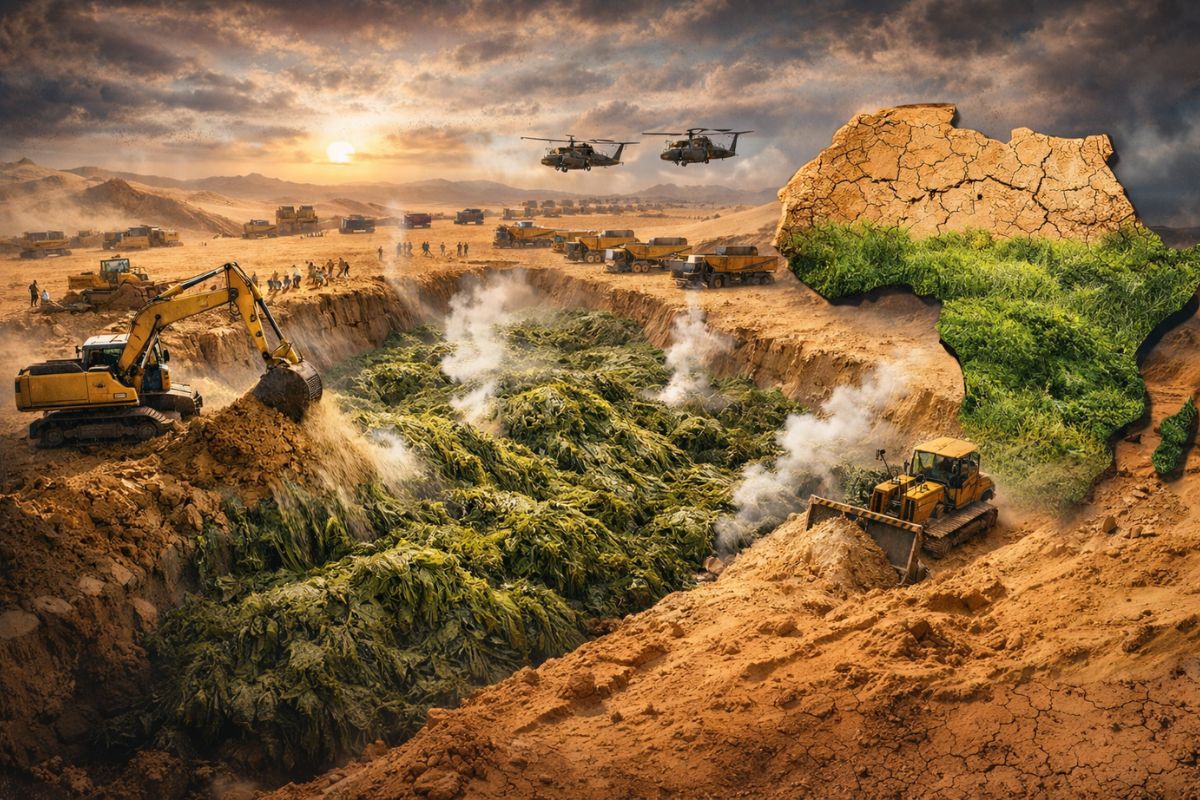


Even Though It Is a Resource-Rich Country in Uranium and Diamonds, Namibia Bets on a Giant Alga from the Ocean Floor to Stop the Desert, Restore the Soil, and Save Its Agriculture.
A resource-rich country in uranium and diamonds, yet unable to feed its entire population. This is the reality of Namibia, which holds more than 11% of the world’s uranium reserves and massive diamond mines offshore, but struggles to put food on the table for millions of people. Only 2% of this resource-rich country’s land is suitable for planting, while the rest is consumed by an ancient and relentless desert.
In the icy depths of the Atlantic, however, an unlikely solution has begun to change this fate.
A giant alga, cultivated in submerged forests, is transforming dead sand into living soil and giving a resource-rich country the chance to finally be abundant in crops, water in the soil, and food on the plate.
-
A Brazilian millionaire couple restores a farm over 150 years old in the interior of São Paulo and transforms the historic property with Portuguese tiles, antique furniture, and new spaces into a refuge that blends tradition, comfort, and sophistication.
-
Submerged city in a lake in Minas reveals intact streets, preserved vehicles, and houses after more than 60 years, impressing divers.

-
Yellowstone has started to rise again in an area of the caldera, and the movement rekindles fears surrounding the U.S. supervolcano, as scientists monitor the deformation and try to understand what is happening underground.
-
Woman arrested after receiving $1.2 million due to banking error and not returning the amount.


A Resource-Rich Country Surrounded by Hunger
Namibia is a resource-rich country in uranium and diamonds, but this does not translate into an abundance of food.
Local agriculture can only feed between 25% and 40% of the population, while the number of inhabitants grows about 2% annually.
The math doesn’t add up for a resource-rich country that sees the demand for food soar while fertile land shrinks every season.
Only a small fraction of the territory has enough water for cultivation. The rest is dominated by the Namib Desert, considered one of the most extreme in the world.
Rivers that appear on maps are, in practice, dry riverbeds, which only see water after extremely rare storms. For those who need to irrigate a crop, they are nearly worthless.
In this scenario, traditional agriculture becomes a lost battle. Without a radical solution, a resource-rich country risks seeing its food system collapse completely.
The Desert that Devours the Soil of Namibia

In the southwest of Africa, the Namib Desert stretches for about 2,000 km along the coast, nearly without knowing rain.
In many places, only 2 to 10 millimeters of water fall per year, less than the content of a tablespoon spread over 1 square meter during 12 whole months.
Dunes up to 300 meters high surround villages and cultivation areas. During the day, the sun scorches the surface with temperatures above 45 °C, and at night the thermometer drops below 10 °C.
This daily thermal shock destroys any attempt of a plant that wants to take root in the soil.
For a resource-rich country, the paradox is cruel. Money is flowing from mines and concessions, but live land is lacking. Every year of advance of the desert is a retreat of agriculture, food security, and the autonomy of the people.
The Cold Current and the Discovery of the Giant Alga
While the land burns under the sun, just a few meters off the coast lies one of the richest marine ecosystems on the planet: the Benguela cold current.
It acts like a giant conveyor belt, bringing nutrients from the bottom of the sea to the surface.
In these cold waters resides the protagonist of this turnaround: a giant alga that forms true submerged forests, with stalks that can reach heights of 50 or 60 meters.
Rather than being a fragile little plant, it is a biological growth machine, capable of growing between 30 and 60 centimeters per day.
This alga acts as a living sponge for nutrients. It absorbs from the water more than 60 different minerals, amino acids, and compounds that stimulate life, including potassium, calcium, and rare elements that the dry soil of Namibia desperately needs.
In a resource-rich country beneath the earth, what was lacking was, ironically, floating next to the coast.
Blue Farms: The Resource-Rich Country Discovers a New Agriculture
Knowing that the alga exists is one thing. Transforming it into a real solution, on an industrial scale, is quite another.
Off the city of Lüderitz, the company Kelp Blue installed the first industrial model of alga cultivation in all of Africa, creating true controlled oceanic forests.
No simple artisanal fishing here. It’s high-tech agriculture offshore, created by a resource-rich country that had to learn how to plant in the ocean to try and save its land.
A system of anchors and submerged cables sets up a kind of stable grid underwater, where the algae grow vertically, making the most of the nutrients in the Benguela current without being swept away by the waves.
In a few years, experimental areas of these blue farms began to show the potential to expand to thousands of hectares.
The harvest is done with extreme care. Instead of pulling the entire plant out, the teams cut only the “crown” of the alga, like pruning a tree, ensuring that the underwater forest remains alive, regenerating for the next harvest.
From Cold Water to Cracked Soil: The Transformation of the Land
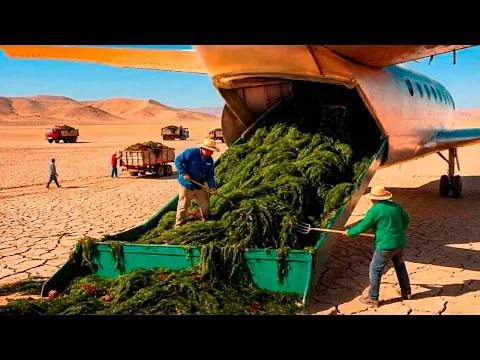

As soon as the alga comes out of the cold water, a race against time begins. It needs to be taken to land the same day, to avoid decomposition.
In nearby factories, the material is washed, ground, and turned into a paste that enters biological fermentation systems.
From there, chemical engineering takes over, separating the alga into different products. The most valuable for Namibia is a liquid biostimulant for plants, a type of “green elixir” that can be applied to degraded soils.
It’s as if the ocean is sending, in the form of a bottle, everything this resource-rich country needed to resurrect its land.
When this liquid touches the cracked and pale soil, the results are impressive. Fields that seemed dead begin to darken, become looser, and, most importantly, retain water like a sponge. It’s not just about nourishing the plant; it’s about rebuilding the home where the plant lives.
Larger Harvests, Living Soil and More Independence
In just two or three uses, experimental farms have reported significant increases in productivity for crops such as corn and millet, which barely survived in the region before.
Even in years with almost no rain, plants treated with the alga extract endure and continue to produce in a scenario where every drop of water is worth its weight in gold.
The microscopic life also reacts. Earthworms reappear, microorganism activity in the soil spikes, and the land, previously as hard as rock, begins to breathe again.
For farmers, this means much more than a pretty yield chart. It means economic freedom.
With the use of the giant alga, many producers have been able to cut their reliance on imported chemical fertilizers, significantly reducing production costs.
For the first time, a resource-rich country is beginning to become a little richer in autonomy, food, and future for those who live off the land.
What Namibia Shows About the Future of a Resource-Rich Country
The story of Namibia is a powerful reminder. Being a resource-rich country does not guarantee a full plate if the soil is dead and agriculture is cornered by extreme weather.
What changes the game is the ability to transform what seemed “just another resource” into a real survival tool.
By using the giant alga to stop the desert, restore the soil, and strengthen agriculture, Namibia shows that a resource-rich country can choose a different kind of wealth: the wealth of having living soil, homegrown food, and less dependence on expensive outside inputs. The miracle didn’t fall from the sky; it rose from the ocean floor.
In the end, the question that remains is simple and uncomfortable: if a resource-rich country like Namibia needed to look to the ocean to save its agriculture, how many other nations will have the courage to do the same before hunger speaks louder?
And you, do you believe that solutions like this giant alga can truly transform other resource-rich countries that still face extreme hunger?





Sim